


Drivers of Under-Five Stunting Trend in 14 Low- and Middle-Income Countries since the Turn of the Millennium: A Multilevel Pooled Analysis of 50 Demographic and Health Surveys
- PMID: 31623183
- PMCID: PMC6835629
- DOI: 10.3390/nu11102485
Drivers of Under-Five Stunting Trend in 14 Low- and Middle-Income Countries since the Turn of the Millennium: A Multilevel Pooled Analysis of 50 Demographic and Health Surveys
Abstract
Background: Understanding the drivers contributing to the decreasing trend in stunting is paramount to meeting the World Health Assembly's global target of 40% stunting reduction by 2025.
Methods: We pooled data from 50 Demographic and Health Surveys since 2000 in 14 countries to examine the relationships between the stunting trend and potential factors at distal, intermediate, and proximal levels. A multilevel pooled trend analysis was used to estimate the association between the change in potential drivers at a country level and stunting probability for an individual child while adjusting for time trends and child-level covariates. A four-level mixed-effects linear probability regression model was fitted, accounting for the clustering of data by sampling clusters, survey-rounds, and countries.
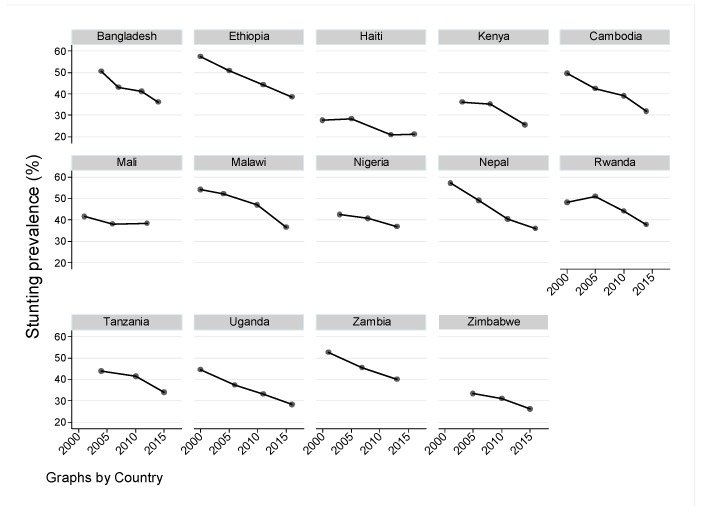
Results: Stunting followed a decreasing trend in all countries at an average annual rate of 1.04 percentage points. Among the distal factors assessed, a decrease in the Gini coefficient, an improvement in women's decision-making, and an increase in urbanization were significantly associated with a lower probability of stunting within a country. Improvements in households' access to improved sanitation facilities and drinking water sources, and children's access to basic vaccinations were the important intermediate service-related drivers, whereas improvements in early initiation of breastfeeding and a decrease in the prevalence of low birthweight were the important proximal drivers.
Conclusions: The results reinforce the need for a combination of nutrition-sensitive and -specific interventions to tackle the problem of stunting. The identified drivers help to guide global efforts to further accelerate stunting reduction and monitor progress against chronic childhood undernutrition.
Keywords: Demographic and Health Survey (DHS); children under-five years; determinants; low- and middle-income countries; stunting trend.
Conflict of interest statement
The authors declare no conflict of interest. The funders had no role in the design of the study; in the collection, analyses, or interpretation of data; in the writing of the manuscript, or in the decision to publish the results.
Figures
References
-
- United Nations Children’s Fund (UNICEF) World Health Organization (WHO) International Bank for Reconstruction and Development. The World Bank . Levels and Trends in Child Malnutrition: Key Findings of the 2019 Edition of the Joint Child Malnutrition Estimates. WHO; Geneva, Switzerland: 2019.
-
- Addo O.Y., Stein A.D., Fall C.H.D., Gigante D.P., Guntupalli A.M., Horta B.L., Kuzawa C.W., Lee N., Norris S.A., Osmond C., et al. Parental childhood growth and offspring birthweight: Pooled analyses from four birth cohorts in low and middle income countries. Am. J. Hum. Biol. 2015;27:99–105. doi: 10.1002/ajhb.22614. - DOI - PMC - PubMed
MeSH terms
Grants and funding
LinkOut - more resources
Full Text Sources
Medical
