Review
. 2019 Oct 16;7(10):459.
doi: 10.3390/microorganisms7100459.

Pathogenetic Impact of Bacterial-Fungal Interactions

Affiliations
Review

Pathogenetic Impact of Bacterial-Fungal Interactions

Filomena Nogueira et al. Microorganisms. .

Abstract

Polymicrobial infections are of paramount importance because of the potential severity of clinical manifestations, often associated with increased resistance to antimicrobial treatment. The intricate interplay with the host and the immune system, and the impact on microbiome imbalance, are of importance in this context. The equilibrium of microbiota in the human host is critical for preventing potential dysbiosis and the ensuing development of disease. Bacteria and fungi can communicate via signaling molecules, and produce metabolites and toxins capable of modulating the immune response or altering the efficacy of treatment. Most of the bacterial-fungal interactions described to date focus on the human fungal pathogen Candida albicans and different bacteria. In this review, we discuss more than twenty different bacterial-fungal interactions involving several clinically important human pathogens. The interactions, which can be synergistic or antagonistic, both in vitro and in vivo, are addressed with a focus on the quorum-sensing molecules produced, the response of the immune system, and the impact on clinical outcome.

Keywords: bacterial–fungal interactions; immune response; in vivo models; microbiome; molecules.


Conflict of interest statement

The authors have declared that no competing interests exist.

Figures
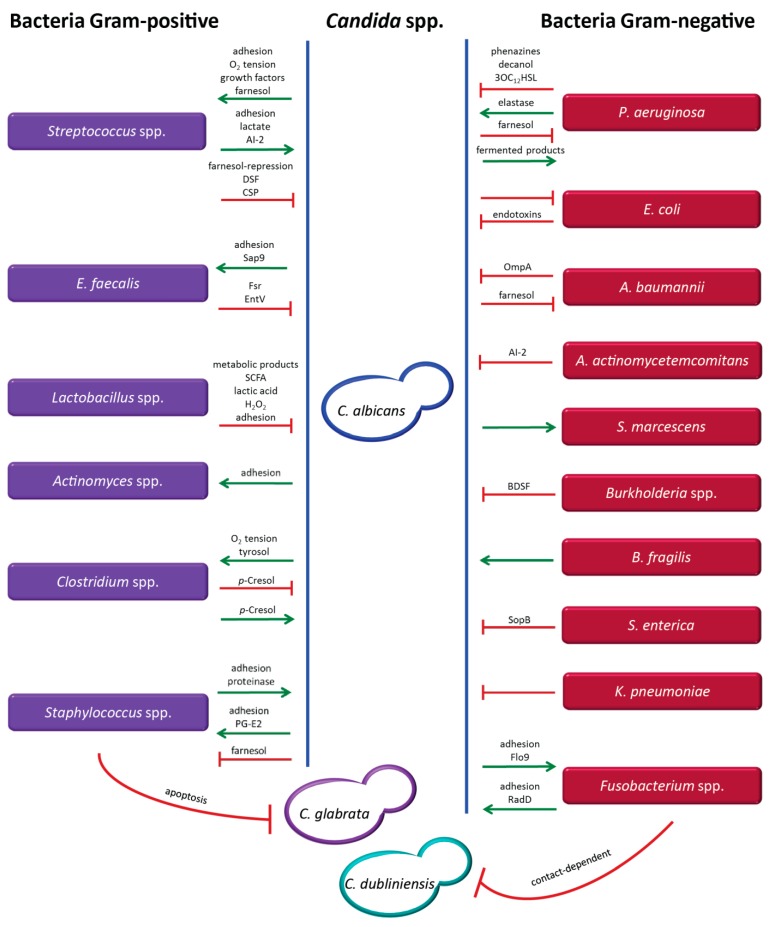
Figure 1
Figure 1
Molecules and factors mediating the interaction between different Candida species and a variety of bacteria. Candida species include Candida (C.) albicans, Candida (C.) glabrata and Candida (C.) dubliniensis. Gram-positive bacteria are represented in lilac (Enterococcus (E.) faecalis) and Gram-negative bacteria in red (Pseudomonas (P.) aeruginosa, Escherichia (E.) coli, Acinetobacter (A.) baumannii, Aggregatibacter (A.) actinomycetemcomitans, Serratia (S.) marcescens, Bacteroides (B.) fragilis, Salmonella (S.) enterica, Klebsiella (K.) pneumoniae). Green arrows indicate supportive interactions and red lines represent inhibitory effects. If not indicated above the green arrows and red lines, the molecules mediating the interaction are currently unknown.
Figure 2
Figure 2
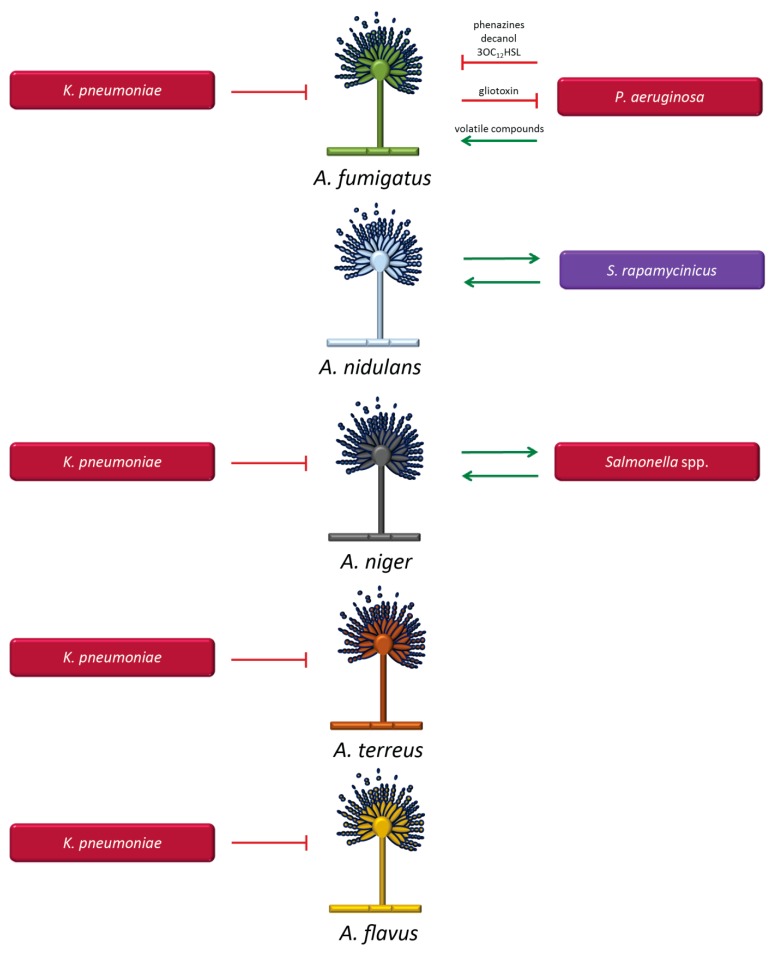
Molecules and factors mediating the interaction between Aspergillus species and bacteria. Aspergillus species include Aspergillus (A.) fumigatus, Aspergillus (A.) nidulans, Aspergillus (A.) niger, Aspergillus (A.) terreus and Aspergillus (A.) flavus. Gram-positive bacteria are represented in lilac (Streptomyces (S.) rapamycinicus) and Gram-negative bacteria in red (Klebsiella (K.) pneumoniae, Pseudomonas (P.) aeruginosa). Green arrows indicate supportive interactions and red lines represent inhibitory effects. If not indicated above the green arrows and red lines, the molecules mediating the interaction are currently unknown.
Figure 3
Figure 3
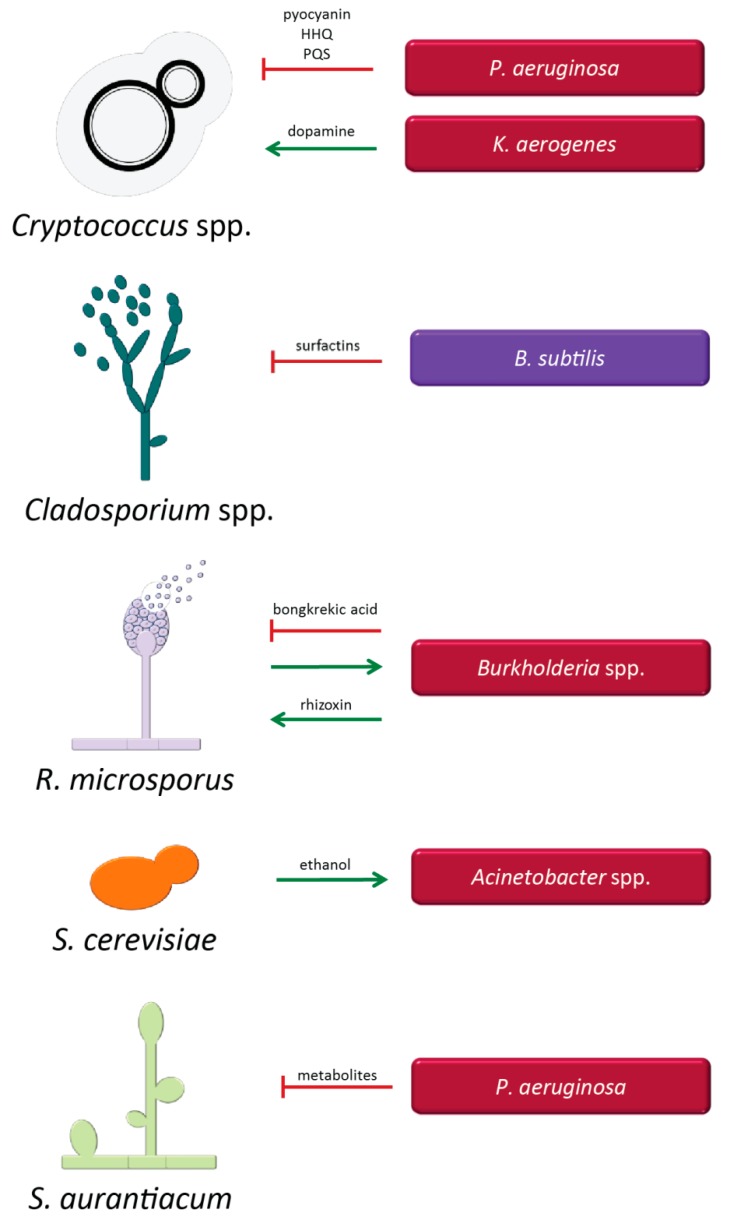
Molecules and factors mediating the interaction between Cryptococcus spp., Cladosporium spp., Rhizopus microsporus, Saccharomyces cerevisiae, Scedosporium aurantiacum, and different bacteria. Gram- positive bacteria are represented in lilac (Bacillus (B.) subtilis) and Gram-negative bacteria are represented in red (Pseudomonas (P.) aeruginosa, Klebsiella (K.) aerogenes). Green arrows indicate supportive interactions and red lines represent inhibitory effects. If not indicated above the green arrows and red lines, the molecules mediating the interaction are currently unknown.

References

    1. Neely A.N., Law E.J., Holder I.A. Increased susceptibility to lethal Candida infections in burned mice preinfected with Pseudomonas aeruginosa or pretreated with proteolytic enzymes. Infect. Immun. 1986;52:200–204. - PMC - PubMed
    1. Bergeron A.C., Seman B.G., Hammond J.H., Archambault L.S., Hogan D.A., Wheeler R.T. Candida and Pseudomonas interact to enhance virulence of mucosal infection in transparent zebrafish. Infect. Immun. 2017 doi: 10.1128/IAI.00475-17. - DOI - PMC - PubMed
    1. Kim S.H., Yoon Y.K., Kim M.J., Sohn J.W. Risk factors for and clinical implications of mixed Candida/bacterial bloodstream infections. Clin. Microbiol. Infect. 2013;19:62–68. doi: 10.1111/j.1469-0691.2012.03906.x. - DOI - PMC - PubMed
    1. Wargo M.J., Hogan D.A. Fungal--bacterial interactions: a mixed bag of mingling microbes. Curr. Opin. Microbiol. 2006;9:359–364. doi: 10.1016/j.mib.2006.06.001. - DOI - PubMed
    1. Peters B.M., Jabra-Rizk M.A., O’May G.A., Costerton J.W., Shirtliff M.E. Polymicrobial interactions: impact on pathogenesis and human disease. Clin. Microbiol. Rev. 2012;25:193–213. doi: 10.1128/CMR.00013-11. - DOI - PMC - PubMed

LinkOut - more resources