. 2019 Oct 16;7(10):461.
doi: 10.3390/microorganisms7100461.

Global Burden of Colistin-Resistant Bacteria: Mobilized Colistin Resistance Genes Study (1980-2018)

Affiliations

Global Burden of Colistin-Resistant Bacteria: Mobilized Colistin Resistance Genes Study (1980-2018)

Mohammed Elbediwi et al. Microorganisms. .

Abstract

Colistin is considered to be an antimicrobial of last-resort for the treatment of multidrug-resistant Gram-negative bacterial infections. The recent global dissemination of mobilized colistin resistance (mcr) genes is an urgent public health threat. An accurate estimate of the global prevalence of mcr genes, their reservoirs and the potential pathways for human transmission are required to implement control and prevention strategies, yet such data are lacking. Publications from four English (PubMed, Scopus, the Cochrane Database of Systematic Reviews and Web of Science) and two Chinese (CNKI and WANFANG) databases published between 18 November 2015 and 30 December 2018 were identified. In this systematic review and meta-analysis, the prevalence of mcr genes in bacteria isolated from humans, animals, the environment and food products were investigated. A total of 974 publications were identified. 202 observational studies were included in the systematic review and 71 in the meta-analysis. mcr genes were reported from 47 countries across six continents and the overall average prevalence was 4.7% (0.1-9.3%). China reported the highest number of mcr-positive strains. Pathogenic Escherichia coli (54%), isolated from animals (52%) and harboring an IncI2 plasmid (34%) were the bacteria with highest prevalence of mcr genes. The estimated prevalence of mcr-1 pathogenic E. coli was higher in food-animals than in humans and food products, which suggests a role for foodborne transmission. This study provides a comprehensive assessment of prevalence of the mcr gene by source, organism, genotype and type of plasmid.

Keywords: Escherichia coli; antibiotic resistance; food-chain; meta-analysis; mobilized colistin resistance (mcr) genes; reservoir.


Conflict of interest statement

All the authors declare no competing interests.

Figures
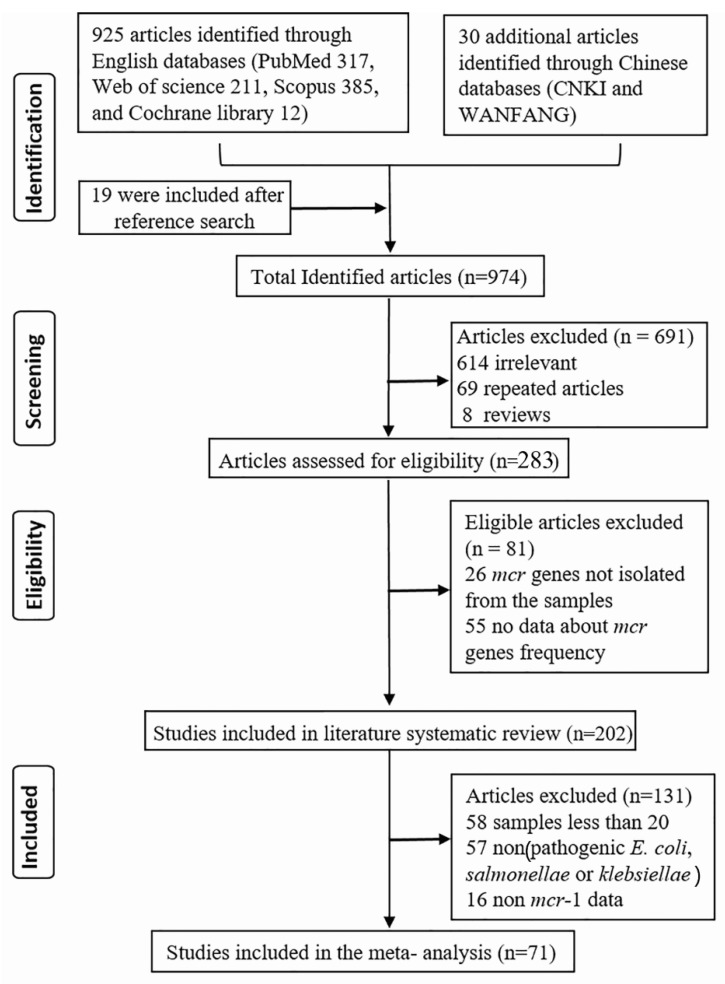
Figure 1
Figure 1
Flow diagram of identification and selection process included in systematic review and meta-analysis.
Figure 2
Figure 2
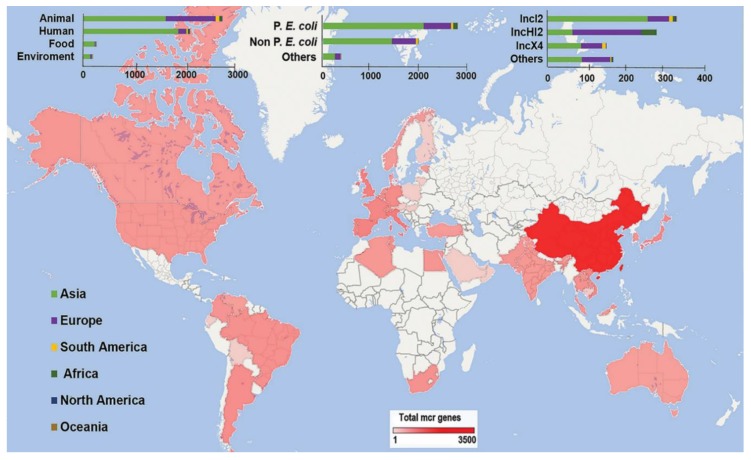
Global view of mcr genes along with the various hosts, bacteria and plasmid types. White colored countries refer to countries that have not yet reported studies on mcr genes.
Figure 3
Figure 3
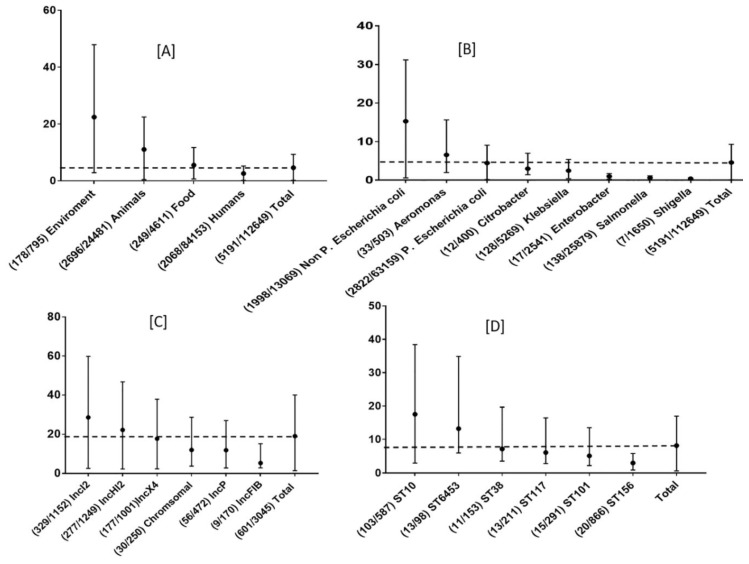
Prevalence of mcr genes from multiple sources (A), bacteria (B), plasmids (C) and pathogenic E. coli sequence type (ST) (D). ( ) contain the positive strains/total strains Values in (A and B) are the prevalence of positive strains in the total number of strains, in (C), the value is the prevalence of plasmid types and in (D) P. E. coli harboring mcr-1 shows the prevalence of different sequence types (ST) of the positive isolates.
Figure 4
Figure 4
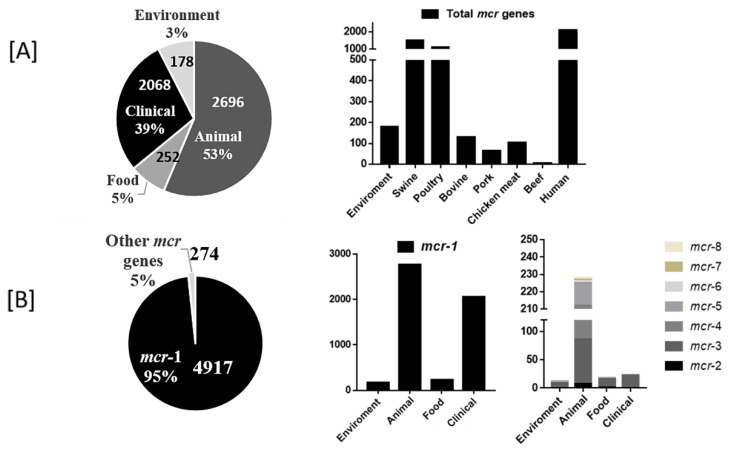
Frequency and distribution of mcr genes according to hosts and types. Hosts harboring mcr genes (A), mcr types (B).
Figure 5
Figure 5
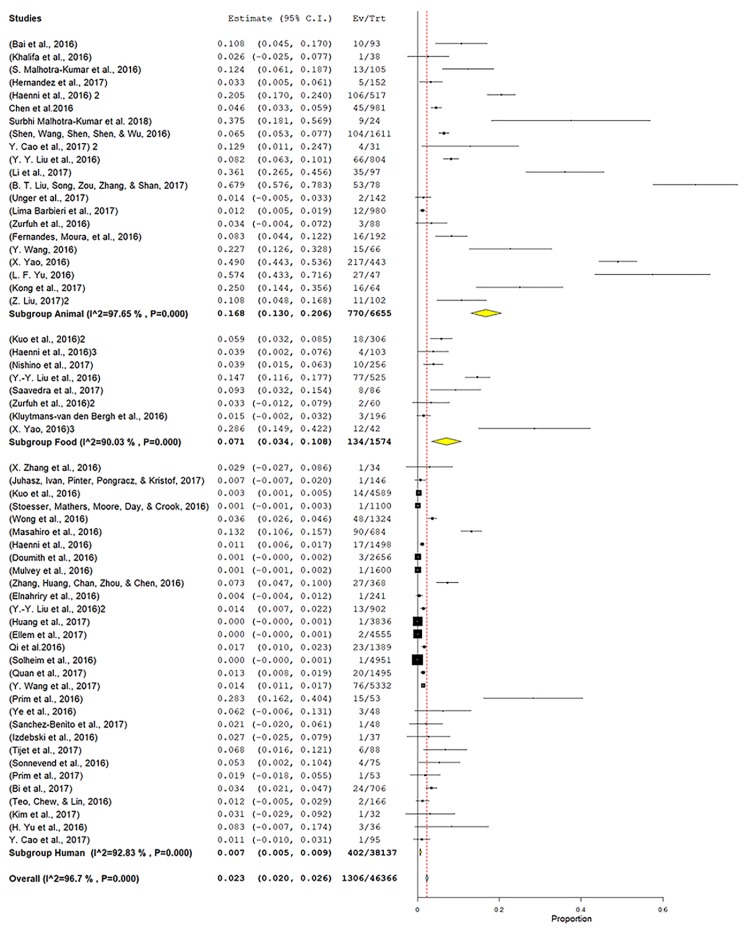
Prevalence of pathogenic E. coli carrying mcr-1 in animals, foods and humans. X-axis is the proportion of the bacteria reported in individual studies as listed along the Y-axis, with the range of proportion in 95% confidence interval. Studies given higher weights are indicated by larger markers. The parallelograms in yellow and the square markers in black represent the pooled point estimate for the sub-group category and individual study, respectively. The horizontal lines of the parallelograms and the square markers represent the 95% confidence interval of this combined point estimate.
Figure 6
Figure 6
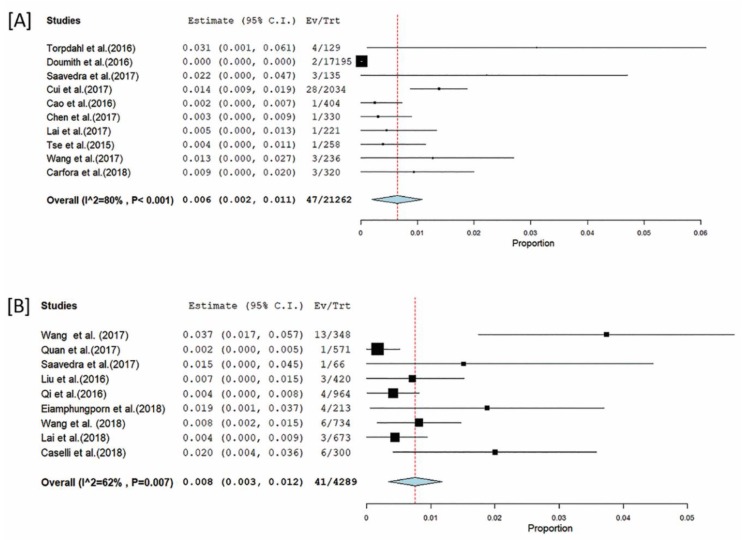
Prevalence of Salmonella (A) and Klebsiella (B) carrying mcr-1. X-axis is the proportion of the bacteria reported in individual studies as listed along the Y-axis, with the range of proportion in 95% confidence interval. Studies given higher weights are indicated by larger markers. The parallelograms in yellow and the square markers in black represent the pooled point estimate for the sub-group category and individual study, respectively. The horizontal lines of the parallelograms and the square markers represent the 95% confidence interval of this combined point estimate.
Figure 7
Figure 7
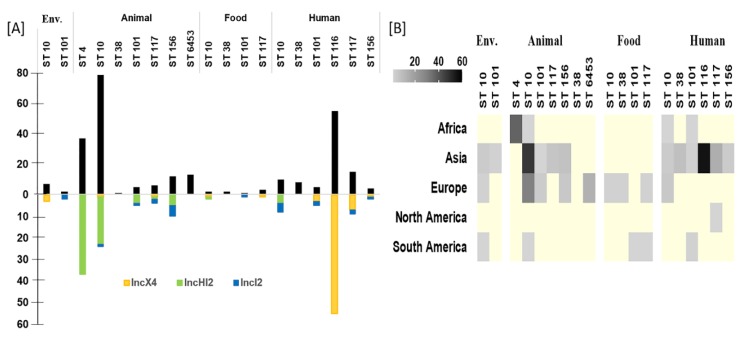
Role of P. E. coli STs in mcr-1 gene dissemination. Particular P. E. coli STs that harbored mcr-1 gene frequency (A). The global distribution of P. E. coli harboring mcr-1 gene (B). Yellow cells in (B) refer to blank, Env. refers to environmental isolates. The scales refer to number of isolates.

References

    1. Nolte O. Antimicrobial Resistance in the 21st Century: A Multifaceted Challenge. Protein Pept. Lett. 2014;21:330–335. doi: 10.2174/09298665113206660106. - DOI - PubMed
    1. Fair R.J., Tor Y. Antibiotics and bacterial resistance in the 21st century. Perspect Med. Chem. 2014;6:25–64. doi: 10.4137/PMC.S14459. - DOI - PMC - PubMed
    1. Theuretzbacher U. Global antimicrobial resistance in Gram-negative pathogens and clinical need. Curr. Opin. Microbiol. 2017;39:106–112. doi: 10.1016/j.mib.2017.10.028. - DOI - PubMed
    1. Caniaux I., van Belkum A., Zambardi G., Poirel L., Gros M.F. MCR: Modern colistin resistance. Eur. J. Clin. Microbiol. Infect. Dis. 2017;36:415–420. doi: 10.1007/s10096-016-2846-y. - DOI - PubMed
    1. Nation R.L., Garonzik S.M., Thamlikitkul V., Giamarellos-Bourboulis E.J., Forrest A., Paterson D.L., Li J., Silveira F.P. Dosing guidance for intravenous colistin in critically-ill patients. Clin. Infect. Dis. 2017;64:565–571. doi: 10.1093/cid/ciw839. - DOI - PMC - PubMed

LinkOut - more resources