


Clinical characteristics of women captured by extending the definition of severe postpartum haemorrhage with 'refractoriness to treatment': a cohort study
- PMID: 31623631
- PMCID: PMC6798374
- DOI: 10.1186/s12884-019-2499-9
Clinical characteristics of women captured by extending the definition of severe postpartum haemorrhage with 'refractoriness to treatment': a cohort study
Abstract
Background: The absence of a uniform and clinically relevant definition of severe postpartum haemorrhage hampers comparative studies and optimization of clinical management. The concept of persistent postpartum haemorrhage, based on refractoriness to initial first-line treatment, was proposed as an alternative to common definitions that are either based on estimations of blood loss or transfused units of packed red blood cells (RBC). We compared characteristics and outcomes of women with severe postpartum haemorrhage captured by these three types of definitions.
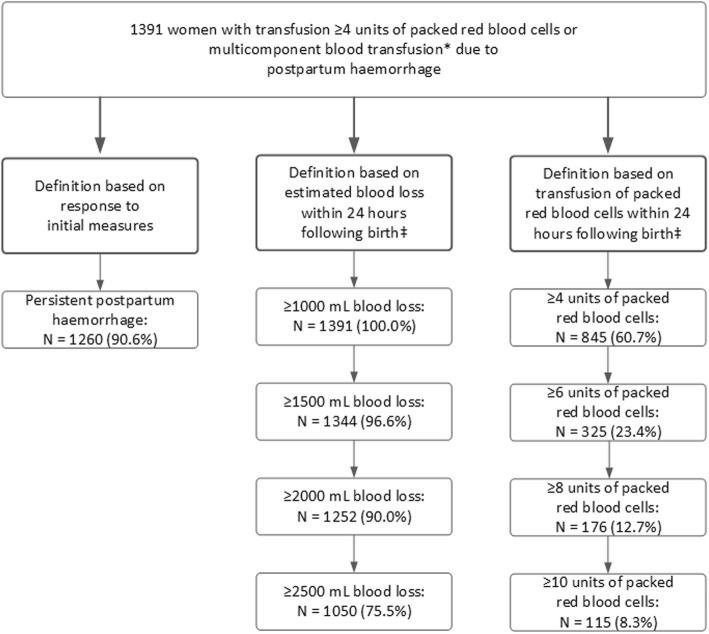
Methods: In this large retrospective cohort study in 61 hospitals in the Netherlands we included 1391 consecutive women with postpartum haemorrhage who received either ≥4 units of RBC or a multicomponent transfusion. Clinical characteristics and outcomes of women with severe postpartum haemorrhage defined as persistent postpartum haemorrhage were compared to definitions based on estimated blood loss or transfused units of RBC within 24 h following birth. Adverse maternal outcome was a composite of maternal mortality, hysterectomy, arterial embolisation and intensive care unit admission.
Results: One thousand two hundred sixty out of 1391 women (90.6%) with postpartum haemorrhage fulfilled the definition of persistent postpartum haemorrhage. The majority, 820/1260 (65.1%), fulfilled this definition within 1 h following birth, compared to 819/1391 (58.7%) applying the definition of ≥1 L blood loss and 37/845 (4.4%) applying the definition of ≥4 units of RBC. The definition persistent postpartum haemorrhage captured 430/471 adverse maternal outcomes (91.3%), compared to 471/471 (100%) for ≥1 L blood loss and 383/471 (81.3%) for ≥4 units of RBC. Persistent postpartum haemorrhage did not capture all adverse outcomes because of missing data on timing of initial, first-line treatment.
Conclusion: The definition persistent postpartum haemorrhage identified women with severe postpartum haemorrhage at an early stage of haemorrhage, unlike definitions based on blood transfusion. It also captured a large majority of adverse maternal outcomes, almost as large as the definition of ≥1 L blood loss, which is commonly applied as a definition of postpartum haemorrhage rather than severe haemorrhage.
Keywords: Definition; Maternal morbidity; Maternal mortality; Postpartum haemorrhage.
Conflict of interest statement
TA and JR are on the editorial board of BMC Pregnancy and Childbirth. All other authors declare that they have no competing interests.
Figures
References
-
- Knight M, Callaghan WM, Berg C, Alexander S, Bouvier-Colle MH, Ford JB, Joseph KS, Lewis G, Liston RM, Roberts CL, et al. Trends in postpartum hemorrhage in high resource countries: a review and recommendations from the international postpartum hemorrhage collaborative group. BMC Pregnancy Childbirth. 2009;9:55. doi: 10.1186/1471-2393-9-55. - DOI - PMC - PubMed
Publication types
MeSH terms
LinkOut - more resources
Full Text Sources
Medical
