Randomized Controlled Trial
. 2019 Oct 22;74(16):2058-2070.
doi: 10.1016/j.jacc.2019.07.085.

Guiding Therapy by Coronary CT Angiography Improves Outcomes in Patients With Stable Chest Pain

Affiliations
Randomized Controlled Trial

Guiding Therapy by Coronary CT Angiography Improves Outcomes in Patients With Stable Chest Pain

Philip D Adamson et al. J Am Coll Cardiol. .

Abstract

Background: Within the SCOT-HEART (Scottish COmputed Tomography of the HEART Trial) trial of patients with stable chest pain, the use of coronary computed tomography angiography (CTA) reduced the rate of death from coronary heart disease or nonfatal myocardial infarction (primary endpoint).

Objectives: This study sought to assess the consistency and mechanisms of the 5-year reduction in this endpoint.

Methods: In this open-label trial, 4,146 participants were randomized to standard care alone or standard care plus coronary CTA. This study explored the primary endpoint by symptoms, diagnosis, coronary revascularizations, and preventative therapies.

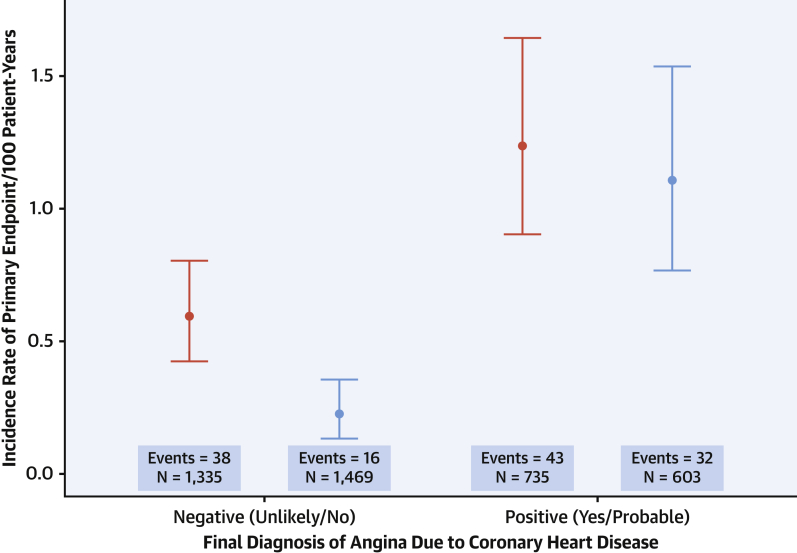
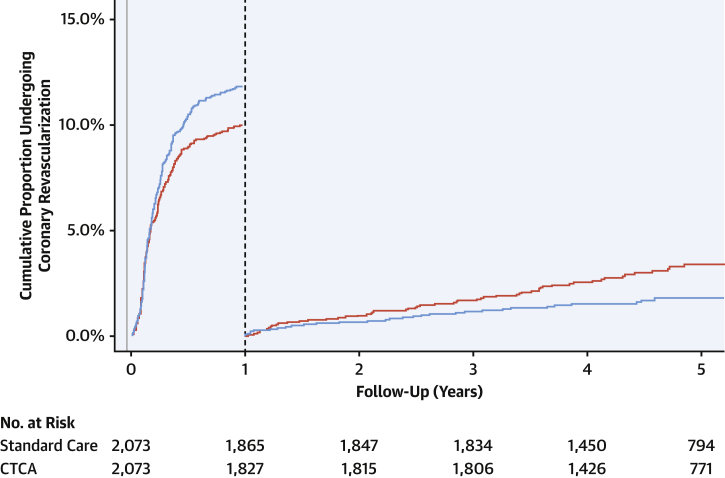
Results: Event reductions were consistent across symptom and risk categories (p = NS for interactions). In patients who were not diagnosed with angina due to coronary heart disease, coronary CTA was associated with a lower primary endpoint incidence rate (0.23; 95% confidence interval [CI]: 0.13 to 0.35 vs. 0.59; 95% CI: 0.42 to 0.80 per 100 patient-years; p < 0.001). In those who had undergone coronary CTA, rates of coronary revascularization were higher in the first year (hazard ratio [HR]: 1.21; 95% CI: 1.01 to 1.46; p = 0.042) but lower beyond 1 year (HR: 0.59; 95% CI: 0.38 to 0.90; p = 0.015). Patients assigned to coronary CTA had higher rates of preventative therapies throughout follow-up (p < 0.001 for all), with rates highest in those with CT-defined coronary artery disease. Modeling studies demonstrated the plausibility of the observed effect size.

Conclusions: The beneficial effect of coronary CTA on outcomes is consistent across subgroups with plausible underlying mechanisms. Coronary CTA improves coronary heart disease outcomes by enabling better targeting of preventative treatments to those with coronary artery disease. (Scottish COmputed Tomography of the HEART Trial [SCOT-HEART]; NCT01149590).

Keywords: angina pectoris; computed tomography; coronary heart disease.


Figures

None
Graphical abstract
Figure 1
Figure 1
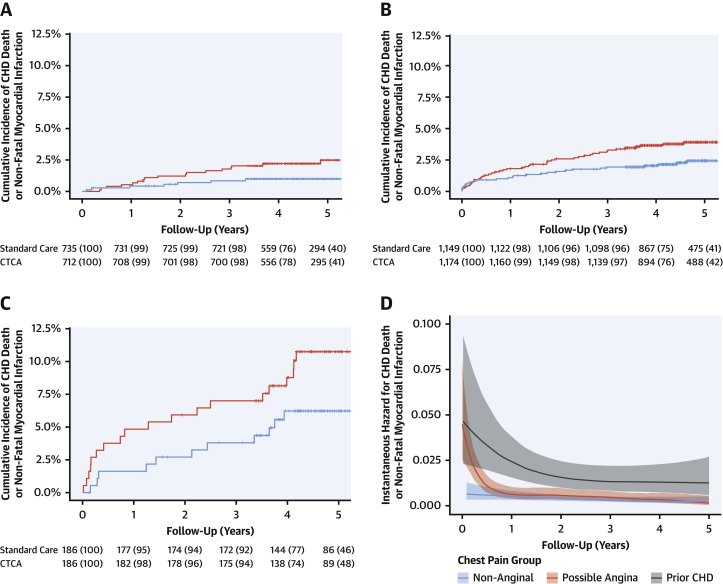
Cumulative Incidence of CHD Death or Nonfatal MI Cumulative incidence curves for coronary heart disease (CHD) death or nonfatal myocardial infarction (MI) in (A) patients with nonanginal chest pain, (B) patients with possible angina, and (C) patients with prior CHD, allocated to standard care alone (red) and computed tomography coronary angiography (CTCA) plus standard of care (blue). (D) Instantaneous hazards over time for each of the 3 chest pain groups. Patients in the nonanginal group (blue) have a low risk of the primary endpoint that is constant over time. Patients in the prior CHD group (gray) are at highest risk but the magnitude of risk is greatest during the first 1 to 2 years. Patients in the possible angina group (red) have a high early risk that rapidly declines over the first 6 to 12 months.
Figure 2
Figure 2
5-Year Incidence Rates of CHD Death or Nonfatal MI Five-year incidence rates of CHD death or nonfatal MI in patients with (right) and without (left) a diagnosis of angina due to CHD 6 weeks after randomization according to the trial allocation of standard care alone (red) and computed tomography coronary angiography plus standard of care (blue). Abbreviations as in Figure 1.
Figure 3
Figure 3
Cumulative Incidence of Coronary Revascularization Within the First Year and Beyond 1 Year Landmark analysis demonstration cumulative incidence curves for coronary revascularization within the first year and beyond 1 year in patients allocated to standard care alone (red) and computed tomography coronary angiography (CTCA) plus standard of care (blue).
Figure 4
Figure 4
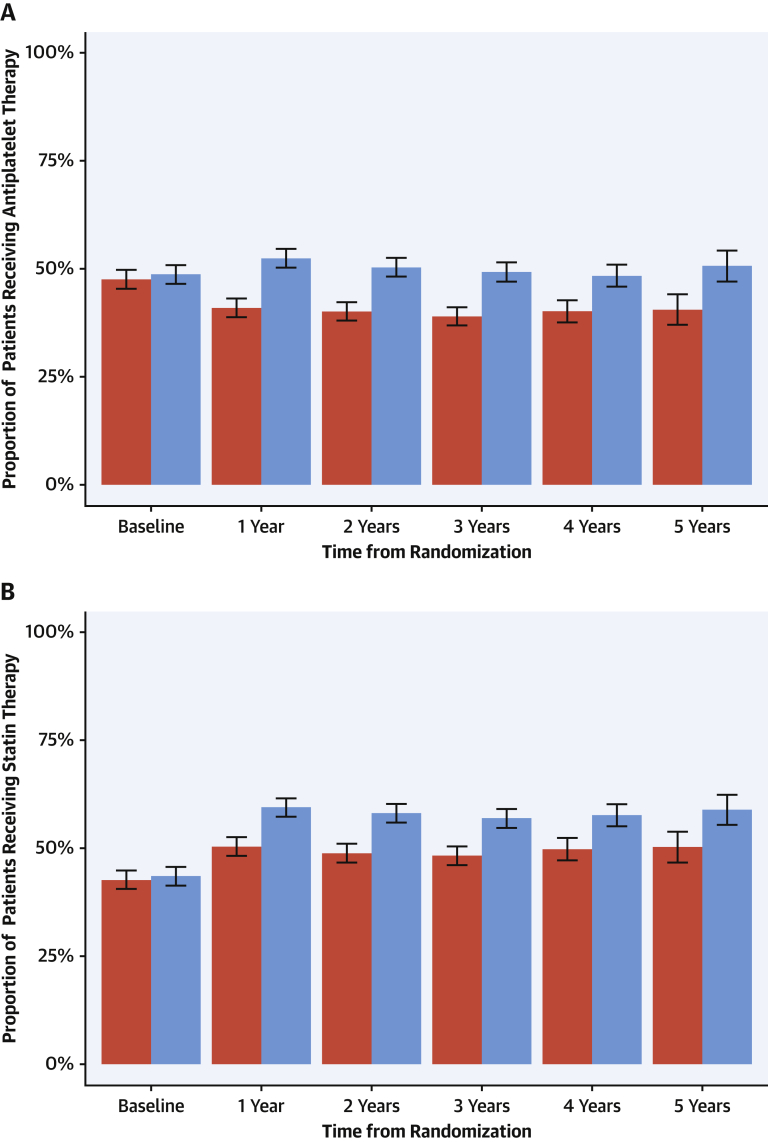
Prescribing of Preventative Therapy Over 5 Years of Follow-Up Frequency of prescribing for (A) antiplatelet and (B) statin therapy across 5 years in patients allocated to standard care alone (red) and computed tomography coronary angiography plus standard of care (blue). The error bars relate to confidence intervals for comparison between trial arms. p < 0.001 for all comparisons except baseline where p = NS.
Figure 5
Figure 5
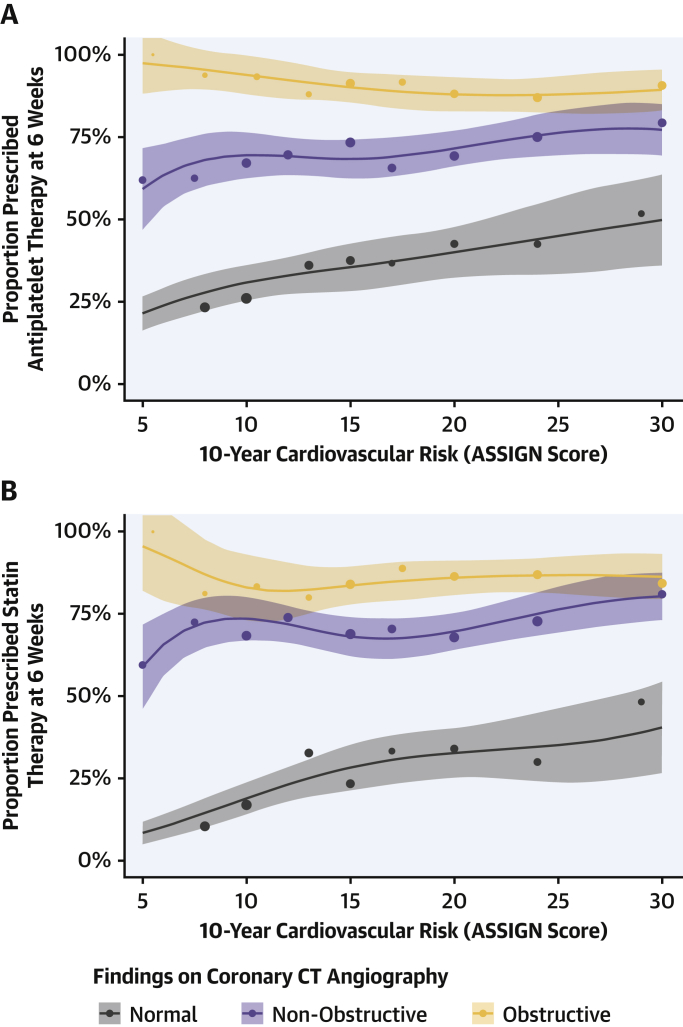
Interaction Between Coronary CT Angiography Findings and Clinically Estimated Cardiovascular Risk in Relation to Prescribing of Preventative Therapy Frequency of prescribing for (A) antiplatelet and (B) statin therapy at 6 weeks in patients with obstructive (orange) and nonobstructive (purple) coronary artery disease, and normal coronary arteries (gray) on coronary computed tomography (CT) angiography across a range of 10-year cardiovascular risk as determined from the ASSIGN score . The lines and corresponding shaded areas represent the prescribing estimates and 95% confidence intervals derived from a regression model. The dots represent the observed prescribing rates among the trial cohort grouped according to ASSIGN score with size proportional to the number of patients included in each group.
Central Illustration
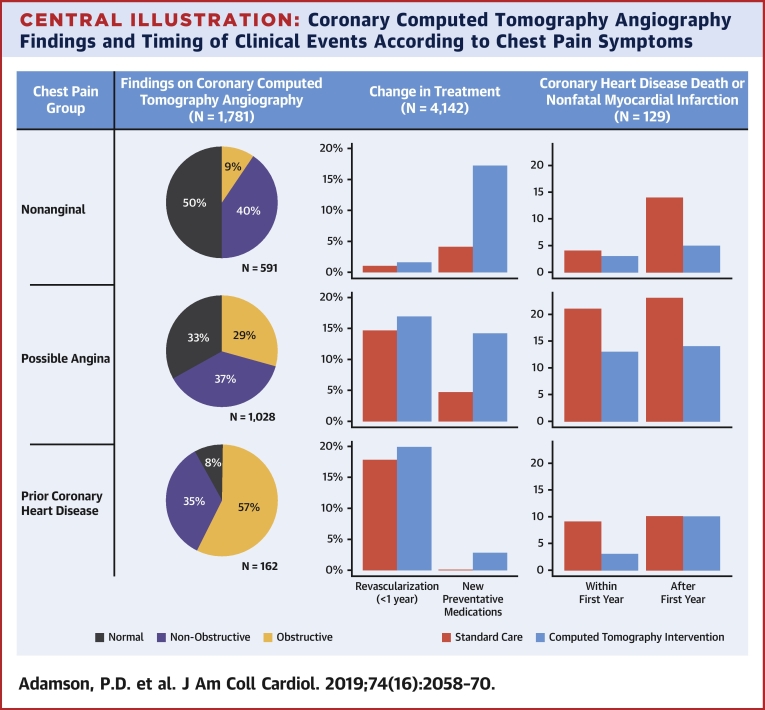
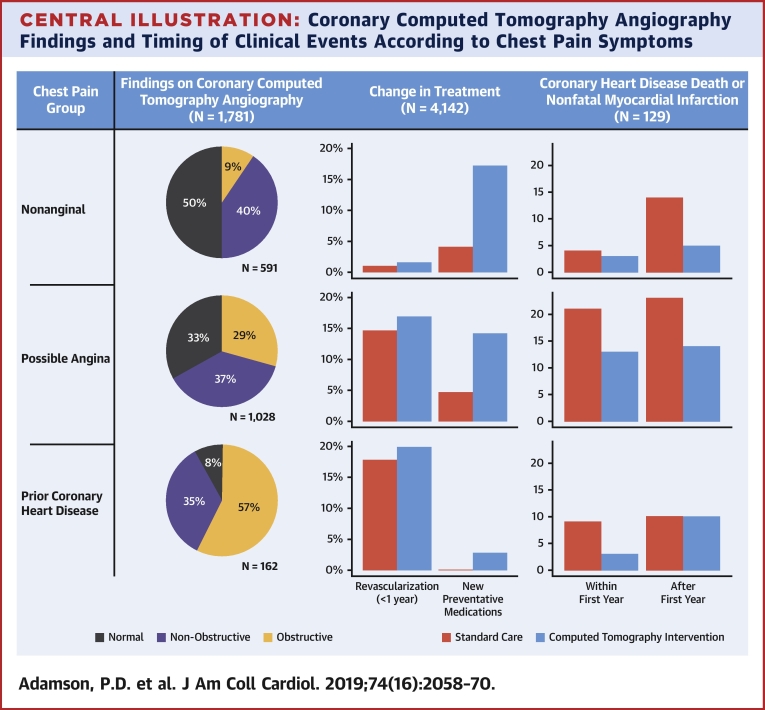
Coronary Computed Tomography Angiography Findings and Timing of Clinical Events According to Chest Pain Symptoms Findings on coronary computed tomography angiography (left), changes in provision of preventative medications and early coronary revascularization (center), and timing of coronary heart disease death or nonfatal myocardial infarction events (right) according to the National Institute of Health and Care Excellence guideline classification of chest pain symptoms.

Comment in

References

    1. Montalescot G., Sechtem U., Achenbach S., for the European Society of Cardiology Task Force 2013 ESC guidelines on the management of stable coronary artery disease: the Task Force on the management of stable coronary artery disease of the European Society of Cardiology. Eur Heart J. 2013;34:2949–3003. - PubMed
    1. Miller J.M., Rochitte C.E., Dewey M. Diagnostic performance of coronary angiography by 64-row CT. N Engl J Med. 2008;359:2324–2336. - PubMed
    1. Williams M.C., Hunter A., Shah A.S.V., for the SCOT-HEART Investigators Use of coronary computed tomographic angiography to guide management of patients with coronary disease. J Am Coll Cardiol. 2016;67:1759–1768. - PMC - PubMed
    1. The SCOT-HEART Investigators CT coronary angiography in patients with suspected angina due to coronary heart disease (SCOT-HEART): an open-label, parallel-group, multicentre trial. Lancet. 2015;385:2383–2391. - PubMed
    1. Douglas P.S., Hoffmann U., Patel M.R., for the PROMISE Investigators Outcomes of anatomical versus functional testing for coronary artery disease. N Engl J Med. 2015;372:1291–1300. - PMC - PubMed

Publication types

MeSH terms

Associated data