


Atrial fibrillation in patients with end-stage renal disease on hemodialysis: Magnitude of the problem and new approach to oral anticoagulation
- PMID: 31624777
- PMCID: PMC6781927
- DOI: 10.1002/rth2.12250
Atrial fibrillation in patients with end-stage renal disease on hemodialysis: Magnitude of the problem and new approach to oral anticoagulation
Abstract
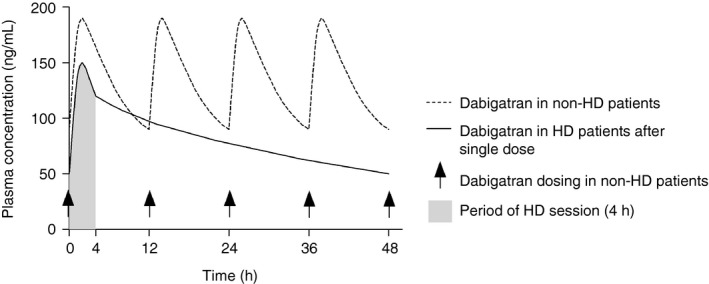
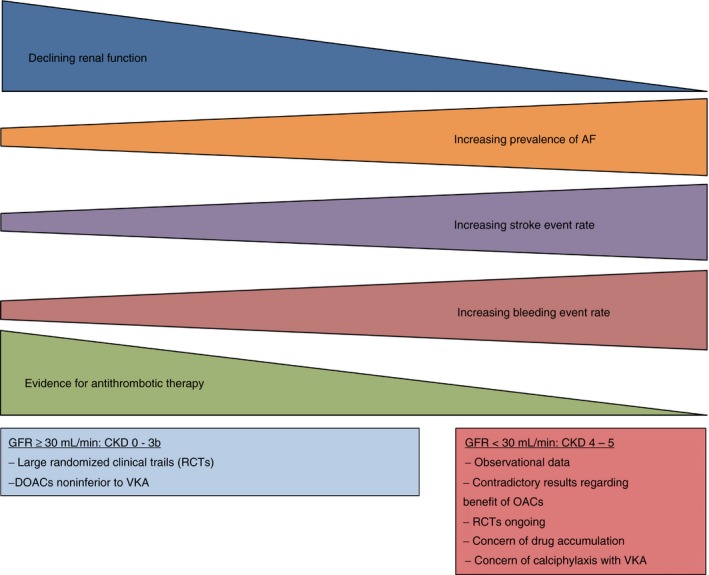
Atrial fibrillation (AF) is a frequent comorbid condition in patients with end-stage renal disease on hemodialysis (HD) with a prevalence of up to 27%. The incidence rate of stroke in AF patients on HD is approximately 5%. The AF-associated risk of stroke is a major clinical challenge because current evidence for anticoagulation in HD patients with AF is based on observational data. Results from these observational studies is largely contradictory because they do not show a clear benefit of vitamin K antagonists over no treatment in terms of stroke prevention, and they show an increased risk of hemorrhage associated with anticoagulation treatment in HD patients. HD patients were not included in randomized trials of the direct oral anticoagulants (DOACs), and therefore there is no evidence to support efficacy and safety of DOACs compared to vitamin K antagonists in HD patients. The pharmacological characteristics of DOACs are of particular interest in the HD setting. The factor Xa inhibitors rivaroxaban, apixaban, and edoxaban are not predominantly eliminated via the kidneys. The thrombin inhibitor dabigatran is 80% eliminated via the kidneys but is dialyzable due to its low protein binding. In this narrative review, we examine the current state of evidence regarding the prevalence of AF in patients on HD, the associated risk of stroke, and the efficacy and safety of anticoagulation for stroke prevention in the HD setting. Further, based on the pharmacokinetic properties of DOACs, we discuss their potential use in patients on HD and ongoing randomized trials.
Keywords: anticoagulation; atrial fibrillation; bleeding; chronic stroke; factor Xa inhibitors; kidney failure; renal dialysis.
© 2019 The Authors. Research and Practice in Thrombosis and Haemostasis published by Wiley Periodicals, Inc on behalf of International Society on Thrombosis and Haemostasis.
Figures
References
-
- Wolf PA, Abbott RD, Kannel WB. Atrial fibrillation as an independent risk factor for stroke: the Framingham study. Stroke. 1991;22:983–8. - PubMed
-
- Petersen P, Boysen G, Godtfredsen J, Andersen E, Andersen B. Placebo‐controlled, randomized trial of warfarin and aspirin for prevention of thromboembolic complications in chronic atrial fibrillation. The Copenhagen AFASAK Study. Lancet. 1989;333:175–9. - PubMed
-
- The Boston Area Anticoagulation Trial for Atrial Fibrillation Investigators . The effect of low‐dose warfarin on the risk of stroke in patients with nonrheumatic atrial fibrillation. N Engl J Med. 1990;323:1505–11. - PubMed
-
- Steffel J, Braunwald E. Novel oral anticoagulants: focus on stroke prevention and treatment of venous thrombo‐embolism. Eur Heart J. 2011;32:1968–76. - PubMed
Publication types
LinkOut - more resources
Full Text Sources
