


Poststroke depression and risk of recurrent stroke: A meta-analysis of prospective studies
- PMID: 31626084
- PMCID: PMC6824697
- DOI: 10.1097/MD.0000000000017235
Poststroke depression and risk of recurrent stroke: A meta-analysis of prospective studies
Abstract
Background: Conflicting results have been reported on the association of poststroke depression with recurrent stroke events. This meta-analysis of prospective studies aims to evaluate whether poststroke depression is an independent predictor of stroke recurrence among stroke patients.
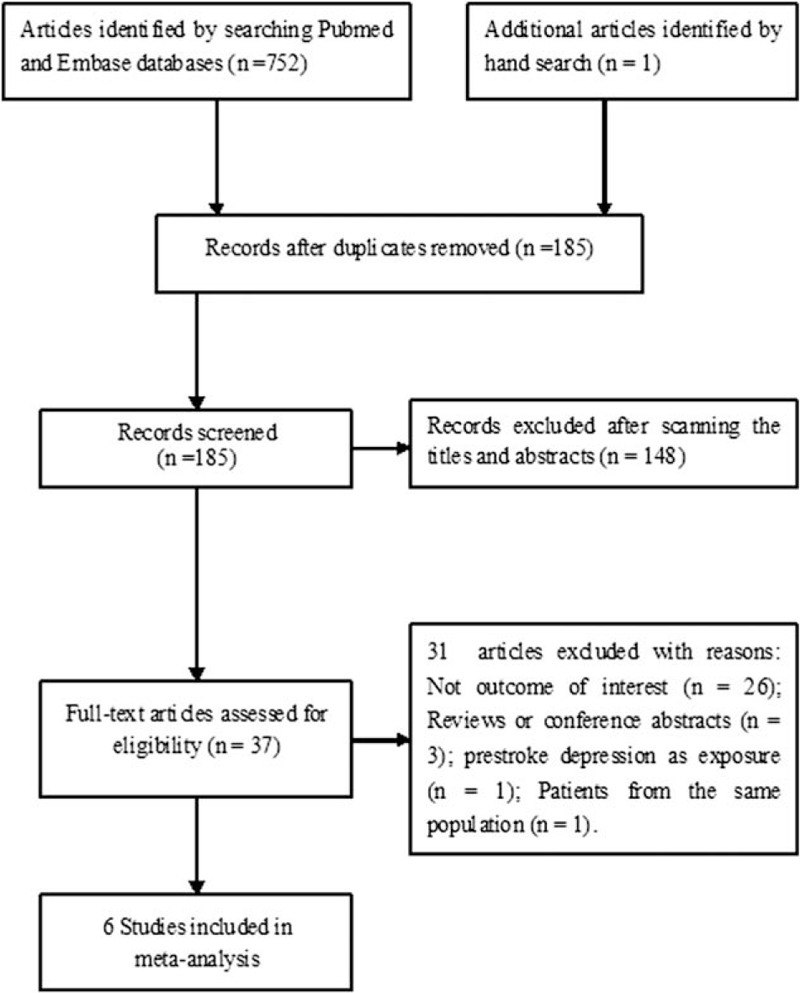
Methods: A systematic search of articles in PubMed and Embase databases from their inception to October 2018 was conducted. Prospective studies reporting risk estimates of stroke recurrence by depression status in stroke patients were included and pooled risk ratio (RR) with 95% confidence intervals (CIs) of stroke recurrence was calculated for patients with or without poststroke depression.
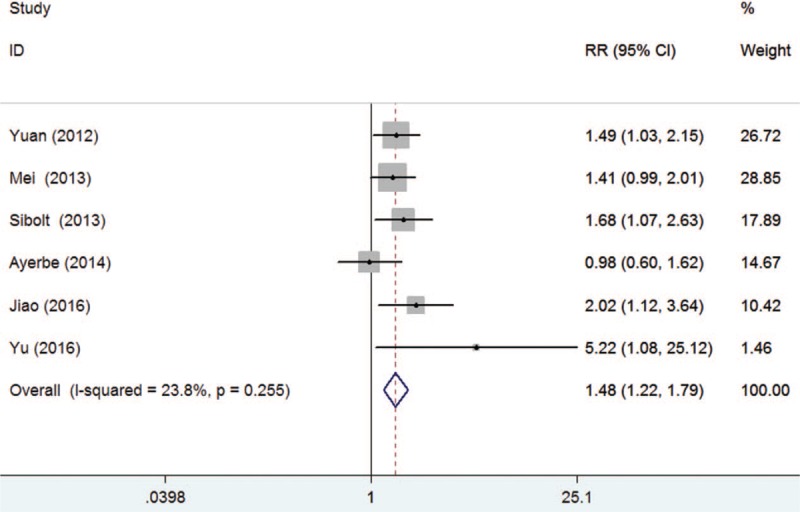
Results: Six studies with 4648 stroke patients were finally included, and the prevalence of poststroke depression was found to from 15.9% to 40.5%. The pooled adjusted RR for stroke recurrence in patients suffering from poststroke depression was 1.48 (1.22-1.79) in a fixed-effect model. Subgroup analyses indicated that poststroke depression significantly increased stroke recurrence (RR 1.64; 95% CI, 1.28-2.10) among ischemic stroke patients but not in total stroke patients (RR 1.28; 95% CI, 0.96-1.73).
Conclusions: This meta-analysis suggests that poststroke depression may be an independent predictor of stroke recurrence among ischemic stroke patients. Further studies are required to investigate whether treatment of poststroke depression can reduce the risk of stroke recurrence.
Conflict of interest statement
The authors have no conflicts of interest to disclose.
Figures
References
-
- Feigin VL, Norrving B, Mensah GA. Global burden of stroke. Circ Res 2017;120:439–48.. - PubMed
-
- Singh RJ, Chen S, Ganesh A, et al. Long-term neurological, vascular, and mortality outcomes after stroke. Int J Stroke 2018;13:787–96.. - PubMed
-
- Tsivgoulis G, Katsanos AH, Patousi A, et al. Stroke recurrence and mortality in northeastern Greece: the Evros Stroke Registry. J Neurol 2018;265:2379–87.. - PubMed
-
- Olindo S, Saint-Vil M, Jeannin S, et al. One-year disability, death and recurrence after first-ever stroke in a Black Afro-Caribbean population. Int J Stroke 2017;12:844–50.. - PubMed
-
- Mohan KM, Wolfe CD, Rudd AG, et al. Risk and cumulative risk of stroke recurrence: a systematic review and meta-analysis. Stroke 2011;42:1489–94.. - PubMed
Publication types
MeSH terms
LinkOut - more resources
Full Text Sources
Medical
