. 2019 Dec 1;95(12):fiz166.
doi: 10.1093/femsec/fiz166.

Distinctive microbial communities in subzero hypersaline brines from Arctic coastal sea ice and rarely sampled cryopegs

Affiliations

Distinctive microbial communities in subzero hypersaline brines from Arctic coastal sea ice and rarely sampled cryopegs

Zachary S Cooper et al. FEMS Microbiol Ecol. .

Abstract

Hypersaline aqueous environments at subzero temperatures are known to be inhabited by microorganisms, yet information on community structure in subzero brines is very limited. Near Utqiaġvik, Alaska, we sampled subzero brines (-6°C, 115-140 ppt) from cryopegs, i.e. unfrozen sediments within permafrost that contain relic (late Pleistocene) seawater brine, as well as nearby sea-ice brines to examine microbial community composition and diversity using 16S rRNA gene amplicon sequencing. We also quantified the communities microscopically and assessed environmental parameters as possible determinants of community structure. The cryopeg brines harbored surprisingly dense bacterial communities (up to 108 cells mL-1) and millimolar levels of dissolved and particulate organic matter, extracellular polysaccharides and ammonia. Community composition and diversity differed between the two brine environments by alpha- and beta-diversity indices, with cryopeg brine communities appearing less diverse and dominated by one strain of the genus Marinobacter, also detected in other cold, hypersaline environments, including sea ice. The higher density and trend toward lower diversity in the cryopeg communities suggest that long-term stability and other features of a subzero brine are more important selective forces than in situ temperature or salinity, even when the latter are extreme.

Keywords: Marinobacter; Arctic; bacterial diversity; cryopeg; sea ice; subsurface microbiology.


Figures

Figure 1.
Figure 1.
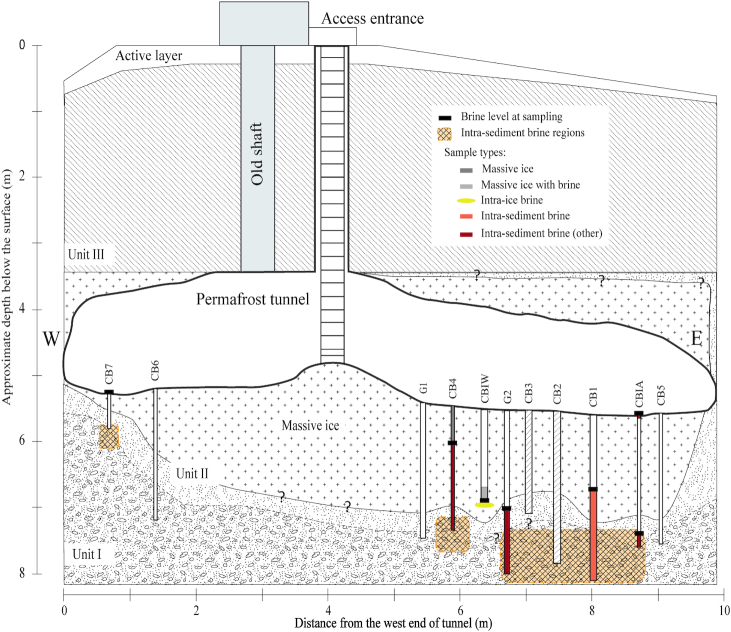
North-facing cross-sectional diagram of the Barrow Permafrost Tunnel system. The tunnel is entered via the access ladder, and equipment and supplies are lowered through the same space. Cryopeg boreholes CB1, CB2, CB3 and the upper (dry) portion of CBIW were drilled prior to this study; CB2 ad CB3 were sealed and unavailable for this study. The other boreholes were drilled in 2017 and 2018, with pipes installed to preserve the holes and facilitate sampling. Crosshatched sections indicate confirmation of cryopeg sediments (intra-sediment brine regions). Units I–III refer to permafrost regions, following Meyer et al. (2010a). W and E indicate West and East directions, respectively. Question mark symbols ‘?’ indicate unresolved boundary position. See Table 1 for sample details, and Text S1 (Supporting Information) for borehole terminology and drilling details.
Figure 2.
Figure 2.
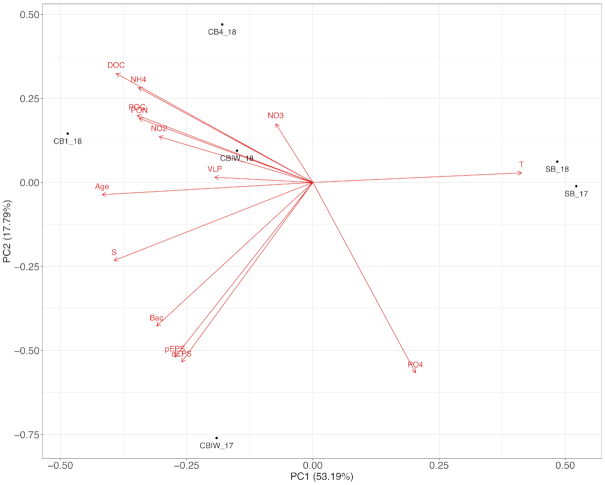
PCA of cryopeg and sea-ice brine samples that had a full suite of measured environmental factors. Vectors indicate contribution of each variable to each principal component.
Figure 3.
Figure 3.
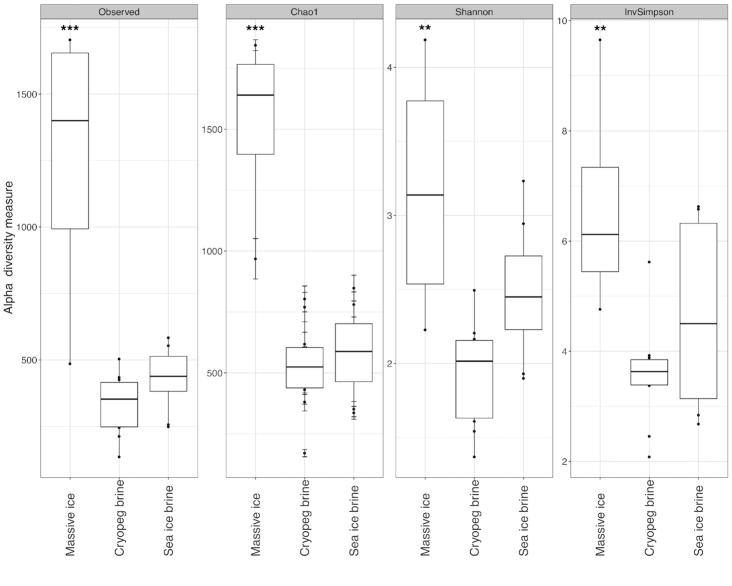
Indices of microbial community richness (left panels) and diversity (right panels) for the three main sample types: massive ice, cryopeg brine and sea-ice brine. Massive ice samples (n = 4) differ significantly from cryopeg brines (n = 10) by every measure (** indicates P < 0.01 and *** indicates P < 0.001). Indices for sea-ice brines (n = 8) tend to be higher than cryopeg brines, also by every measure, but not significantly (e.g. P = 0.0796 for Shannon diversity index).
Figure 4.
Figure 4.
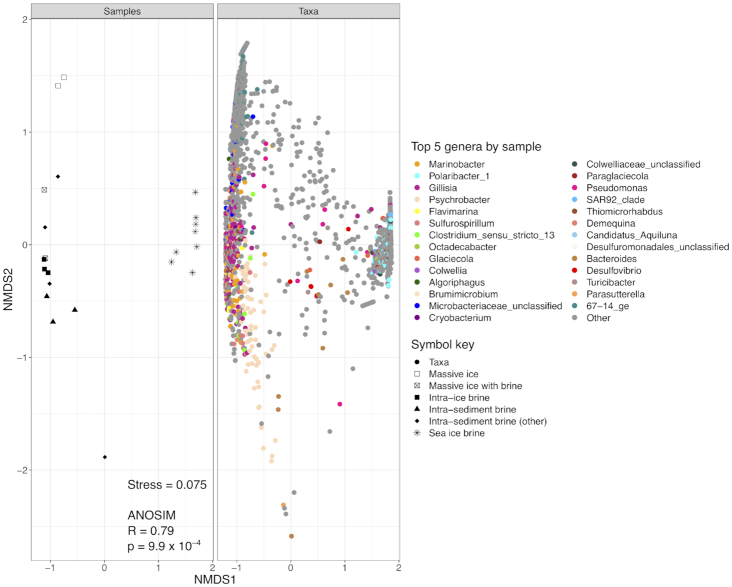
Split NMDS ordination, using Bray–Curtis dissimilarities, showing relatedness of each sample and OTU contributions (colored by genus) to sample ordination. Left panel: black and white symbols indicate sample subtype; right panel: colors indicate taxonomy.
Figure 5.
Figure 5.
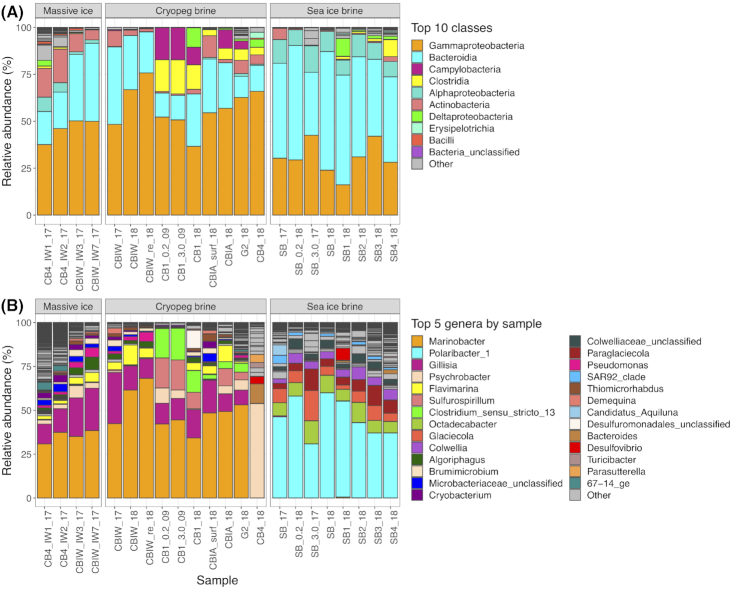
Relative abundance plots of taxa in each sample, grouped by the three main sample types. (A) The top 10 classes across all samples are color coded; lower abundance classes are in gray. (B) The top five genera from each sample are color-coded and shown in each sample where they occur; lower abundance genera are in gray. Sample designations are further described in Table 1.

References

    1. Boetius A, Anesio AM, Deming JW et al. .. Microbial ecology of the cryosphere: sea ice and glacial habitats. Nat Rev Microbiol. 2015;13:677–90. - PubMed
    1. Bowman JP, McCammon SA, Brown M V et al. .. Diversity and association of psychrophilic bacteria in Antarctic sea ice. Appl Environ Microbiol. 1997;63:3068–78. - PMC - PubMed
    1. Bowman JS, Rasmussen S, Blom N et al. .. Microbial community structure of Arctic multiyear sea ice and surface seawater by 454 sequencing of the 16S RNA gene. ISME J. 2012;6:11–20. - PMC - PubMed
    1. Bowman JS. The relationship between sea ice bacterial community structure and biogeochemistry: a synthesis of current knowledge and known unknowns. Elem Sci Anth. 2015;3:000072.
    1. Brown MV, Bowman JP. A molecular phylogenetic survey of sea-ice microbial communities (SIMCO). FEMS Microbiol Ecol. 2001;35:267–75. - PubMed

Publication types