


Effect οf Genotype and Growing Year on the Nutritional, Phytochemical, and Antioxidant Properties of Industrial Hemp (Cannabis sativa L.) Seeds
- PMID: 31627349
- PMCID: PMC6826498
- DOI: 10.3390/antiox8100491
Effect οf Genotype and Growing Year on the Nutritional, Phytochemical, and Antioxidant Properties of Industrial Hemp (Cannabis sativa L.) Seeds
Abstract
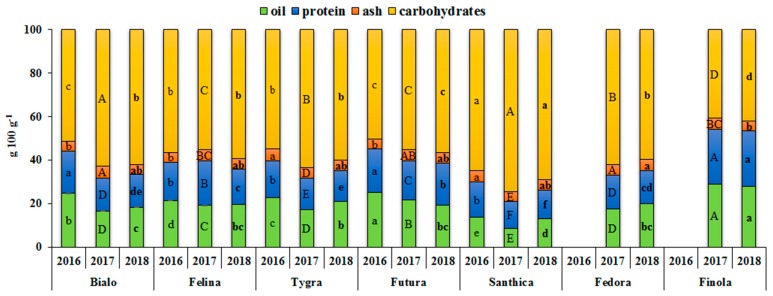
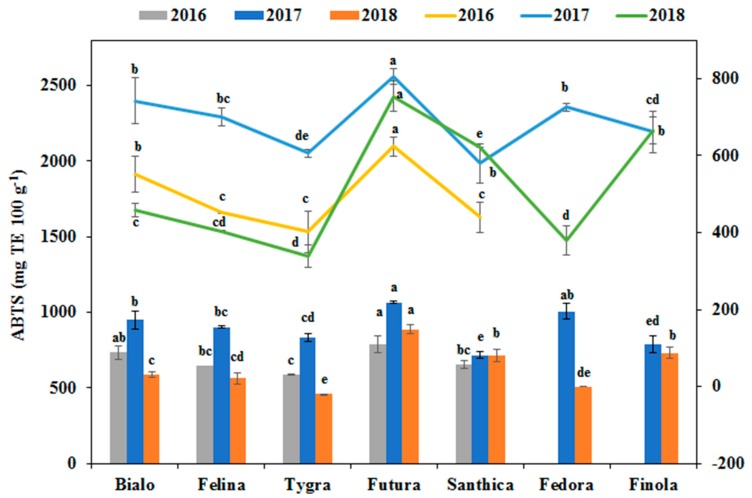
Cannabis sativa L. seeds have been an important source of protein, oil, and dietary fiber for human and animals. Currently, there is a growing interest in the commercial products of these seeds, which are recognized as a legitimate source of medicaments, cosmeceuticals, and nutraceuticals. The objective of this study was to investigate the nutritional, phytochemical composition, and antioxidant properties of seeds from seven hemp cultivars grown in Greece for three consecutive years. All the measured parameters strongly varied under the influence of growing year and genotype. In particular, protein, oil, and carbohydrates' content of hemp seeds as well as fatty acids' composition were mainly affected by genotype, whereas the growing year had a major effect on phytochemical components and antioxidant activity, which was determined by the 2,2'-azino-bis (3-ethylbenzthiazoline sulfonate) (ABTS) and ferric-reducing antioxidant power (FRAP) assays. Moreover, a predominant effect of the year was observed for phenolic profiles as determined by high-performance liquid chromatography and total carotenoids' content. This study suggests that hemp seeds could be a promising food crop as a result of their high nutritive traits and antioxidant potential. A comparison of the studied cultivars, showed that Finola seeds had the highest oil and protein contents and, thus, appeared to be the most promising cultivar for cultivation in Greece.
Keywords: antioxidant; fatty acid profile; genotype; growing year; hemp seed (Cannabis sativa L.); lignanamides; nutritional components; phytochemicals.
Conflict of interest statement
The authors declare no conflict of interest.
Figures


References
-
- Amaducci S., Scordia D., Liu F.H., Zhang Q., Guo H., Testa G.S., Cosentino L. Key cultivation techniques for hemp in Europe and China. Ind. Crops Prod. 2015;68:2–16. doi: 10.1016/j.indcrop.2014.06.041. - DOI
-
- Salentijn E.M.J., Zhang Q., Amaducci S., Yang M., Trindade L.M. New developments in fiber hemp (Cannabis sativa L.) breeding. Ind. Crops Prod. 2015;68:32–41. doi: 10.1016/j.indcrop.2014.08.011. - DOI
-
- Callaway J.C. Hemp seed as a nutritional resource: An overview. Euphytica. 2004;140:65–72. doi: 10.1007/s10681-004-4811-6. - DOI
-
- Kriese U., Schumann E., Weber W.E., Beyer M., Bruhl L., Matthaus B. Oil content, tocopherol composition and fatty acid patterns of the seeds of 51 Cannabis sativa L. genotypes. Euphytica. 2004;137:339–351. doi: 10.1023/B:EUPH.0000040473.23941.76. - DOI
LinkOut - more resources
Full Text Sources
Miscellaneous
