Mapping Geospatial Access to Comprehensive Cancer Care in Nigeria
- PMID: 31634049
- PMCID: PMC6825250
- DOI: 10.1200/JGO.19.00283
Mapping Geospatial Access to Comprehensive Cancer Care in Nigeria
Abstract
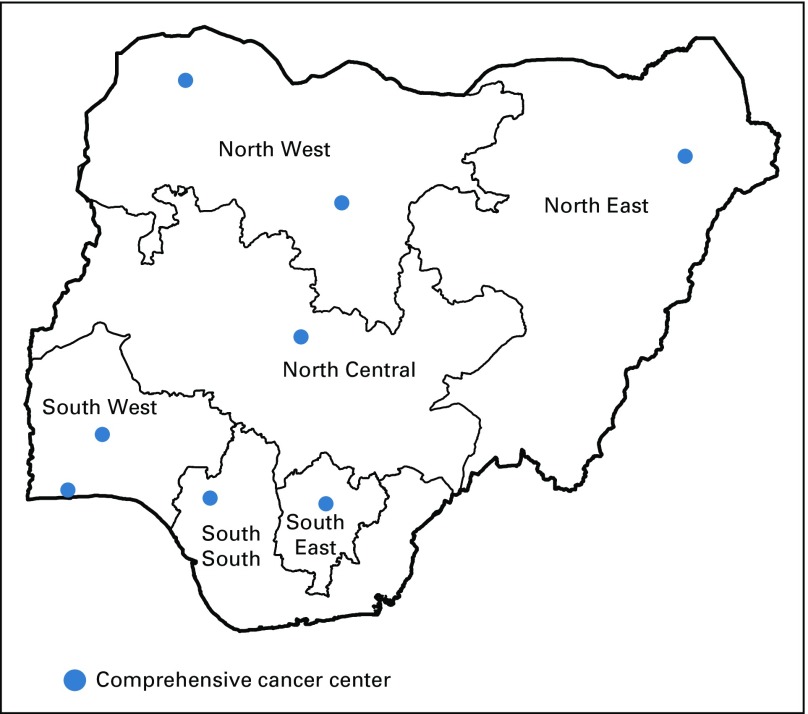
Purpose: To address the increasing burden of cancer in Nigeria, the National Cancer Control Plan outlines the development of 8 public comprehensive cancer centers. We map population-level geospatial access to these eight centers and explore equity of access and the impact of future development.
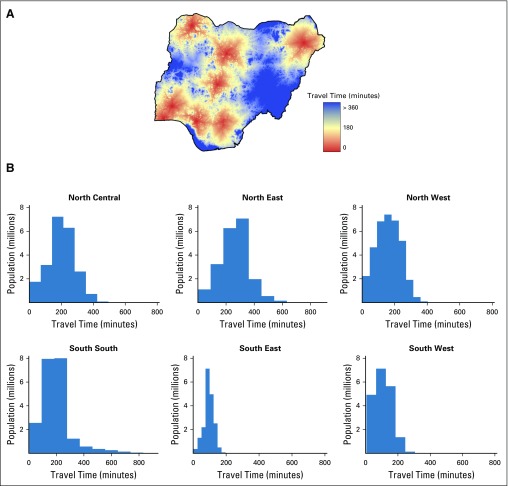
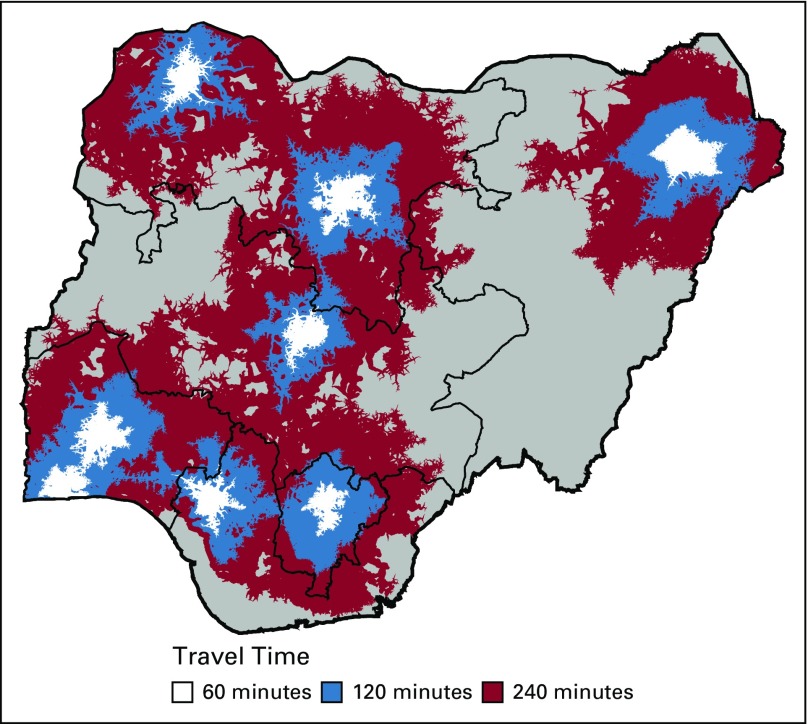
Methods: Geospatial methods were used to estimate population-level travel times to the 8 cancer centers. A cost distance model was built using open source road infrastructure data with verified speed limits. Geolocated population estimates were amalgamated with this model to calculate travel times to cancer centers at a national and regional level for both the entire population and the population living on < US$2 per day.
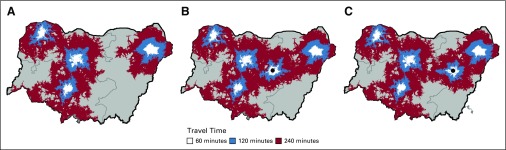
Results: Overall, 68.9% of Nigerians have access to a comprehensive cancer center at 4 hours of continuous vehicular travel. However, there is significant variability in access between geopolitical zones (P < .001). The North East has the lowest access at 4 hours (31.4%) and the highest mean travel times (268 minutes); this is significantly lower than the proportion with 4-hour access in the South East (31.4% v 85.0%, respectively; P < .001). The addition of a second comprehensive cancer center in the North East, in either Bauchi or Gombe, would significantly improve access to this underserved region.
Conclusion: The Federal Ministry of Health endorses investment in 8 public comprehensive cancer centers. Strengthening these centers will allow the majority of Nigerians to access the full complement of multidisciplinary care within a reasonable time frame. However, geospatial access remains inequitable, and the impact on outcomes is unclear. This must be considered as the cancer control system matures and expands.
Conflict of interest statement
T. Peter Kingham
No other potential conflicts of interest were reported.
Figures
References
-
- Irabor D, Adedeji OA: Colorectal cancer in Nigeria: 40 years on—A review. Eur J Cancer Care (Engl) 18:110-115, 2009. - PubMed
-
- https://www.iccp-portal.org/plans/nigeria-national-cancer-control-plan International Cancer Control Partnership: National Cancer Control Plan: 2018-2022, Federal Ministry of Health.
-
- Gelband H, Jha P, Sankaranarayanan R, et al (eds): Cancer services and the comprehensive cancer center, in Cancer: Disease Control Priorities (vol 3, ed 3). Washington, DC, International Bank for Reconstruction and Development/The World Bank, 2015, pp 195-210.
-
- Irabor OC, Nwankwo KC, Adewuyi SA. The stagnation and decay of radiation oncology resources: Lessons from Nigeria. Int J Radiat Oncol Biol Phys. 2016;95:1327–1333. - PubMed
Publication types
MeSH terms
Grants and funding
LinkOut - more resources
Full Text Sources