A Systematic Review and Meta-analysis of the Prevalence of Community-Onset Bloodstream Infections among Hospitalized Patients in Africa and Asia
- PMID: 31636071
- PMCID: PMC7187598
- DOI: 10.1128/AAC.01974-19
A Systematic Review and Meta-analysis of the Prevalence of Community-Onset Bloodstream Infections among Hospitalized Patients in Africa and Asia
Abstract
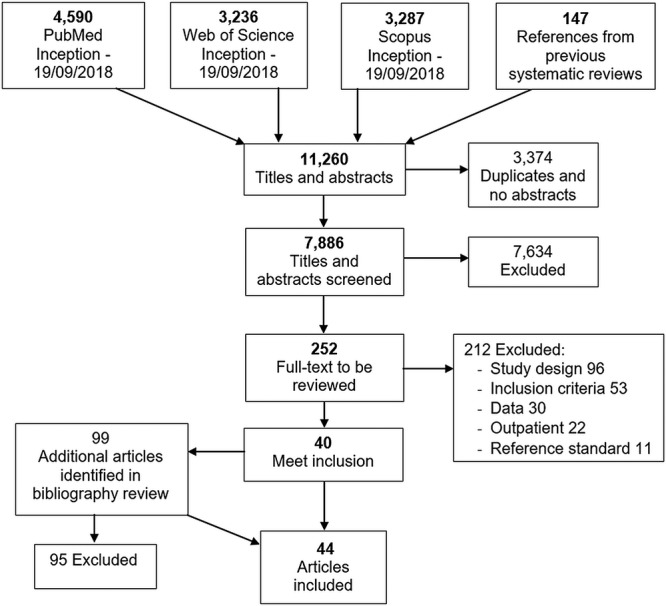
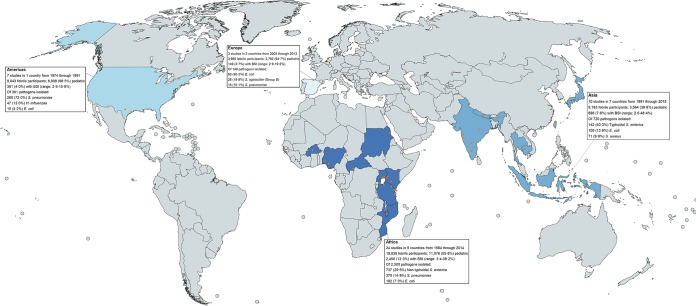
Community-onset bloodstream infections (CO-BSI) are major causes of severe febrile illness and death worldwide. In light of new data and the growing problem of antimicrobial resistance (AMR) among pathogens causing BSI, we undertook a systematic review of hospital-based studies of CO-BSI among patients hospitalized with fever. Without restriction to language or country, we searched PubMed, Web of Science, and Scopus for prospective hospital-based studies of culture-confirmed CO-BSI among febrile inpatients. We determined by study the prevalence of BSI among participants, the pathogens responsible for BSI, and the antimicrobial susceptibility patterns of pathogens causing BSI, according to place and time. Thirty-four (77.3%) of 44 eligible studies recruited 29,022 participants in Africa and Asia combined. Among participants in these two regions, the median prevalence of BSI was 12.5% (range, 2.0 to 48.4%); of 3,220 pathogens isolated, 1,119 (34.8%) were Salmonella enterica, 425 (13.2%) Streptococcus pneumoniae, and 282 (8.8%) Escherichia coli Antimicrobial susceptibility testing was reported in 16 (36.4%) studies. When isolates collected prior to 2008 were compared to those collected in the period of 2008 through 2018, the proportions of typhoidal Salmonella and Staphylococcus aureus isolates resistant to several clinically relevant antimicrobials increased over time, while S. pneumoniae susceptibility was stable. CO-BSI remain a major cause of severe febrile illness among hospitalized patients in Africa and Asia, with S. enterica, S. pneumoniae, and E. coli predominating. There is a concerning increase in AMR among serious infections caused by community-onset pathogens. Ongoing surveillance is needed to inform empirical management and strategies to control AMR.
Keywords: antimicrobial resistance; bacteremia; bloodstream infections; community-onset infections.
Copyright © 2019 Marchello et al.
Figures
References
-
- Petit PL, van Ginneken JK. 1995. Analysis of hospital records in four African countries, 1975–1990, with emphasis on infectious diseases. J Trop Med Hyg 98:217–227. - PubMed
-
- Feikin DR, Olack B, Bigogo GM, Audi A, Cosmas L, Aura B, Burke H, Njenga MK, Williamson J, Breiman RF. 2011. The burden of common infectious disease syndromes at the clinic and household level from population-based surveillance in rural and urban Kenya. PLoS One 6:e16085. doi:10.1371/journal.pone.0016085. - DOI - PMC - PubMed
-
- Centers for Disease Control and Prevention. 2019. National Hospital Ambulatory Medical Care Survey: 2015 emergency department summary tables. https://www.cdc.gov/nchs/data/nhamcs/web_tables/2015_ed_web_tables.pdf.
-
- Keitel K, Kagoro F, Samaka J, Masimba J, Said Z, Temba H, Mlaganile T, Sangu W, Rambaud-Althaus C, Gervaix A, Genton B, D'Acremont V. 2017. A novel electronic algorithm using host biomarker point-of-care tests for the management of febrile illnesses in Tanzanian children (e-POCT): a randomized, controlled non-inferiority trial. PLoS Med 14:e1002411. doi:10.1371/journal.pmed.1002411. - DOI - PMC - PubMed
Publication types
MeSH terms
Substances
Grants and funding
LinkOut - more resources
Full Text Sources
Medical