The Household Water InSecurity Experiences (HWISE) Scale: development and validation of a household water insecurity measure for low-income and middle-income countries
- PMID: 31637027
- PMCID: PMC6768340
- DOI: 10.1136/bmjgh-2019-001750
The Household Water InSecurity Experiences (HWISE) Scale: development and validation of a household water insecurity measure for low-income and middle-income countries
Abstract
Objective: Progress towards equitable and sufficient water has primarily been measured by population-level data on water availability. However, higher-resolution measures of water accessibility, adequacy, reliability and safety (ie, water insecurity) are needed to understand how problems with water impact health and well-being. Therefore, we developed the Household Water InSecurity Experiences (HWISE) Scale to measure household water insecurity in an equivalent way across disparate cultural and ecological settings.
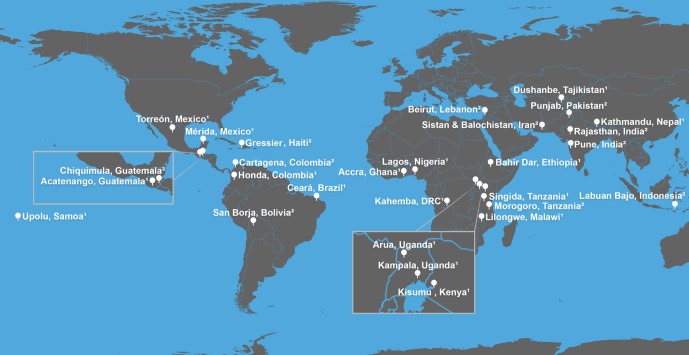
Methods: Cross-sectional surveys were implemented in 8127 households across 28 sites in 23 low-income and middle-income countries. Data collected included 34 items on water insecurity in the prior month; socio-demographics; water acquisition, use and storage; household food insecurity and perceived stress. We retained water insecurity items that were salient and applicable across all sites. We used classical test and item response theories to assess dimensionality, reliability and equivalence. Construct validity was assessed for both individual and pooled sites using random coefficient models.
Findings: Twelve items about experiences of household water insecurity were retained. Items showed unidimensionality in factor analyses and were reliable (Cronbach's alpha 0.84 to 0.93). The average non-invariance rate was 0.03% (threshold <25%), indicating equivalence of measurement and meaning across sites. Predictive, convergent and discriminant validity were also established.
Conclusions: The HWISE Scale measures universal experiences of household water insecurity across low-income and middle-income countries. Its development ushers in the ability to quantify the prevalence, causes and consequences of household water insecurity, and can contribute an evidence base for clinical, public health and policy recommendations regarding water.
Keywords: anthropology; cross-cultural; food insecurity; household water insecurity; scale development; scale validation.
© Author(s) (or their employer(s)) 2019. Re-use permitted under CC BY-NC. No commercial re-use. See rights and permissions. Published by BMJ.
Conflict of interest statement
Competing interests: None declared.
Figures
References
-
- Webb P. Water insecurity and the poor: issues and research needs. Bonn, Germany: Universität Bonn, 1998. https://www.zef.de/uploads/tx_zefportal/Publications/zef_dp2-98.pdf
-
- World Economic Forum The global risks report. 2018 13th Edition Geneva, Switzerland: World Economic Forum, 2018. http://www3.weforum.org/docs/WEF_GRR18_Report.pdf
Grants and funding
LinkOut - more resources
Full Text Sources