


Injury Rate in TackleBar Football
- PMID: 31637268
- PMCID: PMC6785918
- DOI: 10.1177/2325967119874065
Injury Rate in TackleBar Football
Abstract
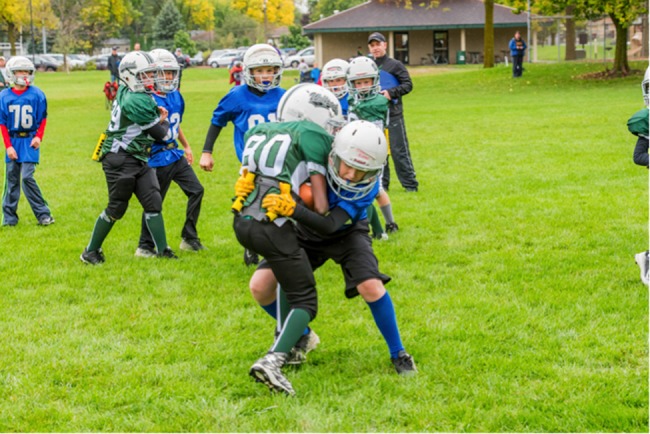
Background: As football comes under greater scrutiny because of concussions and other injuries, many people are searching for safer alternatives, especially for youth athletes. The injury rate in TackleBar football, one such alternative, is not currently known.
Purpose: To describe TackleBar football and calculate its injury rate over a single season to compare it with both traditional tackle and flag football.
Study design: Descriptive epidemiology study.
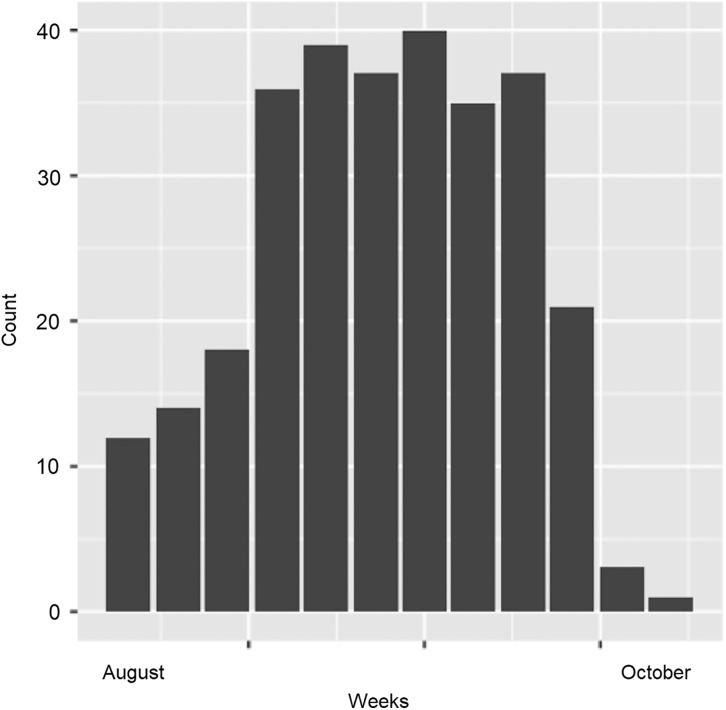
Methods: TackleBar football was described, and injuries of male athletes (age range, 9-14 years) participating in TackleBar football were tracked over the course of a season (August 5 through October 27, 2018) and compared with published injury rates for traditional tackle and flag football.
Results: The overall injury rate of TackleBar football was found to be 0.31 per 1000 athlete-exposures (AEs), which is lower than youth tackle (2.25-2.60/1000 AEs) and flag (5.77/1000 AEs) football.
Conclusion: TackleBar football may represent a reasonable alternative to tackle and flag football with regard to injuries.
Keywords: concussion; football; injury; youth.
© The Author(s) 2019.
Conflict of interest statement
One or more of the authors has declared the following potential conflict of interest or source of funding: T.H. is the chief executive officer of TackleBar as well as a shareholder in the company. TackleBar itself holds a number of patents covering its intellectual property. U.S. has received research support from Integra LifeSciences; consulting fees from Medtronic; speaking fees from Integra LifeSciences, Medtronic, and Abbott Laboratories; and hospitality payments from Globus Medical, Mazor Robotics, Medtronic, Vertex Pharmaceuticals, DePuy Synthes, St Jude Medical, Surgical Theater, NuVasive, and LDR Spine USA. AOSSM checks author disclosures against the Open Payments Database (OPD). AOSSM has not conducted an independent investigation on the OPD and disclaims any liability or responsibility relating thereto.
Figures
References
-
- Aspen Institute. What if…flag becomes the standard way of playing football until high school? Available at: https://assets.aspeninstitute.org/content/uploads/2018/09/FINAL-Future-o.... Accessed November 19, 2018.
-
- Babiss LA, Gangwisch JE. Sports participation as a protective factor against depression and suicidal ideation in adolescents as mediated by self-esteem and social support. J Dev Behav Pediatr. 2009;30(5):376–384. - PubMed
-
- Chung J, Cummings P, Samadani U. Does CTE call for an end to youth tackle football? Star Tribune. February 10, 2018 Available at: http://www.startribune.com/does-cte-call-for-an-end-to-youth-tackle-foot.... Accessed May 17, 2019.
-
- Council on Sports Medicine and Fitness. Tackling in youth football. Pediatrics. 2015;136(5):e1419–e1430. - PubMed
LinkOut - more resources
Full Text Sources
Research Materials
