


US Growth Hormone Use in the Idiopathic Short Stature Era: Trends in Insurer Payments and Patient Financial Burden
- PMID: 31637343
- PMCID: PMC6795021
- DOI: 10.1210/js.2019-00246
US Growth Hormone Use in the Idiopathic Short Stature Era: Trends in Insurer Payments and Patient Financial Burden
Abstract
Objective: To investigate trends in prevalence and expenditures of growth hormone (GH) use by US youth in the last 15 years, a period during which the US Food and Drug Administration (FDA) approved GH treatment of idiopathic short stature (ISS), and insurers imposed greater barriers to GH treatment reimbursements.
Design: With the use of 2001 to 2016 OptumInsight commercial claims data, we analyzed trends in claims of GH drugs among beneficiaries aged 0 to 18 years (n = 38,857 beneficiaries receiving GH). Outcome measures included annual prevalence of GH claims and annual total insurer and total patient payments for GH claims. t Tests were used for linear time trends in outcomes. The percentage of beneficiaries switching GH brands also was calculated.
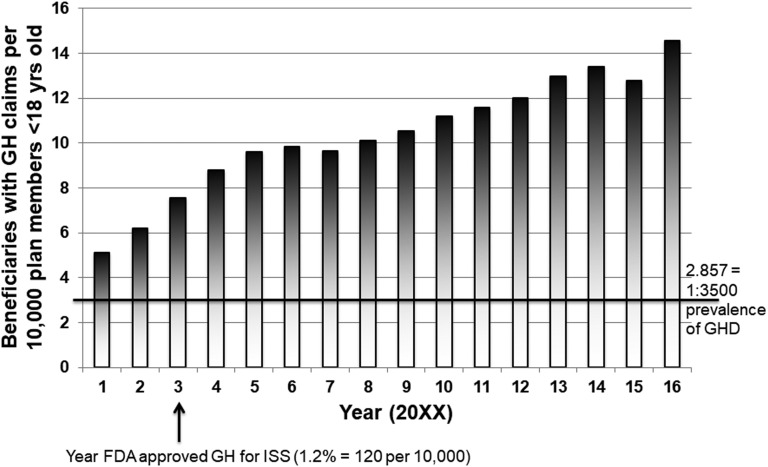
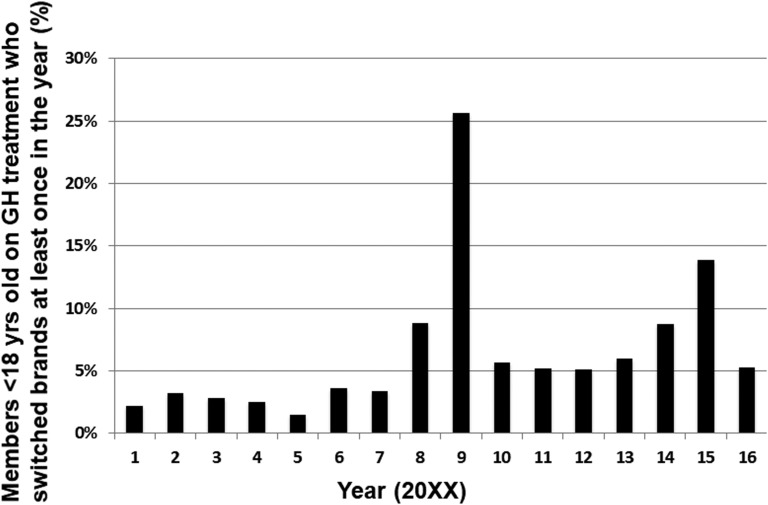
Results: The number of members with GH claims per 10,000 beneficiaries under age 18 rose steadily from 5.1 in 2001 to 14.6 in 2016, without a dramatic change around 2003, the ISS approval date. Mean total GH expenditures decreased (-26% in constant dollars), as did the estimated insurance paid amount (-28%). However, mean total patient spending increased by 163%. Beneficiaries switching GH brands in the year ranged from 1.4% to 3.6% in 2001 to 2007 and from 5.1% to 8.8% after, with 25.6% switching in 2009 and 13.9% switching in 2015.
Conclusions: The FDA ISS approval was not a watershed event in the steady increase in GH use by US youth. Progressive restrictions on coverage and formulary preference coverage strategies appear to have succeeded in lowering total expenditures and insurer burden of GH treatment per beneficiary. However, those savings were not passed on to patients who bore greater burdens financially and from brand switches.
Keywords: growth hormone; idiopathic short stature; insurance; pediatric.
Copyright © 2019 Endocrine Society.
Figures

References
-
- Lindsay R, Feldkamp M, Harris D, Robertson J, Rallison M. Utah Growth Study: growth standards and the prevalence of growth hormone deficiency. J Pediatr. 1994;125(1):29–35. - PubMed
-
- Food and Drug Administration. NDA 19-640/S-033: NDA approval letter. Available at: https://www.accessdata.fda.gov/drugsatfda_docs/appletter/2003/19640se1-0.... Accessed 5 April 2019.
-
- United States Census Bureau. American Fact Finder. Available at: https://factfinder.census.gov/faces/nav/jsf/pages/index.xhtml. Accessed 24 June 2019.
-
- Grimberg A, Feudtner C, Gordon CM. Consequences of brand switches during the course of pediatric growth hormone treatment. Endocr Pract. 2012;18(3):307–316. - PubMed
LinkOut - more resources
Full Text Sources