. 2020 Jan;19(1):e13038.
doi: 10.1111/acel.13038. Epub 2019 Oct 22.

Systemic GDF11 stimulates the secretion of adiponectin and induces a calorie restriction-like phenotype in aged mice

Affiliations

Systemic GDF11 stimulates the secretion of adiponectin and induces a calorie restriction-like phenotype in aged mice

Lida Katsimpardi et al. Aging Cell. 2020 Jan.

Abstract

Aging is a negative regulator of general homeostasis, tissue function, and regeneration. Changes in organismal energy levels and physiology, through systemic manipulations such as calorie restriction and young blood infusion, can regenerate tissue activity and increase lifespan in aged mice. However, whether these two systemic manipulations could be linked has never been investigated. Here, we report that systemic GDF11 triggers a calorie restriction-like phenotype without affecting appetite or GDF15 levels in the blood, restores the insulin/IGF-1 signaling pathway, and stimulates adiponectin secretion from white adipose tissue by direct action on adipocytes, while repairing neurogenesis in the aged brain. These findings suggest that GDF11 has a pleiotropic effect on an organismal level and that it could be a linking mechanism of rejuvenation between heterochronic parabiosis and calorie restriction. As such, GDF11 could be considered as an important therapeutic candidate for age-related neurodegenerative and metabolic disorders.

Keywords: GDF11; adiponectin; aging; calorie restriction; heterochronic parabiosis; rejuvenation.


Conflict of interest statement

The authors declare no competing interests.

Figures
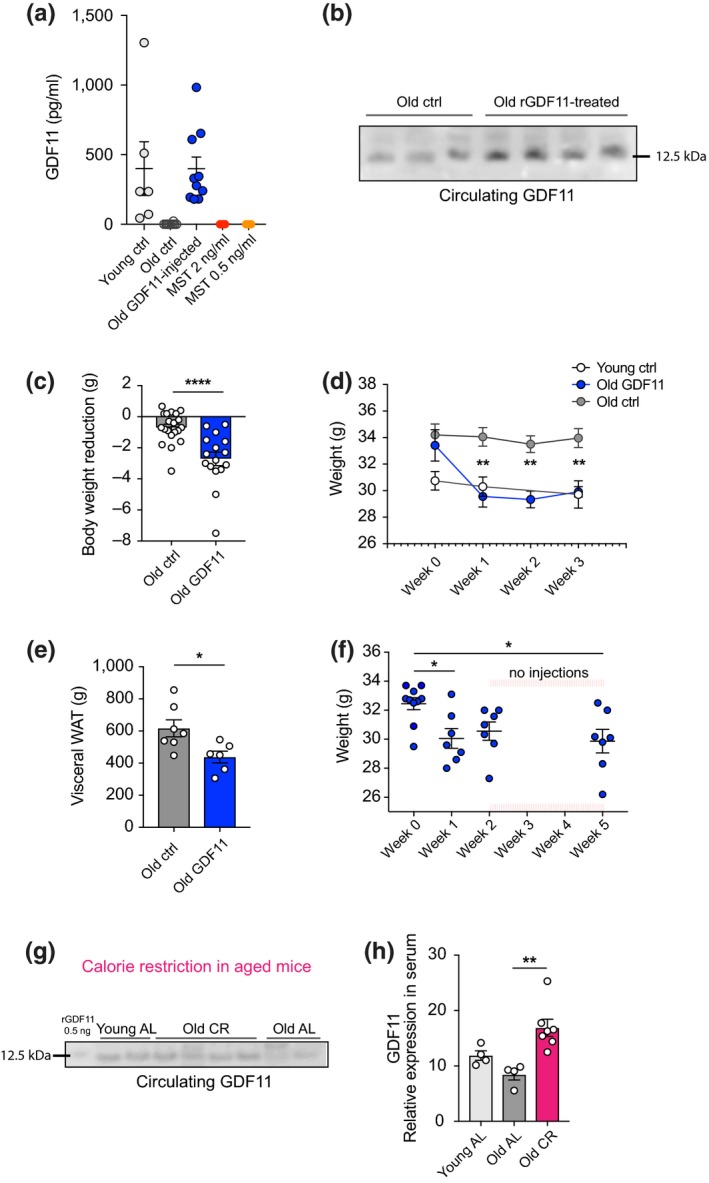
Figure 1
Figure 1
Serum GDF11 levels correlate with weight loss and calorie restriction. (a) ELISA measurements of circulating GDF11 in the plasma of young, old, and GDF11‐treated old mice 12 hr after injection (n Y = 6, n O = 10, n GDF11 = 10 mice per group). Recombinant MST (2 and 0.5 ng/ml) was used as a specificity control. (b) Western blot of equal serum volumes from aged GDF11‐injected and aged control mice probed with a specific anti‐GDF11 antibody. (c) Graphic representation of body weight reduction after 8 days of daily systemic GDF11 or saline administration in 22‐month‐old mice (n = 20 mice per group). (d) Weekly measurement of weight over 3 weeks of daily GDF11 or saline administration (n = 7 mice per group). (e) Measurement of WAT weight after 22 days of treatment (n O = 7, n GDF11 = 6 mice per group). (f) Weekly weight measurement of mice injected with GDF11 for 2 weeks and monitored for 3 weeks without injections (n = 10 mice per group). (G) Western blot from equal volumes of young and old AL and old CR mice plasma probed with anti‐GDF11 antibody. (h) Quantification of (G) by optical intensity (n Y‐AL = 4, n O‐AL = 4, n O‐CR = 7 mice per group). One‐way and two‐way ANOVA and Tukey's post hoc test for multiple group comparisons; Mann–Whitney test for two‐group comparisons; *p < .05, **p < .01; ****p < .0001; mean ± SEM
Figure 2
Figure 2
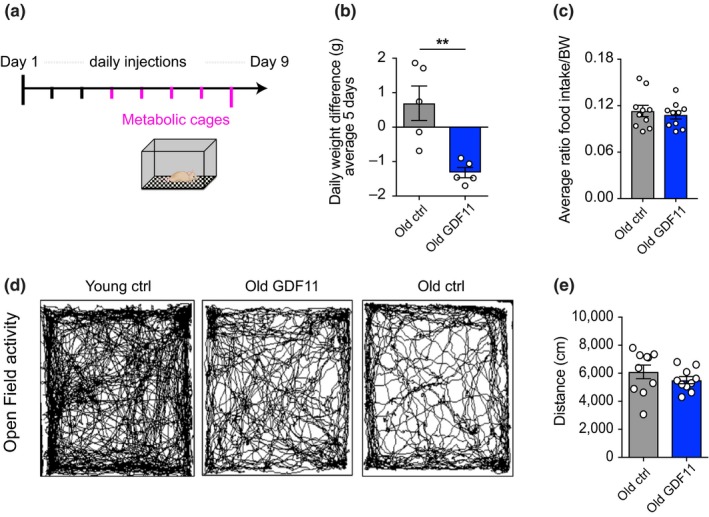
Food consumption and physical activity are not affected when GDF11‐treated aged mice lose weight. (a) Schematic representation of metabolic cage experiment: Young and aged mice were injected with saline or GDF11 for 3 days before transfer to metabolic cages, where they remained for 5 days while continuing to be injected daily. (b) Graphic representation of daily weight loss, averaged over 5 days (n = 5 mice per group). (c) Graphic representation of the average ratio of food intake per body weight (n Y = 4, n O = 10, n GDF = 10 mice per group). (d) Measurement of distance travelled during 20 min in the open‐field arena (n = 9 mice per group). (g) Representative traces of mouse movements during 20 min of the open field test. Mann–Whitney test for two‐group comparisons; **p < .01; mean ± SEM
Figure 3
Figure 3
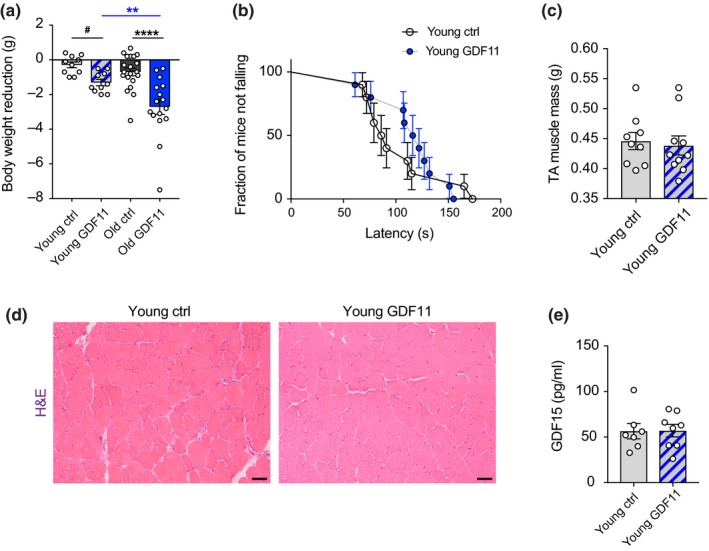
Young mice perform better and exhibit a moderate GDF15‐independent body weight reduction after systemic GDF11 treatment. (a) Graphic representation of body weight reduction after 8 days of daily systemic GDF11 or saline administration in young and aged mice (n Y = 10, n O = 20 mice per group). (b) Evaluation of young mice for their locomotor and coordination performance using the rotarod test. The survival curve represents the fraction of mice not falling from the rotarod over the latency to first fall. The data represent the best out of three trials for each mouse. (medianyoung‐ctrl = 55, medianyoung‐GDF11 = 60; calculated using the Wilcoxon rank test). (c) Measurement of tibialis anterior muscle mass (n Y = 9, n YGDF11 = 10 mice per group). (d) Histological analysis of tibialis anterior muscle sections by H&E staining. Scale bar: 50 μm. (e) ELISA measurements of circulating GDF15 in the plasma of saline or GDF11‐treated young mice (n Y = 7, n YGDF11 = 8 mice per group). One‐way and two‐way ANOVA and Tukey's post hoc test for multiple group comparisons; Mann–Whitney test for two‐group comparisons; **p < .01; ****p < .0001; #: t‐test between young ctrl and young GDF11 mice with p = .0007; mean ± SEM
Figure 4
Figure 4
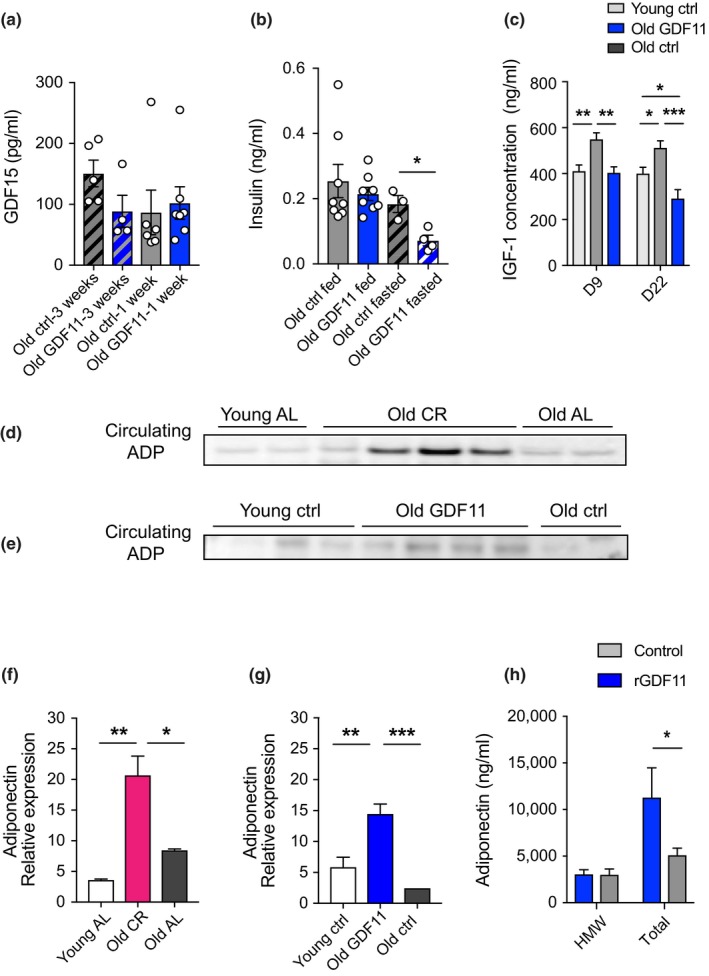
GDF11 treatment in aged mice induces hormonal changes similar to CR. (a) ELISA measurements of circulating GDF15 in the plasma of aged mice treated with either saline or GDF11 for 1 or 3 weeks (n O‐3weeks = 5, n GDF11‐3weeks = 4, n O‐1week = 6, n GDF11‐1week = 6 mice per group). (b) ELISA measurements of insulin in the plasma of fed or 6 hr‐fasted aged mice treated with either saline or GDF11 (n O‐fed = 8, n GDF11‐fed = 8, n O‐fasted = 3, n GDF11‐fasted = 4 mice per group). (C) ELISA measurement of circulating IGF‐1 in the plasma of young, old, and GDF11‐treated old mice (n = 5 mice per group). (d‐e) Representative Western blot images of equal volumes of serum from (d) young AL, old CR, and old AL and (e) young ctrl, old GDF11‐treated old ctrl, both probed with anti‐adiponectin antibody. (f) Quantification of (d) by optical density. (g) Quantification of (e) by optical density. (f) ELISA measurement of HMW or total adiponectin in the plasma of aged saline or 1‐week GDF11‐treated old mice (n = 4 mice per group). One‐way and two‐way ANOVA and Tukey's post hoc test for multiple group comparisons; Mann–Whitney test for two‐group comparisons; *p < .05, **p < .01; ***p < .001; mean ± SEM
Figure 5
Figure 5
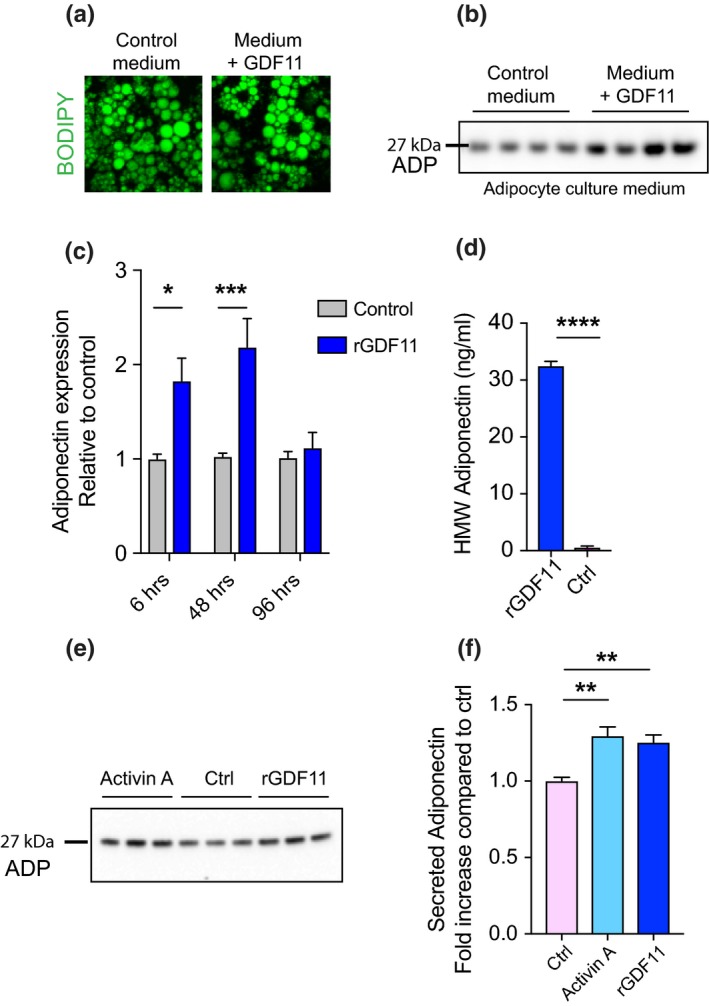
GDF11 stimulates adiponectin release in mature adipocyte cultures. (a) BODIPY staining of lipid droplets in mature adipocytes in vitro treated with rGDF11 or control medium. (b) Representative Western blot images of equal volumes of adipocyte culture medium after 6 hr of 20 ng/ml rGDF11 or no treatment probed with anti‐adiponectin antibody. (c) Quantification by Western blot of adiponectin release in adipocyte culture medium after 6, 48, and 96 hr of rGDF11 or no treatment (n = 4 conditioned medium samples per group). (d) ELISA measurement of HMW adiponectin in adipocyte conditioned medium after 6 hr of rGDF11 or no treatment (n = 3 conditioned medium samples per group). (e) Representative Western blot images of equal volumes of adipocyte culture medium after 6 hr of 20 ng/ml rGDF11, 20 ng/ml activin A or no treatment, probed with anti‐adiponectin antibody. (f) Quantification by Western blot of (E) (n = 6 conditioned medium samples per group). One‐way and two‐way ANOVA with Tukey's post hoc test for multiple group comparisons; Mann–Whitney test for two‐group comparisons; *p < .05, **p < .01, *** p < .001; ****p < .0001; mean ± SEM

References

    1. Anderson, R. M. , Shanmuganayagam, D. , & Weindruch, R. (2009). Caloric restriction and aging: Studies in mice and monkeys. Toxicologic Pathology, 37, 47–51. 10.1177/0192623308329476 - DOI - PMC - PubMed
    1. Anqi, X. , Ruiqi, C. , Yanming, R. , & Chao, Y. (2019). Neuroprotective potential of GDF11 in experimental intracerebral hemorrhage in elderly rats. Journal of Clinical Neuroscience, 63, 182–188. 10.1016/j.jocn.2019.02.016 - DOI - PubMed
    1. Berryman, D. E. , List, E. O. , Coschigano, K. T. , Behar, K. , Kim, J. K. , & Kopchick, J. J. (2004). Comparing adiposity profiles in three mouse models with altered GH signaling. Growth Hormone and IGF Research, 14, 309–318. 10.1016/j.ghir.2004.02.005 - DOI - PubMed
    1. Berryman, D. E. , List, E. O. , Palmer, A. J. , Chung, M. Y. , Wright‐Piekarski, J. , Lubbers, E. , … Kopchick, J. J. (2010). Two‐year body composition analyses of long‐lived GHR null mice. Journals of Gerontology Series A: Biological Sciences and Medical Sciences, 65, 31–40. 10.1093/gerona/glp175 - DOI - PMC - PubMed
    1. Bonkowski, M. S. , Rocha, J. S. , Masternak, M. M. , Al Regaiey, K. A. , & Bartke, A. (2006). Targeted disruption of growth hormone receptor interferes with the beneficial actions of calorie restriction. Proceedings of the National Academy of Sciences of the United States of America, 103, 7901–7905. 10.1073/pnas.0600161103 - DOI - PMC - PubMed

Publication types

MeSH terms

LinkOut - more resources