


Global patterns and trends in ovarian cancer incidence: age, period and birth cohort analysis
- PMID: 31640608
- PMCID: PMC6806513
- DOI: 10.1186/s12885-019-6139-6
Global patterns and trends in ovarian cancer incidence: age, period and birth cohort analysis
Abstract
Background: Ovarian cancer (OC) is the seventh most common malignancy worldwide and the most lethal gynaecological malignancy. We aimed to explore global geographical patterns and temporal trends from 1973 to 2015 for 41 countries in OC incidence and especially to analyse the birth cohort effect to gain further insight into the underlying causal factors of OC and identify countries with increasing risk of OC.
Methods: OC data were drawn from the Cancer Incidence in Five Continents databases and online databases published by governments. The joinpoint regression model was applied to detect changes in OC trends. The age-period-cohort model was applied to explore age and birth cohort effects.
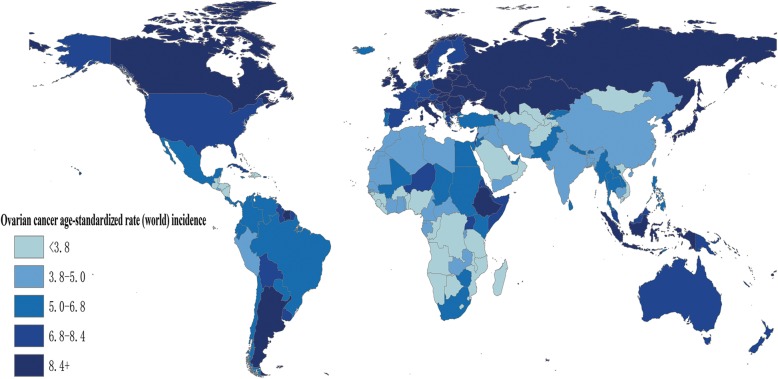
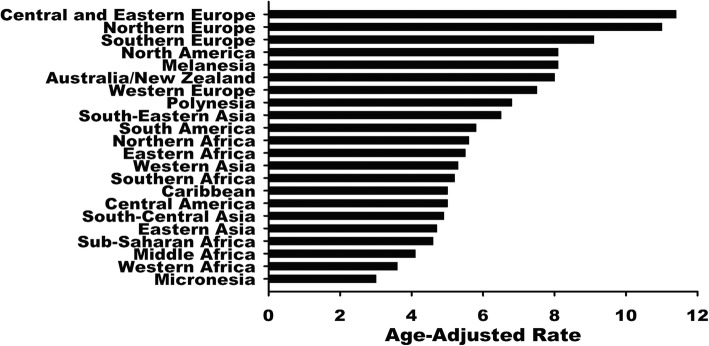
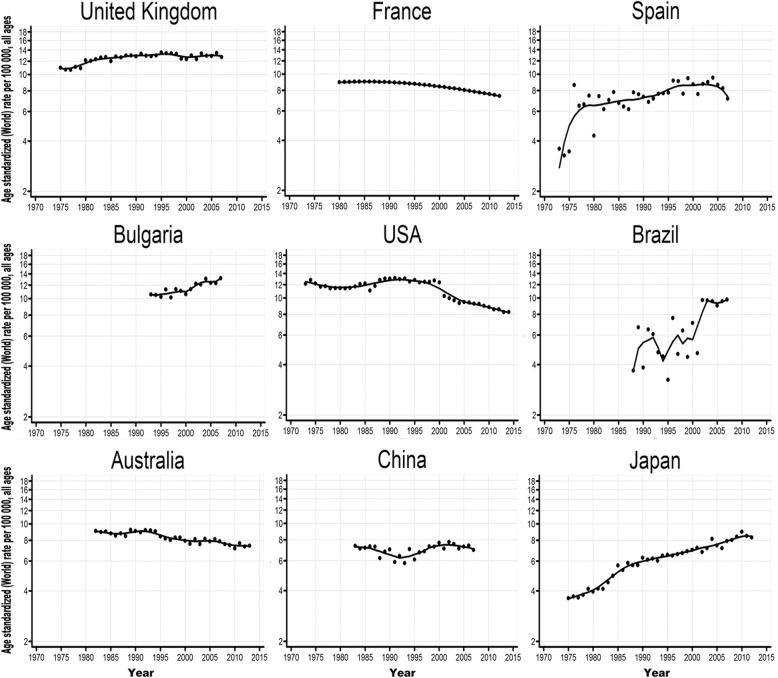
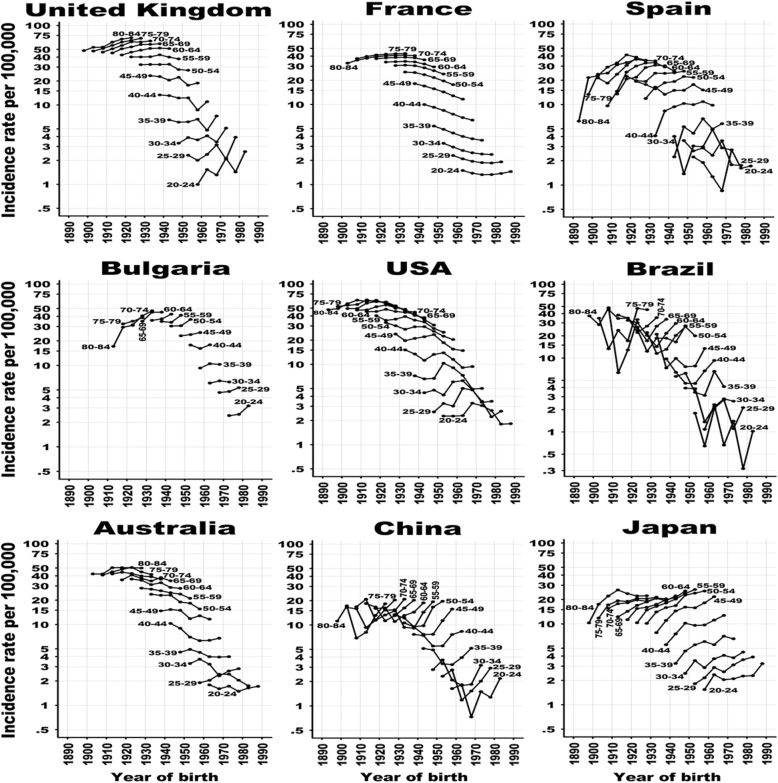
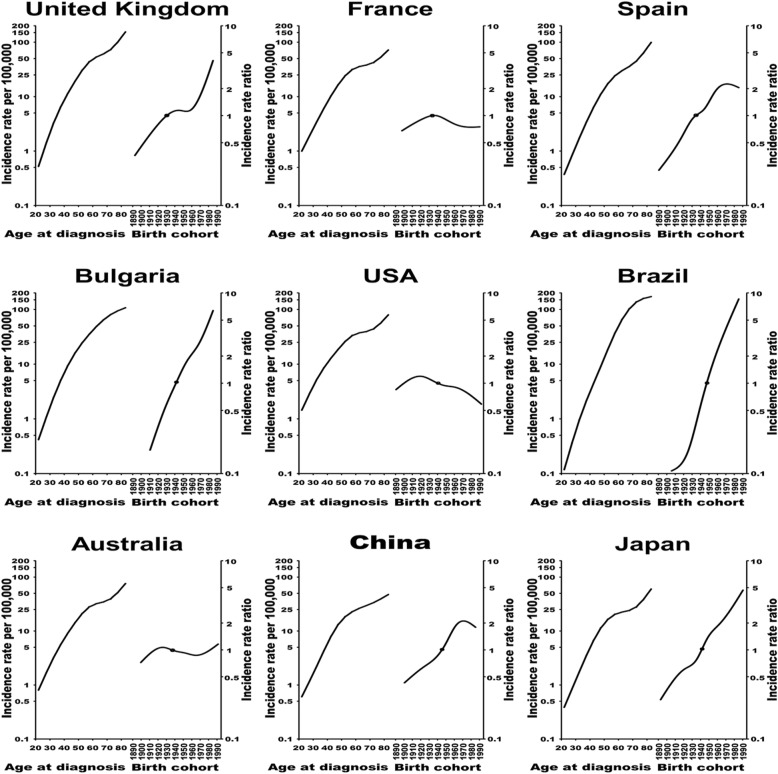
Results: The age-standardized rate of OC incidence ranged from 3.0 to 11.4 per 100,000 women worldwide in 2012. The highest age-standardized rate was observed in Central and Eastern Europe, with 11.4 per 100,000 women in 2012. For the most recent 10-year period, the increasing trends were mainly observed in Central and South America, Asia and Central and Eastern Europe. The largest significant increase was observed in Brazil, with an average annual percentage change of 4.4%. For recent birth cohorts, cohort-specific increases in risk were pronounced in Estonia, Finland, Iceland, Lithuania, the United Kingdom, Germany, the Netherlands, Italy, Malta, Slovenia, Bulgaria, Russia, Australia, New Zealand, Brazil, Costa Rica, Ecuador, India, Japan, the Philippines and Thailand.
Conclusions: Disparities in the incidence and risk of OC persist worldwide. The increased risk of birth cohort in OC incidence was observed for most countries in Asia, Central and Eastern Europe, and Central and South America. The reason for the increasing OC risk for recent birth cohorts in these countries should be investigated with further epidemiology studies.
Keywords: Birth cohort; Global variations; Incidence; Ovarian cancer; Trends.
Conflict of interest statement
The authors declare that they have no competing interests.
Figures
References
-
- Torre LA, Bray F, Siegel RL, Ferlay J, Lortet-Tieulent J, Jemal A. Global cancer statistics, 2012. CA Cancer J Clin. 2015;65(2):87–108. - PubMed
-
- Jayson GC, Kohn EC, Kitchener HC, Ledermann JA. Ovarian cancer. Lancet (London, England) 2014;384(9951):1376–1388. - PubMed
-
- Luo G, Zhang Y, Guo P, Wang L, Huang Y, Li K. Global patterns and trends in stomach cancer incidence: age, period and birth cohort analysis. Int J Cancer. 2017;141(7):1333–1344. - PubMed
-
- Erdmann F, Lortet-Tieulent J, Schuz J, Zeeb H, Greinert R, Breitbart EW, Bray F. International trends in the incidence of malignant melanoma 1953-2008--are recent generations at higher or lower risk? Int J Cancer. 2013;132(2):385–400. - PubMed
MeSH terms
Substances
Grants and funding
LinkOut - more resources
Full Text Sources
Medical
