


A high-precision, geometric and registration accuracy full-system test method for adaptive SRS, demonstrated on Gamma Knife® Icon™
- PMID: 31641548
- PMCID: PMC6774497
A high-precision, geometric and registration accuracy full-system test method for adaptive SRS, demonstrated on Gamma Knife® Icon™
Abstract
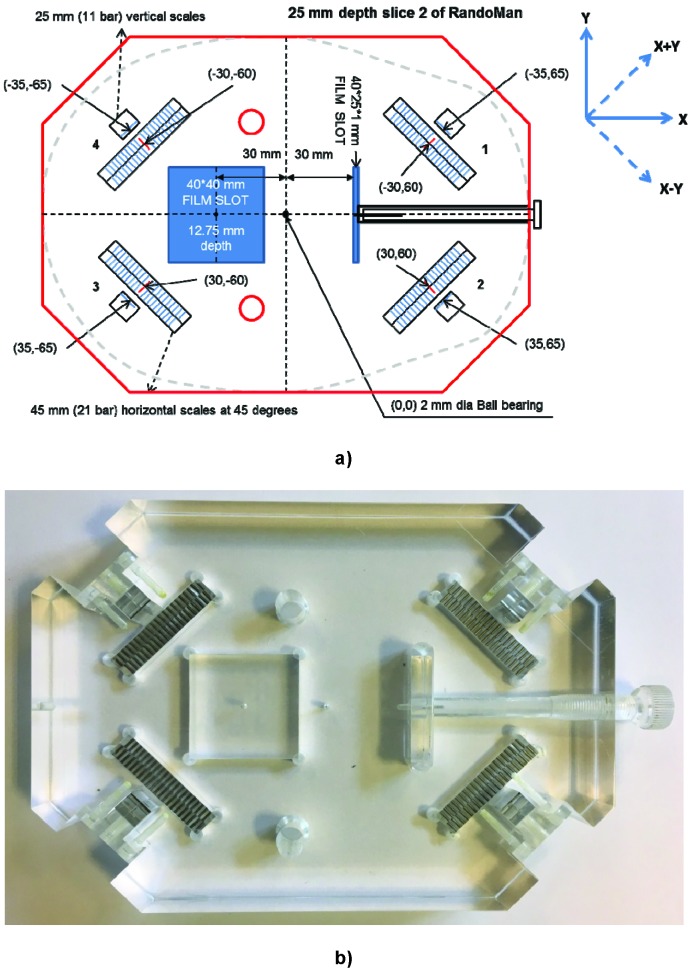
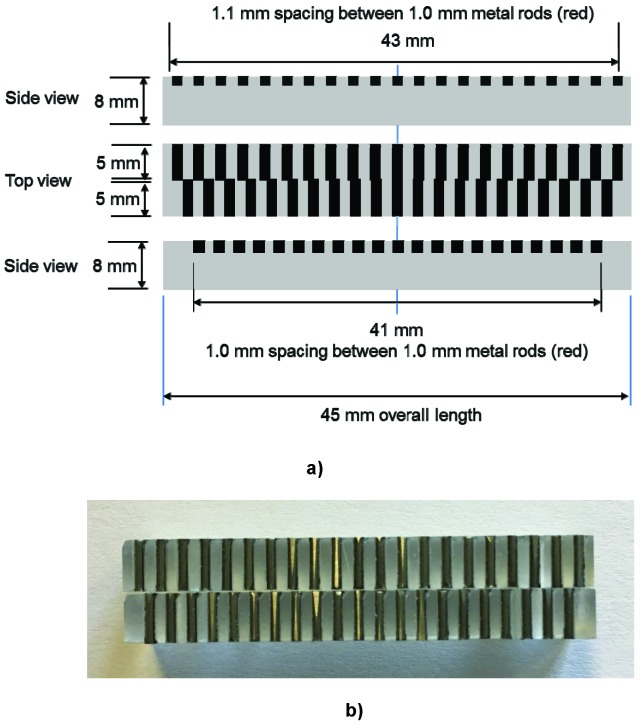
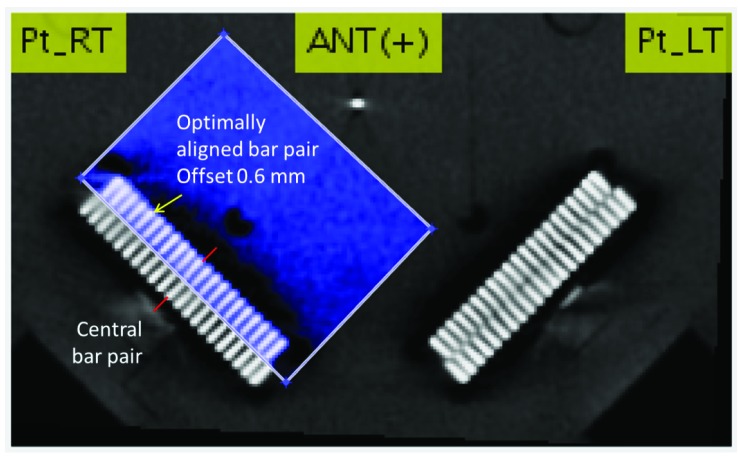
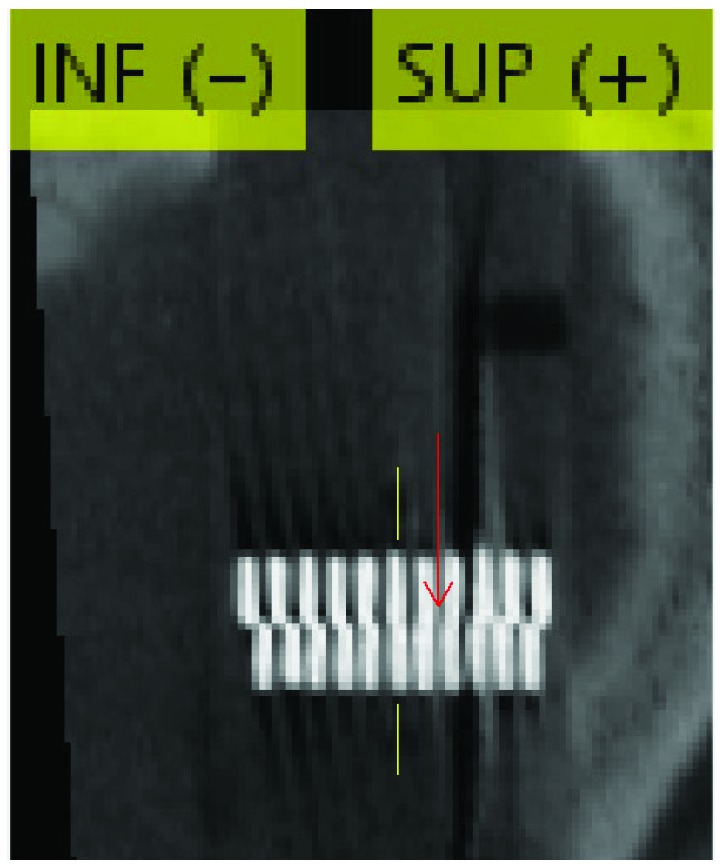
A novel full-system test (FST) phantom and method have been developed to demonstrate and quality assure the geometric accuracy of image co-registration and overall shot delivery in the context of SRS using Gamma Knife® Icon™. The method uses Vernier scale bars to achieve sub-voxel precision co-registration measurements and pin-located radiochromic films to determine overall shot delivery precision. Validation tests demonstrated that artificially applied registration errors of < 0.15 mm could be accurately detected and quantified. Cross-validation of full-system test results with the manufacturer standard focal precision test demonstrated that both approaches measure similar focal precision errors, to within < 0.1 mm, and that registration and focal precision components of the full-system geometric error can be successfully decoupled using our Vernier FST approach. CBCT co-registration errors were shown to be of comparable magnitude to the focal precision errors, demonstrating that CBCT registration based in-mask treatments can achieve sub-voxel geometric accuracy, rivalling traditional frame-based immobilisation. This full-system geometric test method and phantom design concept is in principle applicable to any SRS technique involving image co-registration.
Keywords: Gamma Knife; Icon; co-registration; cone beam CT; full-system test.
© 2019 Old City Publishing, Inc.
Conflict of interest statement
Authors’ disclosure of potential conflicts of interest Gavin Wright reports attendance at user group meetings of early Icon adopters and meetings organized and hosted by Elekta, and providing consultation services to Elekta for which his department has received a fee. All other authors have nothing to disclose.
Figures
References
-
- Studholme C., Hill D., Hawkes D. An overlap invariant entropy measure of 3D medical image alignment. Pattern Recognit. 1999;32(1):71–86
-
- Schönemann PH. A generalized solution of the orthogonal procrustes problem. Psychometrika. 1966;31(1):1-10. doi:10.1007/BF02289451 - DOI
LinkOut - more resources
Full Text Sources
Miscellaneous