. 2019 Oct 2;2(10):e1913804.
doi: 10.1001/jamanetworkopen.2019.13804.

Association of Flavored Tobacco Use With Tobacco Initiation and Subsequent Use Among US Youth and Adults, 2013-2015

Affiliations

Association of Flavored Tobacco Use With Tobacco Initiation and Subsequent Use Among US Youth and Adults, 2013-2015

Andrea C Villanti et al. JAMA Netw Open. .

Abstract

Importance: Flavors in tobacco products may appeal to young and inexperienced users.

Objective: To examine among youth (aged 12-17 years), young adults (aged 18-24 years), and adults (aged ≥25 years) the prevalence of first use of flavored tobacco products among new tobacco users and the association between first flavored use of a given tobacco product and tobacco use 1 year later, including progression of tobacco use.

Design, setting, and participants: This cohort study represents a longitudinal analysis of data from the Population Assessment of Tobacco and Health (PATH) Study, a nationally representative study with data collected in 2013 to 2014 (wave 1) and 2014 to 2015 (wave 2). Participants were noninstitutionalized individuals, including 11 996 youth and 26 447 adults, in selected households who participated in both waves of the PATH Study. Data analysis was conducted from July 2016 to June 2019.

Main outcomes and measures: Prevalence of tobacco product use at wave 2.

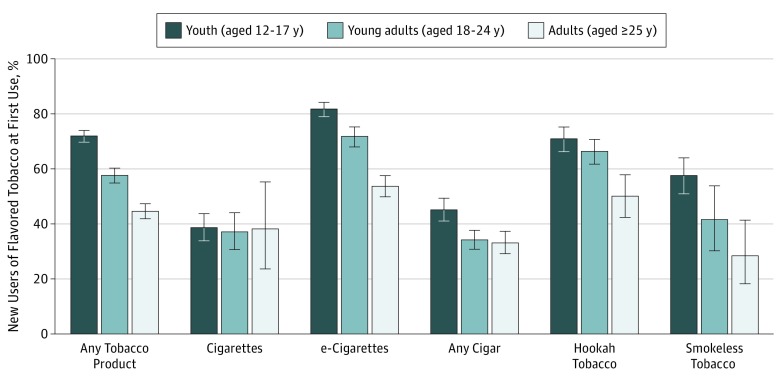
Results: The mean (SE) age of the participants was 14.5 (0.0) years for youth, 21.1 (0.0) years for young adults, and 50.3 (0.0) for adults. Most youth (71.9%; 95% CI, 69.7%-74.0%) and young adults (57.6%; 95% CI, 54.9%-60.3%) who were new users of tobacco products over the 10- to 13-month follow-up period used flavored products. First use of a menthol or mint or other flavored cigarette documented at wave 1 was positively associated with past 12-month and past 30-day cigarette use in all age groups at wave 2 compared with first use of a nonflavored cigarette (youth, flavored cigarette, past 12-month use adjusted prevalence ratio [aPR], 1.14 [95% CI, 1.05-1.25] and past 30-day use aPR, 1.15 [95% CI, 1.00-1.31]; youth, menthol or mint cigarette, past 12-month use aPR, 1.18 [95% CI, 1.08-1.29] and past 30-day use aPR, 1.19 [95% CI, 1.04-1.37]; young adult, flavored cigarette, past 12-month use aPR, 1.09 [95% CI, 1.04-1.15] and past 30-day use aPR, 1.13 [95% CI, 1.06-1.21]; young adult menthol or mint cigarette, past 12-month use aPR, 1.10 [95% CI, 1.05-1.16] and past 30-day use aPR, 1.15 [95% CI, 1.07-1.23]; adult flavored cigarette, past 12-month use aPR, 1.10 [95% CI, 1.05-1.15] and past 30-day use aPR, 1.09 [95% CI, 1.04-1.14]; adult menthol or mint cigarette, past 12-month use aPR, 1.13 [95% CI, 1.08-1.18] and past 30-day use aPR, 1.12 [95% CI, 1.07-1.17]). Among young adults, first use of flavored e-cigarettes (aPR, 2.05; 95% CI, 1.61-2.61), any cigars (aPR, 1.60; 95% CI, 1.26-2.02), cigarillos (aPR, 1.49; 95% CI, 1.08-2.05), filtered cigars (aPR, 3.69; 95% CI, 2.08-6.57), hookah (aPR, 1.91; 95% CI, 1.23-2.98), and any smokeless tobacco (aPR, 1.54; 95% CI, 1.08-2.20) was prospectively associated with current regular use of those products at wave 2 compared with first nonflavored use. Among adults aged 25 years and older, first use of flavored e-cigarettes (aPR, 1.60; 95% CI, 1.41-1.82), any cigars (aPR, 1.56; 95% CI, 1.29-1.87), cigarillos (aPR, 1.29; 95% CI, 1.01-1.64), filtered cigars (aPR, 1.79; 95% CI, 1.25-2.54), hookah (aPR, 5.66; 95% CI, 2.04-15.71), and any smokeless tobacco (aPR, 1.55; 95% CI, 1.32-1.82) was prospectively associated with current regular use of those products at wave 2 compared with first nonflavored use.

Conclusions and relevance: In this longitudinal cohort study, flavors in tobacco products were associated with youth and young adult tobacco experimentation. First use of a flavored tobacco product may place youth, young adults, and adults at risk of subsequent tobacco use.


Conflict of interest statement

Conflict of Interest Disclosures: Ms Johnson reported receiving grants and personal fees from Westat and the Population Assessment of Tobacco and Health Study during the conduct of the study. Dr Cummings reported receiving grant funding from Pfizer, Inc, to study the impact of a hospital-based tobacco cessation intervention and reported receiving funding as an expert witness in litigation filed against the tobacco industry. Dr Delnevo reported receiving grants from Rutgers Center for Tobacco Studies during the conduct of the study outside the submitted work. Dr Wackowski reported receiving grants from the National Institutes of Health and the US Food and Drug Administration Center for Tobacco Products outside the submitted work. This article was prepared while Dr Conway was employed at the National Institute on Drug Abuse, National Institutes of Health, Bethesda, MD. No other disclosures were reported.

Figures

Figure.
Figure.. Weighted Proportions of New Tobacco Users at Wave 2 Who Reported Using a Flavored Product at First Use
Percentages are weighted to represent the US population, and 95% CIs (whiskers) are estimated using the balanced repeated replication method. New use is ascribed to the participants’ age at wave 1. Respondents were categorized into age groups (youth aged 12-17 years, young adults aged 18-24 years, and adults aged ≥25 years) according to their ages at wave 1. New use of a tobacco product is defined as starting to use a product between waves 1 and 2. This can include never users at wave 1 who start tobacco use at wave 2 and ever users at wave 1 who report use of a new product or products at wave 2. Individuals who reported “don’t know” or refused to answer any part of the definition of ever use or first flavored use were excluded from the denominator. Unweighted numbers and unweighted percentages are presented for each age group: Among 11 996 youth, 2136 (17.8%) reported new use of a tobacco product, 9622 (80.2%) reported no new initiation, and 238 (2.0%) did not provide information on initiation between wave 1 and wave 2. Among 7325 young adults, 2058 (24.9%) reported new use of a tobacco product, 5232 (74.7%) reported no new initiation, and 35 (0.4%) did not provide information on initiation between wave 1 and wave 2. Among 19 116 adults aged 25 years and older, 2580 (8.1%) reported new use of a tobacco product, 16 407 (91.4%) reported no new initiation, and 129 (0.5%) did not provide information on initiation between wave 1 and wave 2. First flavored use is defined as reporting that the first product used was “flavored to taste like menthol, mint, clove, spice, candy, fruit, chocolate, alcohol (such as wine or cognac), or other sweets.” Individuals who did not report “yes,” “no,” or “I don’t know” or refused to answer whether their first product was flavored were excluded from the denominator. Flavored pipe tobacco and dissolvable tobacco use was not assessed among youth. Unweighted numbers and unweighted percentages are presented for each age group. For 2136 youth new tobacco users, 95 (4.5%) did not report whether they had used any flavored product between wave 1 and wave 2. For 2058 young adult new tobacco users, 58 (2.8%) did not report whether they had used any flavored product between wave 1 and wave 2. For 2580 adult (aged ≥25 years) new tobacco users, 58 (2.3%) did not report whether they had used any flavored product between wave 1 and wave 2. Any tobacco product included cigarettes, e-cigarettes, traditional cigars, cigarillos, filtered cigars, hookah, pipe (for adults only), smokeless tobacco, and snus or dissolvable tobacco (for adults only); any cigar use reflects use of a traditional cigar, cigarillo, or filtered cigar. Data are from the Population Assessment of Tobacco and Health (PATH) Study,,, waves 1 and 2.

References

    1. Hoffman AC, Salgado RV, Dresler C, Faller RW, Bartlett C. Flavour preferences in youth versus adults: a review. Tob Control. 2016;25(2)(suppl):-. doi:10.1136/tobaccocontrol-2016-053192 - DOI - PMC - PubMed
    1. Kostygina G, Glantz SA, Ling PM. Tobacco industry use of flavours to recruit new users of little cigars and cigarillos. Tob Control. 2016;25(1):66-74. - PMC - PubMed
    1. Kostygina G, Ling PM. Tobacco industry use of flavourings to promote smokeless tobacco products. Tob Control. 2016;25(2)(suppl):ii40-ii49. doi:10.1136/tobaccocontrol-2016-053212 - DOI - PMC - PubMed
    1. Anderson SJ. Marketing of menthol cigarettes and consumer perceptions: a review of tobacco industry documents. Tob Control. 2011;20(2)(suppl):ii20-ii28. - PMC - PubMed
    1. Donati J. Conference report #23: RJ Reynolds Tobacco. https://www.industrydocuments.ucsf.edu/docs/jfcb0102. Published June 5, 1974. Accessed September 21, 2019.

Publication types

Substances