


Efficacy of a Texting Program to Promote Cessation Among Pregnant Smokers: A Randomized Control Trial
- PMID: 31647564
- PMCID: PMC7291805
- DOI: 10.1093/ntr/ntz174
Efficacy of a Texting Program to Promote Cessation Among Pregnant Smokers: A Randomized Control Trial
Abstract
Introduction: Smoking during pregnancy poses serious risks to baby and mother. Few disseminable programs exist to help pregnant women quit or reduce their smoking. We hypothesized that an SMS text-delivered scheduled gradual reduction (SGR) program plus support texts would outperform SMS support messages alone.
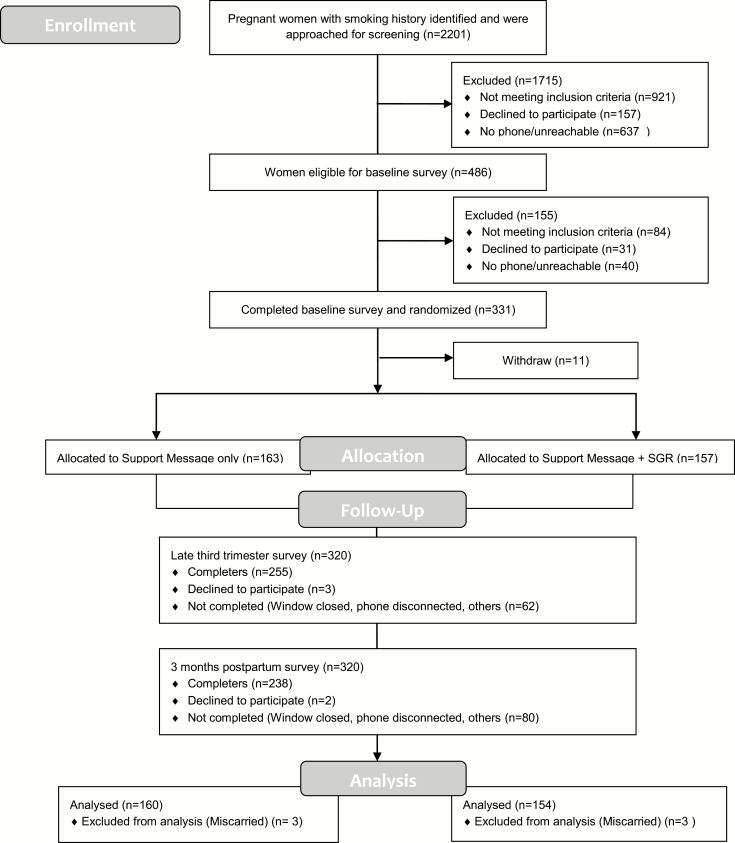
Methods: We recruited 314 pregnant women from 14 prenatal clinics. Half of the women received theory-based support messages throughout their pregnancy to promote cessation and prevent relapse. The other half received the support messages plus alert texts that gradually reduced their smoking more than 3-5 weeks. We conducted surveys at baseline, end of pregnancy, and 3 months postpartum. Our primary outcome was biochemically validated 7-day point prevalence abstinence at late pregnancy. Our secondary outcome was reduction in cigarettes per day.
Results: Adherence to the SGR was adequate with 70% responding to alert texts to smoke within 60 minutes. Women in both arms quit smoking at the same rate (9%-12%). Women also significantly reduced their smoking from baseline to the end of pregnancy from nine cigarettes to four; we found no arm differences in reduction.
Conclusions: Support text messages alone produced significant quit rates above naturally occurring quitting. SGR did not add significantly to helping women quit or reduce. Sending support messages can reach many women and is low-cost. More obstetric providers might consider having patients who smoke sign up for free texting programs to help them quit.
Implications: A disseminable texting program helped some pregnant women quit smoking.Clinical Trial Registration number: NCT01995097.
© The Author(s) 2019. Published by Oxford University Press on behalf of the Society for Research on Nicotine and Tobacco. All rights reserved. For permissions, please e-mail: journals.permissions@oup.com.
Figures
References
-
- Goldenberg RL, Davis RO, Cliver SP, et al. . Maternal risk factors and their influence on fetal anthropometric measurements. Am J Obstet Gynecol. 1993;168(4):1197–1203; discussion 1203. - PubMed
-
- Chapin J, Root W; American College of Obstetricians and Gynecologists Improving obstetrician-gynecologist implementation of smoking cessation guidelines for pregnant women: an interim report of the American College of Obstetricians and Gynecologists. Nicotine Tob Res. 2004;6(suppl 2):S253–S257. - PubMed
-
- Castles A, Adams EK, Melvin CL, Kelsch C, Boulton ML. Effects of smoking during pregnancy. Five meta-analyses. Am J Prev Med. 1999;16(3):208–215. - PubMed
-
- Salihu HM, Aliyu MH, Pierre-Louis BJ, Alexander GR. Levels of excess infant deaths attributable to maternal smoking during pregnancy in the United States. Matern Child Health J. 2003;7(4):219–227. - PubMed
-
- Centers for Disease Control and Prevention. Smoking during pregnancy—United States, 1990–2002. MMWR Morb Mortal Wkly Rep. 2004;53(39):911–915. - PubMed
Publication types
MeSH terms
Associated data
Grants and funding
LinkOut - more resources
Full Text Sources
Medical
