doi: 10.1136/bmj.l5770.
Is Mycobacterium tuberculosis infection life long?
Affiliations
- PMID: 31649096
- PMCID: PMC6812595
- DOI: 10.1136/bmj.l5770
Item in Clipboard
Is Mycobacterium tuberculosis infection life long?
BMJ.
.
Abstract
People with immunoreactivity to tuberculosis are thought to have lifelong asymptomatic infection and remain at risk for active tuberculosis. Marcel A Behr and colleagues argue that most of these people are no longer infected
Conflict of interest statement
Competing interests: We have read and understood BMJ policy on conflicts of interests and have none to declare.
Figures
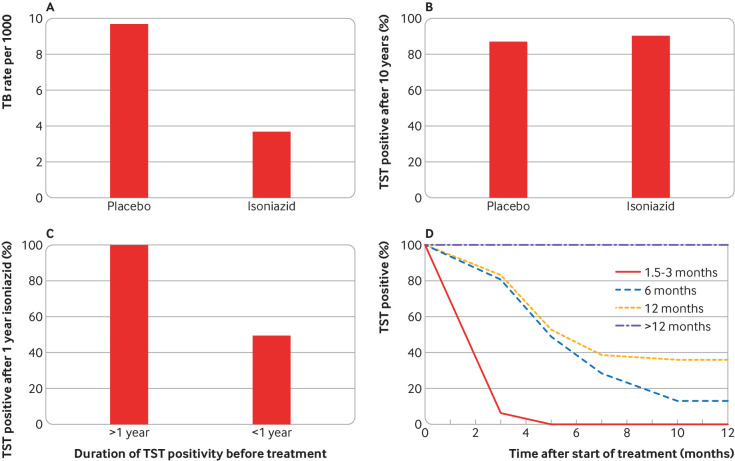
TB immunoreactivity reversion over time. A) Efficacy of one year of isoniazid prophylaxis (n=9382) versus placebo (n=9140) over a 10 year observation period, including the year of treatment, for residents of US mental institutions. Isoniazid treatment reduced TB disease by 62% over the observation period. B) TB immunoreactivity over a 10 year observation period for residents of Milledgeville mental institution participating in a placebo controlled (n=697) trial of isoniazid treatment (n=686) to prevent TB infection, all of whom were TB immunoreactive at enrolment. C) TB immunoreactivity for University of Virginia Hospital workers with known duration of TST positivity (<1 year (n=20) and >1 year (n=17)) before isoniazid treatment for one year. D) TB immunoreactivity for US navy sailors with known duration of TST positivity (1.5-3 months (n=45), 6 months (n=98), 12 months (n=36), and >12 months (n=24)) before isoniazid treatment for one year. TST=tuberculin skin test.
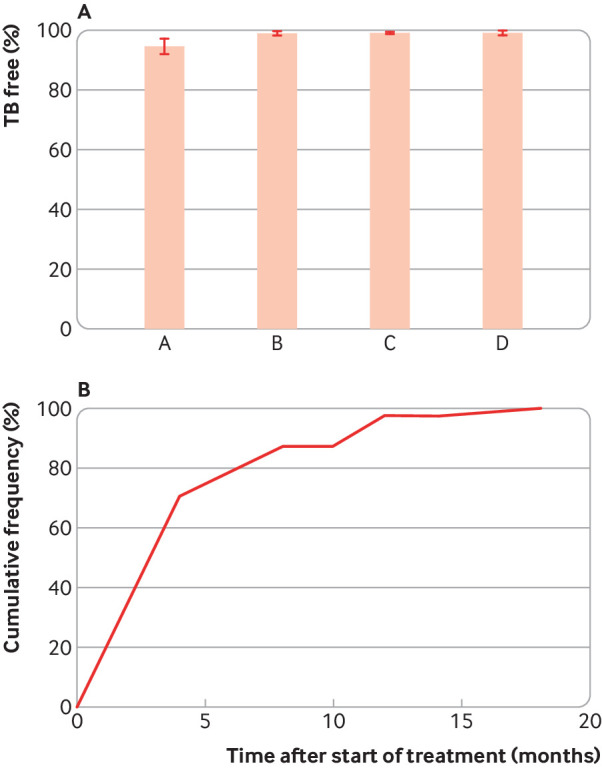
Percentage of likely or known TB immunoreactive patients who developed TB after infliximab treatment and the kinetics of TB development in these patients. A) Percentage of patients receiving infliximab who were free of TB after infliximab treatment, where columns A, B, C, and D are based on data from Gomez-Reino et al (n=1578), Baldin et al (n=1154), Keane et al (n=2931), and Wolfe et al (n=6460). B) The cumulative frequency of TB development in infliximab treated patients versus the time to develop TB after starting infliximab (n=76) from Keane et al, Gomez-Reino et al, and Wolfe et al.
The median, average, and 75th centile time to develop TB after initiation of infliximab were 3, 4.5, and 5.6 months, respectively. Error bars indicate 95% confidence intervals.
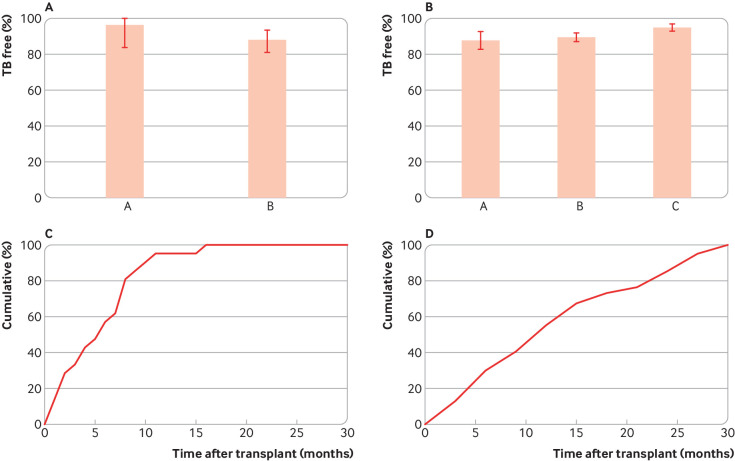
Percentage of patients with likely or known TB immunoreactivity who did not develop TB with immunosuppression caused by HIV/AIDS or solid organ transplantation. A) Patients with HIV/AIDS. Data from Moss et al (A) (n=35) and Horsburgh et al (B) (n=106), which used molecular methods to distinguish disease probably due to remote versus new infection. Only disease due to remote TB infection is shown, in those who had not received full courses of isoniazid preventive therapy. The observation periods were 2-5 years. B) After solid organ transplantation. Columns A, B, and C show data from Atasever et al (n=443), Klote et al (n=15 870), and Torre-Cisneros et al (n=4388). C) Kinetics of TB development after solid organ transplantation (n=21). The median, mean, and 75th centile times were 6.0, 5.8, and 8.0 months after transplant, respectively. D) kinetics of TB development after renal transplantation (n=66). The median, mean, and 75th centile times were 12.0, 13.6 and 21 months after transplant, respectively. Error bars indicate 95% confidence intervals.
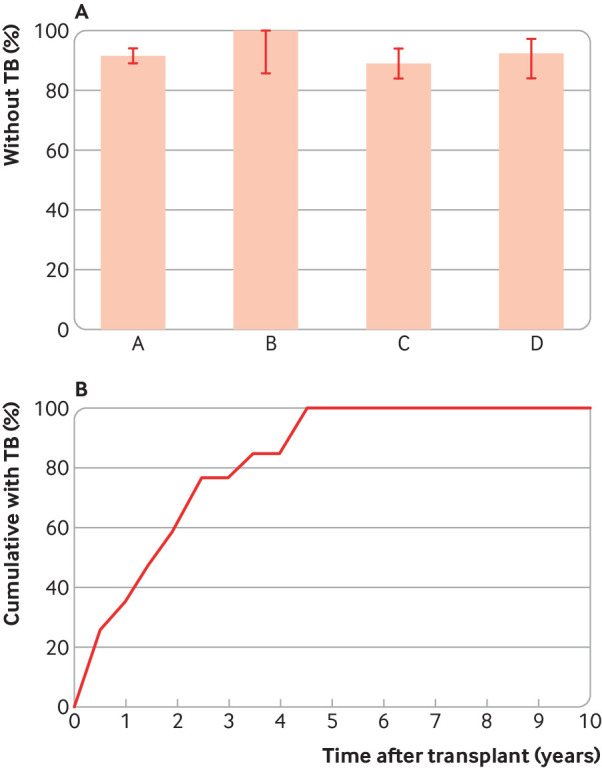
TB in patients undergoing haematopoietic stem cell transplantation. A) Proportion of people with likely TB reactivity who did not develop TB after haematopoietic stem cell transplantation. Columns A, B, C, and D data are taken from Fan et al (n=240), Cheng et al (n=29), Lee et al (n=550), and Agarwal et al (n=175), respectively. B) kinetics of TB development in 39 patients who developed TB over the 10 year observation period. The median, average, and 75th centile incubation times are 1.6, 1.8, and 2.4 years, respectively. Redrawn from Fan et al. Error bars indicate 95% confidence intervals.
Comment in
-
Mycobacterium tuberculosis: concentrate resources on recent infections.BMJ. 2019 Nov 15;367:l6485. doi: 10.1136/bmj.l6485. BMJ. 2019. PMID: 31732487 No abstract available.
References
-
- World Health Organization Global tuberculosis report. World Health Organization, 2018.
-
- World Health Organization Latent tuberculosis infection: updated and consolidated guidelines for programmatic management. World Health Organization, 2018. - PubMed
-
- Ferebee SH. Controlled chemoprophylaxis trials in tuberculosis. A general review. Bibl Tuberc 1970;26:28-106. - PubMed
Publication types
MeSH terms
Substances
Grants and funding
LinkOut - more resources
Full Text Sources