. 2019 Oct 25;366(6464):499-504.
doi: 10.1126/science.aay0678.

Broadly protective human antibodies that target the active site of influenza virus neuraminidase

Affiliations

Broadly protective human antibodies that target the active site of influenza virus neuraminidase

Daniel Stadlbauer et al. Science. .

Abstract

Better vaccines against influenza virus are urgently needed to provide broader protection against diverse strains, subtypes, and types. Such efforts are assisted by the identification of novel broadly neutralizing epitopes targeted by protective antibodies. Influenza vaccine development has largely focused on the hemagglutinin, but the other major surface antigen, the neuraminidase, has reemerged as a potential target for universal vaccines. We describe three human monoclonal antibodies isolated from an H3N2-infected donor that bind with exceptional breadth to multiple different influenza A and B virus neuraminidases. These antibodies neutralize the virus, mediate effector functions, are broadly protective in vivo, and inhibit neuraminidase activity by directly binding to the active site. Structural and functional characterization of these antibodies will inform the development of neuraminidase-based universal vaccines against influenza virus.


Conflict of interest statement

Competing interests: DS, XZ, MM, RN, JST, AJS, PAM, TJW, SS, WY, FK and IAW declare no conflict of interest. A.H.E. is a consultant for Inbios. Washington University has filed a patent application based on the findings reported here with AHE, FK and IAW as inventors.

Figures

Fig. 1.
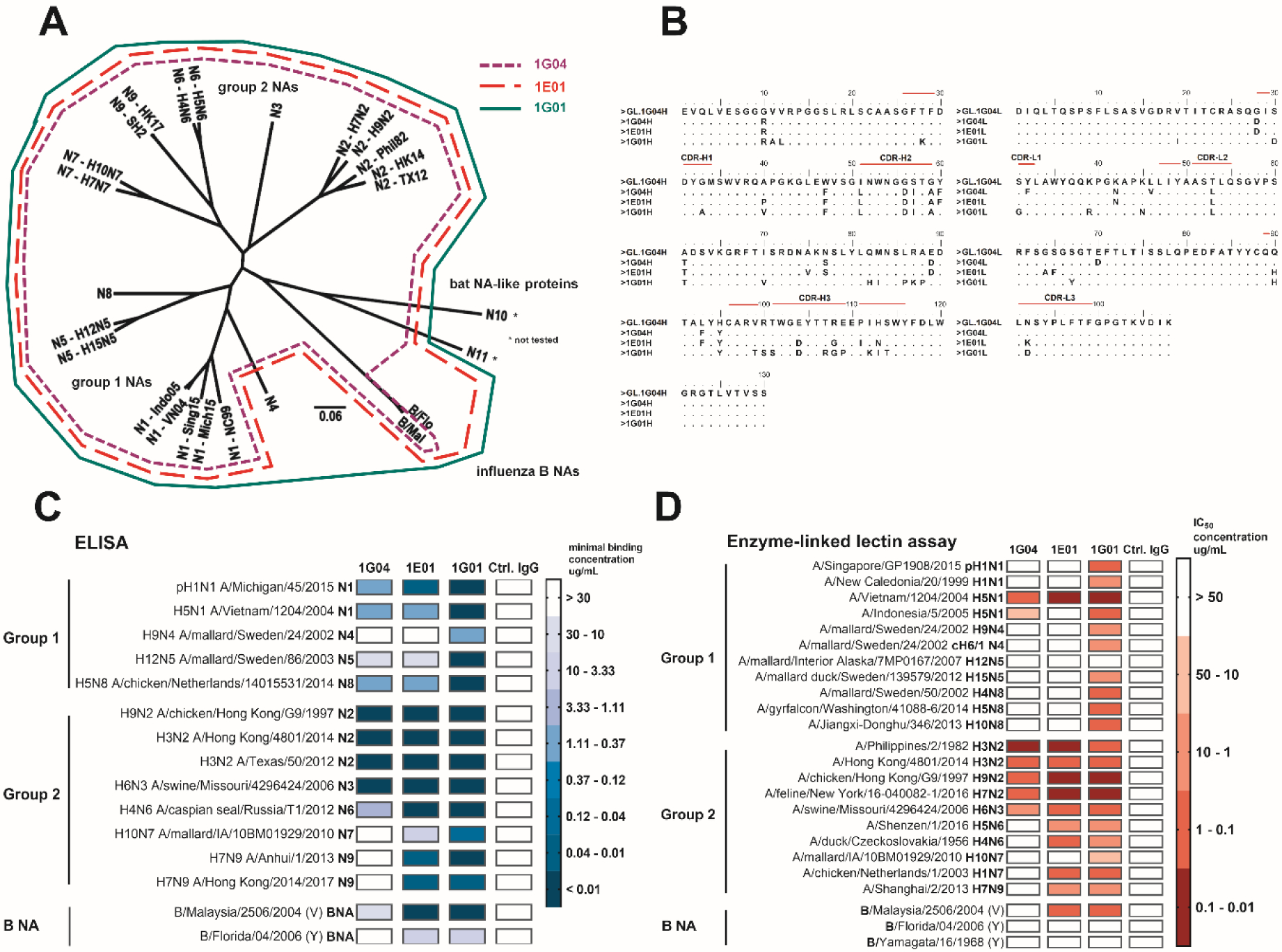
Fig. 1.. Breadth of mAbs 1G04, 1E01 and 1G01.
(A) Phylogenetic tree of influenza A and B virus NAs. The reactivity breadth of the three mAbs is indicated. The scale bar represents a 6% change in amino acids. The tree was built using amino acid sequences in ClustalOmega and visualized in FigTree. (B) Alignment of the amino-acid sequences of each mAb heavy chain (top) and light chain (bottom) to their closest germline immunoglobulin genes as identified by NCBI IgBlast. (C) Heat map of antibody binding to recombinant protein in ELISA. The minimal binding concentration is indicated. (D) Heat map of antibody activity in ELLA NI assays. The IC50 is indicated. For re-assortant strains, virus strain names correspond to the NA of the virus used.
Fig. 2.
Fig. 2.. In vitro functionality of mAbs 1G04, 1E01 and 1G01.
(A) NA representative inhibition curves in an ELLA assay (large substrate, steric hindrance sensitive) against H3N2 strain A/Hong Kong/4801/2014. (B) Activity of the same mAbs against A/Hong Kong/4801/2014 in an NA star assay (small substrate, steric hindrance insensitive). (C) Activity of the Fab of mAb 1G01 in an ELLA assay against A/Hong Kong/4801/2014. (D) A germline (GL) version of 1G04, representing all three antibodies, is also active against H3N2 strain A/Hong Kong/4801/2014. (E) All three mAbs are active in a microneutralization assay against H3N2 strain A/Hong Kong/4801/2014 when antibody is added to the inoculum and overlay. The NA antibodies cannot neutralize the virus when added to the inoculum only, but antibodies prevent viral egress when added to the overlay. The minimal neutralizing concentration is defined as the lowest antibody concentration at which no hemagglutination is detected. (F) ADCC reporter bioassay activity of the three mAbs. MAb CR9114 which has known ADCC reporter activity against H3N2 was used as positive control.
Fig. 3.
Fig. 3.. Crystal structures of 1G04, 1E01 and 1G01 Fabs in complexes with NAs.
(A) Crystal structure of 1G04 with Hunan N9 NA at 3.45 Å resolution. From top to bottom, the NA tetramer with one Fab bound to each protomer of the NA tetramer, the NA protomer with one Fab, the epitope on the NA, and the Fab paratope on the NA. (B) Crystal structure of 1E01 with Japan57 N2 NA at 2.45 Å resolution. From top to bottom, as for A. (C) Crystal structure of 1G01 with CA04 N1 NA at 3.27 Å resolution. From top to bottom, as for A. For all panels, one NA-Fab protomer is colored with NA in light grey and Fab light chain (L-chain) in yellow and Fab heavy chain (H-chain) in orange. The NA and Fab in the other protomers are in dark grey and light grey, respectively. N-linked glycans are shown in stick representation with cyan carbon atoms. Calcium ions are shown as greens spheres. The molecular surface depicting the epitope is colored in green.
Fig. 4.
Fig. 4.. In vivo protection by mAbs 1G04, 1E01 and 1G01.
(A, C-M) The efficacy of the three mAbs in a mouse model against challenge with viruses expressing group 1, group 2 and influenza B virus NAs. Animals were treated with 5 mg/kg of mAbs intraperitoneally 2 hours before intranasal virus challenge. Five animals per group were used. (B) Lung titers of animals treated prophylactically with mAbs (as described for A) on day 3 and day 6 post infection. Three mice per group were used. We also tested therapeutic treatment of 5 mg/kg at 48 (N) and 72 (O) hours post infection. The treatment time points are indicated with errors. Five animals were used per group. For A and C-O, percent weight loss is shown and percent survival is indicated in the respective figure legends. Weight loss was monitored daily except for the 1G01 group in (A) on days 1 and 2 due to technical malfunctioning of a cage. For re-assortant strains, virus strain names correspond to the NA of the virus used.

References

    1. Krammer F, Palese P, Advances in the development of influenza virus vaccines. Nat Rev Drug Discov 14, 167–182 (2015). - PubMed
    1. Erbelding EJ et al., A Universal Influenza Vaccine: The Strategic Plan for the National Institute of Allergy and Infectious Diseases. J Infect Dis 218, 347–354 (2018). - PMC - PubMed
    1. Krammer F, The human antibody response to influenza A virus infection and vaccination. Nat Rev Immunol, (2019). - PubMed
    1. Ekiert DC et al., A highly conserved neutralizing epitope on group 2 influenza A viruses. Science 333, 843–850 (2011). - PMC - PubMed
    1. Ekiert DC et al., Antibody recognition of a highly conserved influenza virus epitope. Science 324, 246–251 (2009). - PMC - PubMed

Publication types

MeSH terms