. 2019 Oct 24;10(11):807.
doi: 10.1038/s41419-019-2043-x.

Exploring specific prognostic biomarkers in triple-negative breast cancer

Affiliations

Exploring specific prognostic biomarkers in triple-negative breast cancer

Chang Bao et al. Cell Death Dis. .

Abstract

Lacking of both prognostic biomarkers and therapeutic targets, triple-negative breast cancer (TNBC) underscores pivotal needs to uncover novel biomarkers and viable therapies. MicroRNAs have broad biological functions in cancers and may serve as ideal biomarkers. In this study, by data mining of the Cancer Genome Atlas database, we screened out 4 differentially-expressed microRNAs (DEmiRNAs) between TNBC and normal samples: miR-135b-5p, miR-9-3p, miR-135b-3p and miR-455-5p. They were specially correlated with the prognosis of TNBC but not non-TNBC. The weighted correlation network analysis (WGCNA) for potential target genes of 3 good prognosis-related DEmiRNAs (miR-135b-5p, miR-9-3p, miR-135b-3p) identified 4 hub genes with highly positive correlation with TNBC subtype: FOXC1, BCL11A, FAM171A1 and RGMA. The targeting relationships between miR-9-3p and FOXC1/FAM171A1, miR-135b-3p and RGMA were validated by dual-luciferase reporter assays. Importantly, the regulatory functions of 4 DEmiRNAs and 3 verified target genes on cell proliferation and migration were explored in TNBC cell lines. In conclusion, we shed lights on these 4 DEmiRNAs (miR-135b-5p, miR-9-3p, miR-135b-3p, miR-455-5p) and 3 hub genes (FOXC1, FAM171A1, RGMA) as specific prognostic biomarkers and promising therapeutic targets for TNBC.


Conflict of interest statement

The authors declare that they have no conflict of interest.

Figures

Fig. 1
Fig. 1. Identification of specific DEmiRNAs related to prognosis of TNBC alone.
a The workflow for identification of DEmiRNAs specifically associated with the prognosis of TNBC. b The volcano plots of DEmiRNAs in TNBC (202 miRNAs) and non-TNBC (136 miRNAs) cohort. The red dots and blue dots respectively represent upregulated (FC > 2) and downregulated (FC < 0.5) DEmiRNAs with statistical significance. c The Kaplan–Meier analysis of 4 candidate DEmiRNAs in TNBC (p < 0.05) and non-TNBC (p > 0.05) cohort
Fig. 2
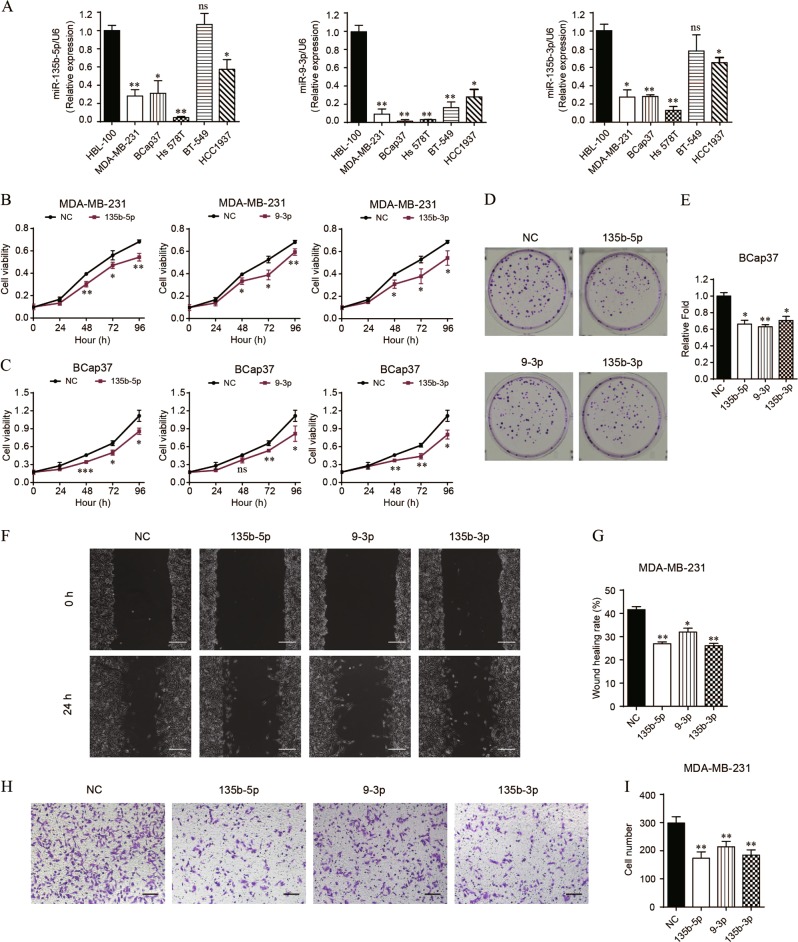
Fig. 2. The proliferation and migration of TNBC cells are suppressed by miR-135b-5p, miR-9-3p and miR-135b-3p.
a The expression levels of miR-135b-5p, miR-9-3p and miR-135b-3p were measured in 5 TNBC cell lines (MDA-MB-231, BCap37, Hs 578 T, BT-549, HCC1937) and a normal breast cell line (HBL-100). b, c The cell growth curves were depicted in MDA-MB-231 and BCap37 cells transfected with mimics of NC (NC), miR-135b-5p (135b-5p), miR-9-3p (9-3p) or miR-135b-3p (135b-3p), respectively. d, e The colony formation assay was performed in BCap37 cells transfected with specific miRNA mimics. f, g 24 h wound healing rates were measured in MDA-MB-231 cells transfected with specific miRNA mimics. Scale bars: 200 μm. h, i The transwell migration assays further confirmed the effects of 3 miRNAs on cell metastasis. Scale bars: 200 μm. Bars indicate the mean ± SD of three independent replicates. *P < 0.05, **P < 0.01, ***P < 0.001
Fig. 3
Fig. 3. The WGCNA for potential target genes of miR-135b-5p, miR-9-3p and miR-135b-3p.
a The predicted target genes of 3 good prognosis-related DEmiRNAs (miR-135b-5p, miR-9-3p, miR-135b-3p) were divided into 7 modules in the cluster dendrogram. b The eigengene of each colored module were calculated and established an adjacency matrix. c The BRCA samples form TCGA database were classified as 5 subtypes: TNBC (n = 115), luminal A (n = 361), luminal B (n = 98), HER2-positive (n = 37) and others (n = 477). The Module-Trait Relationships (MTRs) between module eigengenes (row) and BRCA subtypes (column). The green module highlighted in a red box showed the highest correlation with TNBC subtype. d Correlation analysis between module membership (MM) and gene significance (GS) for each gene in the green module
Fig. 4
Fig. 4. Identification of potential biological roles and hub genes for green module.
a The network of potential targeting between miR-135b-5p/miR9-3p/miR-135b-3p and genes in the green module. b The co-expression network of genes in the green module (edge weight > 0.05). 4 hub genes were highlighted in red
Fig. 5
Fig. 5. MiR-9-3p directly targets FOXC1/FAM171A1, and miR-135b-3p directly targets RGMA.
a, b The dual luciferase assays in MDA-MB-231 cells confirmed that miR-9-3p directly targets FOXC1/FAM171A1, and miR-135b-3p directly targets RGMA. ch The mRNA and protein levels of FOXC1, FAM171A1 and RGMA were measured in MDA-MB-231 with transfection of specific miRNA mimics. i The expression levels of FOXC1, FAM171A1 and RGMA were compared among normal (n = 113), TNBC (n = 115), non-TNBC (n = 973) samples form TCGA database. j The mRNA expressions of FOXC1, FAM171A1 and RGMA were measured in HBL-100 (normal), TNBC (MDA-MB-231, BCap37, Hs 578 T, BT-549, HCC1937) and non-TNBC (MCF-7) cell lines. Bars indicate the mean ± SD of three independent replicates. *P < 0.05, **P < 0.01, ***P < 0.001, ****P < 0.0001
Fig. 6
Fig. 6. Downregulation of FOXC1, FAM171A1 or RGMA inhibits cell proliferation and migration of TNBC cell lines.
a, b The cell growth curves of MDA-MB-231 and BCap37 cells with knockdown of FOXC1, FAM171A1 or RGMA. c, d The colony formation assays of BCap37 cells with downregulation of FOXC1, FAM171A1 or RGMA. e, f The wound healing rates of MDA-MB-231 cells with transfection of specific siRNAs at both 24 h and 48 h measurements. Scale bars: 200 μm. Bars indicate the mean ± SD of three independent replicates. *P < 0.05, **P < 0.01, ***P < 0.001

References

    1. Siegel, R. L. & Miller, K. D. Cancer statistics, 2019. CA Cancer J. Clin. 69, 7–34 (2019). - PubMed
    1. Anastasiadi Z, Lianos GD, Ignatiadou E, Harissis HV, Mitsis M. Breast cancer in young women: an overview. Updates Surg. 2017;69:313–317. doi: 10.1007/s13304-017-0424-1. - DOI - PubMed
    1. Coates AS, et al. Tailoring therapies–improving the management of early breast cancer: St Gallen International Expert Consensus on the Primary Therapy of Early Breast Cancer 2015. Ann. Oncol. 2015;26:1533–1546. doi: 10.1093/annonc/mdv221. - DOI - PMC - PubMed
    1. Polyak K. Breast cancer: origins and evolution. J. Clin. Investig. 2007;117:3155–3163. doi: 10.1172/JCI33295. - DOI - PMC - PubMed
    1. Dent R, et al. Triple-negative breast cancer: clinical features and patterns of recurrence. Clin. Cancer Res. 2007;13:4429–4434. doi: 10.1158/1078-0432.CCR-06-3045. - DOI - PubMed

Publication types

LinkOut - more resources