Meta-Analysis
. 2019 Oct 24;10(1):4857.
doi: 10.1038/s41467-019-12536-4.

Genome-wide association and epidemiological analyses reveal common genetic origins between uterine leiomyomata and endometriosis

Collaborators, Affiliations
Meta-Analysis

Genome-wide association and epidemiological analyses reveal common genetic origins between uterine leiomyomata and endometriosis

C S Gallagher et al. Nat Commun. .

Erratum in

  • Author Correction: Genome-wide association and epidemiological analyses reveal common genetic origins between uterine leiomyomata and endometriosis.
    Gallagher CS, Mäkinen N, Harris HR, Rahmioglu N, Uimari O, Cook JP, Shigesi N, Ferreira T, Velez-Edwards DR, Edwards TL, Mortlock S, Ruhioglu Z, Day F, Becker CM, Karhunen V, Martikainen H, Järvelin MR, Cantor RM, Ridker PM, Terry KL, Buring JE, Gordon SD, Medland SE, Montgomery GW, Nyholt DR, Hinds DA, Tung JY; 23andMe Research Team; Perry JRB, Lind PA, Painter JN, Martin NG, Morris AP, Chasman DI, Missmer SA, Zondervan KT, Morton CC. Gallagher CS, et al. Nat Commun. 2022 Sep 21;13(1):5543. doi: 10.1038/s41467-022-33222-y. Nat Commun. 2022. PMID: 36130970 Free PMC article. No abstract available.

Abstract

Uterine leiomyomata (UL) are the most common neoplasms of the female reproductive tract and primary cause for hysterectomy, leading to considerable morbidity and high economic burden. Here we conduct a GWAS meta-analysis in 35,474 cases and 267,505 female controls of European ancestry, identifying eight novel genome-wide significant (P < 5 × 10⁻⁸) loci, in addition to confirming 21 previously reported loci, including multiple independent signals at 10 loci. Phenotypic stratification of UL by heavy menstrual bleeding in 3409 cases and 199,171 female controls reveals genome-wide significant associations at three of the 29 UL loci: 5p15.33 (TERT), 5q35.2 (FGFR4) and 11q22.3 (ATM). Four loci identified in the meta-analysis are also associated with endometriosis risk; an epidemiological meta-analysis across 402,868 women suggests at least a doubling of risk for UL diagnosis among those with a history of endometriosis. These findings increase our understanding of genetic contribution and biology underlying UL development, and suggest overlapping genetic origins with endometriosis.


Conflict of interest statement

K.T.Z and C.M.B through Oxford University have research collaborations in benign gynecology with Bayer AG, Roche Diagnostics, Volition UK, and M DNA Life Sciences. D.A.H., J.Y.T., and members of the 23andMe Research Team are employees of 23andMe, Inc., and hold stock or stock options in 23andMe. The remaining authors declare no competing interests.

Figures
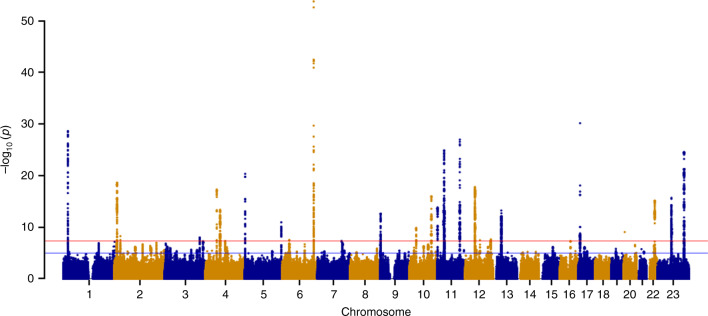
Fig. 1
Fig. 1
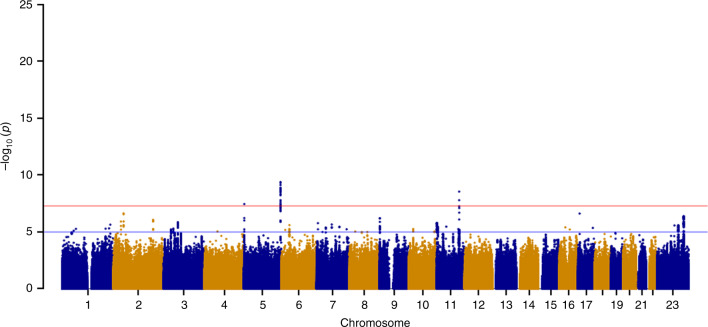
Manhattan plot for UL GWAS meta-analysis across all cohorts. Meta-analysis of GWAS including 302,979 women of white European ancestry across all cohorts identified 29 independent loci associated with UL. Red and blue horizontal lines indicate genome-wide significant (P< 5 × 10−8) and suggestive (P< 1 × 10−5) thresholds, respectively
Fig. 2
Fig. 2
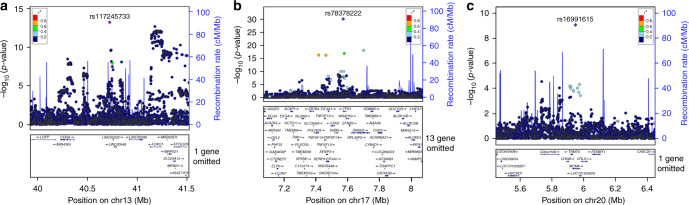
Fine-mapping reveals three association signals with a single driver in 99% credible set. Association with UL is expressed as −log10(P value) for the three signals on chromosomes: (a) 13q14.11, (b) 17p13.1, and (c) 20p12.3. The labeled SNP represents the most significant SNP for each locus. SNP association P-value is shown on the y axis, while SNP position (with gene annotation) appears on the x axis. Each SNP is colored according to the strength of LD with the lead SNP. Regional association plots were produced in LocusZoom
Fig. 3
Fig. 3
Manhattan plot for GWAS on UL limited by heavy menstrual bleeding. GWAS across 202,580 women of white European ancestry identified three independent loci associated with UL limited by heavy menstrual bleeding. Red and blue horizontal lines indicate genome-wide significant (P< 5 × 10−8) and suggestive (P< 1 × 10−5) thresholds, respectively
Fig. 4
Fig. 4
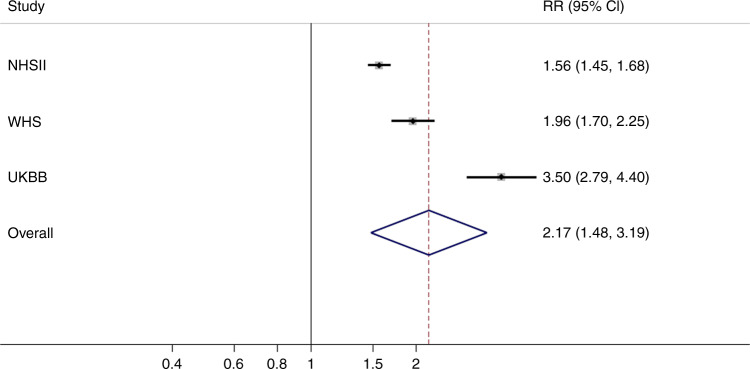
Epidemiologic meta-analysis demonstrates endometriosis is associated with UL. Random-effects, inverse-variance-weighted meta-analysis was performed across the effect sizes and standard errors in 402,868 women from three cohorts (NHSII, WHS, and UKBB). Squares represent point estimates from individual studies, whiskers correspond to the 95% CIs, and the diamond represents results from the meta-analysis. There was evidence of significant heterogeneity based on Cochran’s Q statistic (P< 1 × 10−4)

References

    1. Stewart EA. Clinical practice. Uterine fibroids. N. Engl. J. Med. 2015;372:1646–1655. doi: 10.1056/NEJMcp1411029. - DOI - PubMed
    1. Cramer SF, Patel A. The frequency of uterine leiomyomas. Am. J. Clin. Pathol. 1990;94:435–438. doi: 10.1093/ajcp/94.4.435. - DOI - PubMed
    1. Marino JL, et al. Uterine leiomyoma and menstrual cycle characteristics in a population-based cohort study. Hum. Reprod. 2004;19:2350–2355. doi: 10.1093/humrep/deh407. - DOI - PubMed
    1. Pavone D, Clemenza S, Sorbi F, Fambrini M, Petraglia F. Epidemiology and risk factors of uterine fibroids. Best Pr. Res Clin. Obstet. Gynaecol. 2018;46:3–11. doi: 10.1016/j.bpobgyn.2017.09.004. - DOI - PubMed
    1. Treloar SA, Martin NG, Dennerstein L, Raphael B, Heath AC. Pathways to hysterectomy: Insights from longitudinal twin research. Am. J. Obstet. Gynecol. 1992;167:82–88. doi: 10.1016/S0002-9378(11)91632-9. - DOI - PubMed

Publication types

MeSH terms