Review
. 2020 Mar 25;37(3):425-463.
doi: 10.1039/c9np00051h.

Terpene synthases in disguise: enzymology, structure, and opportunities of non-canonical terpene synthases

Affiliations
Review

Terpene synthases in disguise: enzymology, structure, and opportunities of non-canonical terpene synthases

Jeffrey D Rudolf et al. Nat Prod Rep. .

Abstract

Covering: up to July 2019 Terpene synthases (TSs) are responsible for generating much of the structural diversity found in the superfamily of terpenoid natural products. These elegant enzymes mediate complex carbocation-based cyclization and rearrangement cascades with a variety of electron-rich linear and cyclic substrates. For decades, two main classes of TSs, divided by how they generate the reaction-triggering initial carbocation, have dominated the field of terpene enzymology. Recently, several novel and unconventional TSs that perform TS-like reactions but do not resemble canonical TSs in sequence or structure have been discovered. In this review, we identify 12 families of non-canonical TSs and examine their sequences, structures, functions, and proposed mechanisms. Nature provides a wide diversity of enzymes, including prenyltransferases, methyltransferases, P450s, and NAD+-dependent dehydrogenases, as well as completely new enzymes, that utilize distinctive reaction mechanisms for TS chemistry. These unique non-canonical TSs provide immense opportunities to understand how nature evolved different tools for terpene biosynthesis by structural and mechanistic characterization while affording new probes for the discovery of novel terpenoid natural products and gene clusters via genome mining. With every new discovery, the dualistic paradigm of TSs is contradicted and the field of terpene chemistry and enzymology continues to expand.


Conflict of interest statement

Conflicts of interest

There are no conflicts of interest to declare.

Figures
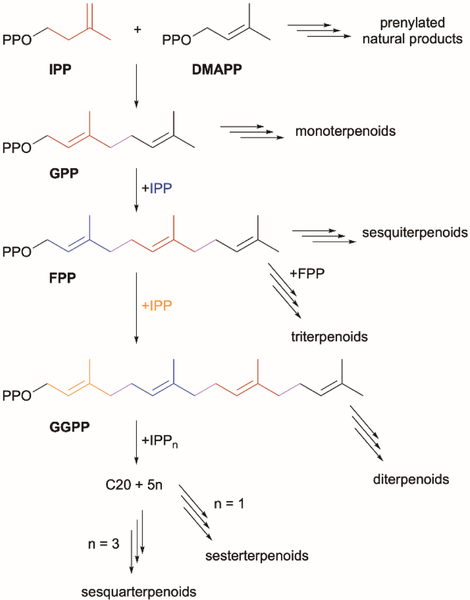
Fig. 1
Fig. 1
The biosynthesis of terpenoids via chain elongation of IPP and DMAPP.
Fig. 2
Fig. 2
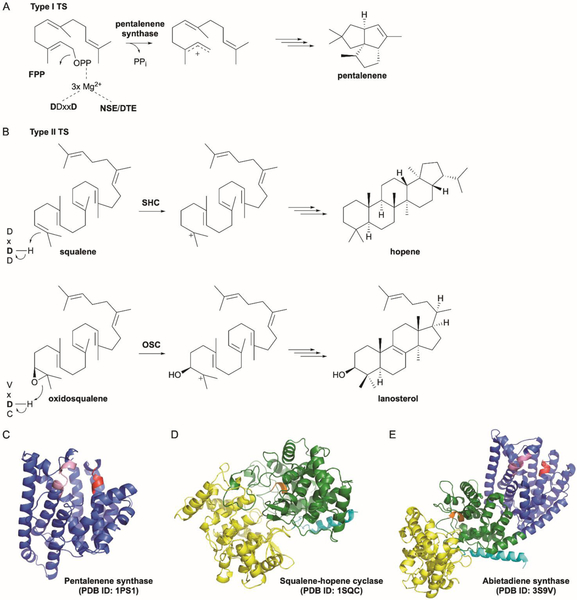
Canonical terpene synthases. (A) Type I TSs generate allylic carbocations by the ionization of a diphosphate moiety. They commonly possess DDxxD and NSE/DTE motifs that coordinate a trinuclear Mg2+ cluster that binds to the diphosphate and provides the electrophilic driving force for ionization. (B) Type II TSs generate carbocations through protonation of alkene or epoxide functional groups. They commonly possess a DxDD motif with the central Asp acting as the catalytic Brønsted acid. (C) Canonical type I TSs such as pentalenene synthase consist of an α domain (blue). The two Mg2+-binding Asp rich motifs DDxxD and NSE/DTE are colored in red and pink, respectively. (D) Canonical type II TSs such as SHC consist of β (green) and γ (yellow) domains. The Asp rich motif DxDD is colored in orange. The γ domain is an insertion domain between the first and second helices of the β domain. The N-terminal helix of the β domain is colored in cyan. (E) TSs can be present in a variety of domain combinations; bifunctional TSs such as abietadiene synthase possess αβγ structures.
Fig. 3
Fig. 3
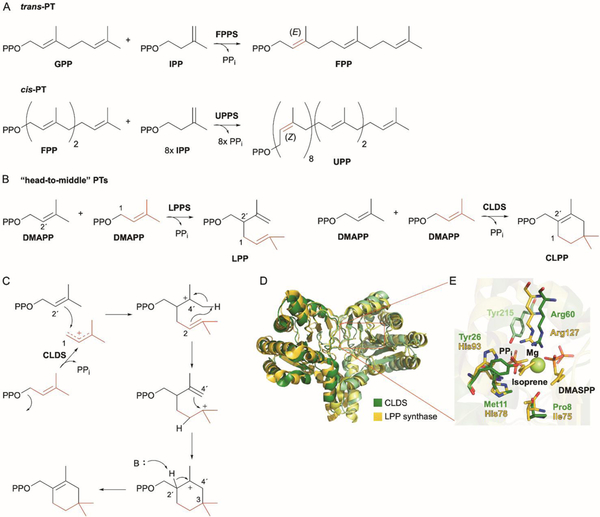
CLDS is a cis-prenyltransferase that catalyzes sequential condensation and cyclization reactions. (A) Chain elongation PTs, which use diphosphate ionization to condense two prenyl diphosphates into longer chains, are categorised into trans- or cis-PTs depending on their formation of E or Z double bonds, respectively. The canonical cis-PT UPPS attaches eight molecules of IPP to FPP to yield UPP. (B) LPPSs from plants catalyze “head-to-middle” prenyltransfer using two molecules of DMAPP. CLDS from Streptomyces sp. CL190 catalyzes both “head-to-middle” condensation and cyclization to yield CLPP. (C) The proposed mechanism of CLDS involves C-1–C-2´ bond formation, proton transfer from C-4´ to C-2, cyclization via a C-3–C-4´ bond formation, and deprotonation at C-2´. (D) Superposition of dimeric structures of CLDS (green; PDB ID: 5GUL) and LPPS (yellow; PDB ID: 5HC8). Deep and light colors represent two subunits. (E) Active site comparison of CLDS and LPPS. PPi, isoprene, and DMASPP are shown as sticks; Mg2+ is shown as a limon sphere..
Fig. 4
Fig. 4
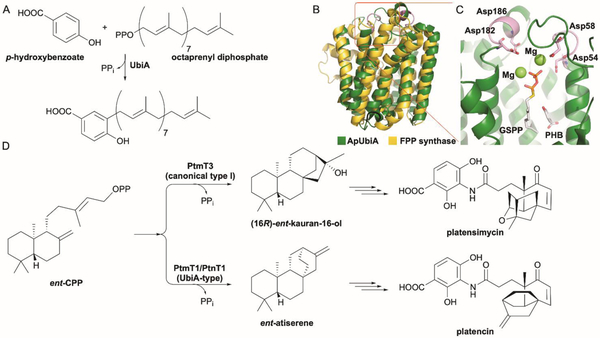
UbiA-type cyclases are membrane-bound type I TSs. (A) UbiA is an aromatic PT that catalyzes the attachment of an octaprenyl group to p-hydroxybenzoate. (B) Superposition of ApUbiA (green; PDB ID: 4OD5) and FPPS (yellow; PDB ID: 1RQI). (C) Local view of the active site of ApUbiA. The two Asp-rich motifs, NDxxDxxxD and DxxxD, are shown in pink; geranyl S-thiolodiphosphate (GSPP) and p-hydroxybenzoic acid (PHB) are shown as gray sticks; two Mg2+ ions are shown as limon spheres. (D) The biosynthesis of PTM and PTN diverge at their associated type I TS reactions. In PTM biosynthesis, CPP is converted into (16R)-ent-kauran-16-ol by the canonical type I TS PtmT3. In PTN biosynthesis, a UbiA-like type I TS specifically converts CPP into ent-atiserene.
Fig. 5
Fig. 5
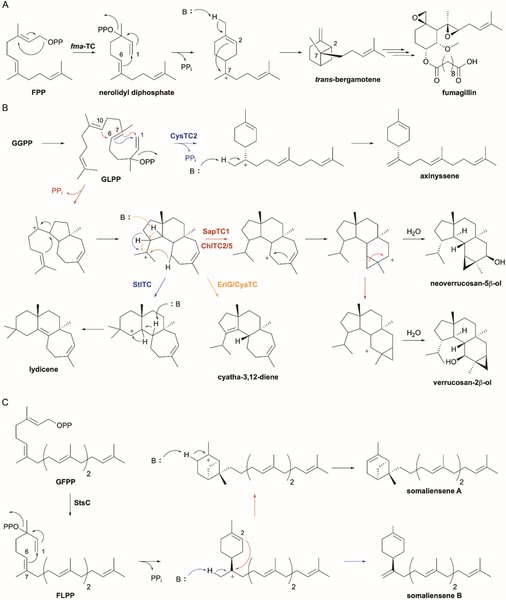
UbiA-type cyclases form sesquiterpenoids, diterpenoids, and sesterterpenoids. (A) fma-TC initially isomerises FPP into nerolidyl diphosphate then catalyzes two cyclizations to yield trans-bergamotene, a precursor in fumagillin biosynthesis. (B) The proposed mechanisms of seven new UbiA-type DTSs recently identified in fungi and bacteria. CysTC2 cyclizes GLPP into axinyssene. The other six DTSs, SapTC1, ChlTC2, ChlTC5, EriG, CyaTC, and StlTC all create a common 7-6-5 intermediate through two sequential cyclizations of GLPP followed by a ring expansion and another cyclization. StlTC forms lydicene, EriG/CyaTC give cyatha-3,12-diene, and SapTC1/ChlTC2/ChlTC5 produce two verruconsanols via cyclopropylcarbinyl cation rearrangements. (C) StsC, a UbiA-type sester-TS, catalyzes the formation of the bicyclic somaliensene A and the monocyclic somaliensene B via FLPP and cyclohexenylmethyl carbocationic intermediates.
Fig. 6
Fig. 6
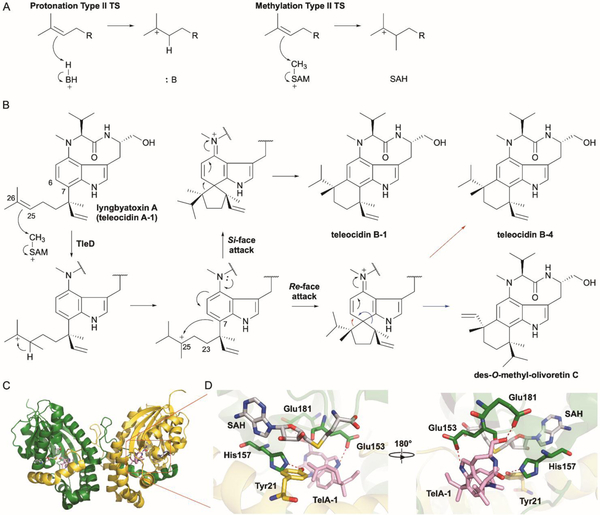
Methyltransferases initiate terpene cyclization via a type I-like methylation reaction. (A) SAM-dependent methylation of an alkene is a functional replacement of a type II TS protonation mechanism. (B) Teleocidin biosynthesis requires the bifunctional SAM-dependent MT and TS TleD. Methylation-induced cyclization is completed via either Re- or Si- face attack of the C-25 carbocation by C-7 of indole followed by C–C bond migration to C-6. (C) Overall structure of the TleD dimer (PDB ID: 5GM2). The two subunits are colored in green and yellow; SAH and teleocidin A-1 (TelA-1) are shown as gray and pink sticks, respectively. (D) Local views of the active site and dimer domain-swapped interactions. H-bonds are shown as red dashes.
Fig. 7
Fig. 7
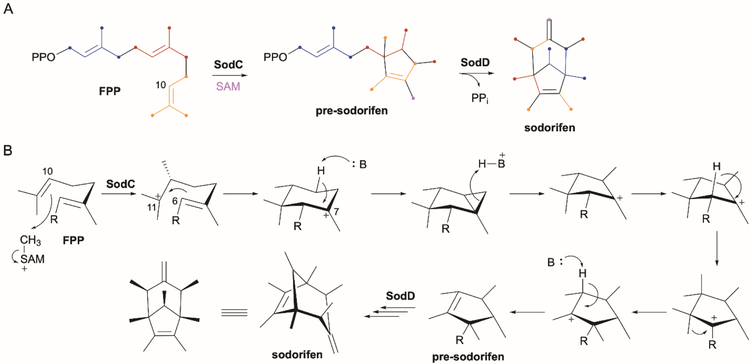
A bifunctional MT-TS in sodorifen biosynthesis. (A) Sodorifen is biosynthesized by the MT-like TS SodC and the canonical type I TS SodD. Colored dots on atoms represent the biosynthetic origin of the sodorifen scaffold. (B) The proposed mechanism of pre-sodorifen formation by SodC involves methylation at C-10 followed by cyclization, a series of 1,2-hydride and alkyls shifts, and a cyclpropyl-mediated ring contraction.
Fig. 8
Fig. 8
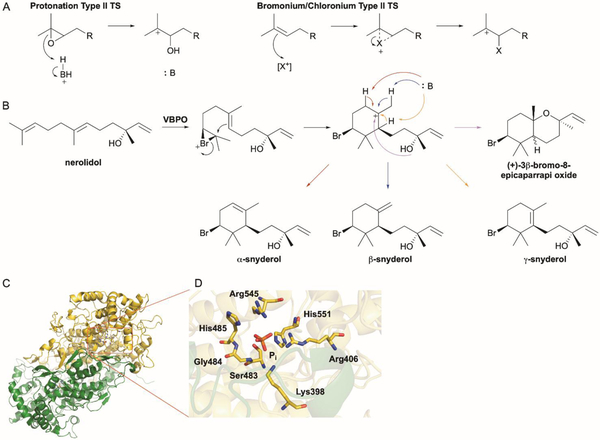
Vanadium haloperoxidases initiate terpene cyclization via a type II-like epoxide protonation reaction. (A) Halogenation and formation of an electrophilic bromonium or chloronium ion is a functional replacement of a type II TS protonation mechanism. (B) VBPOs from marine red algae brominate the terminal olefin of nerolidol and facilitate cyclization to form the snyderols and related compounds. (C) Overall structure of the CVBPO dimer (PDB ID: 1QHB). The two subunits are colored in green and yellow; active site residues and phosphate are shown as sticks. (D) Local view of the active site.
Fig. 9
Fig. 9
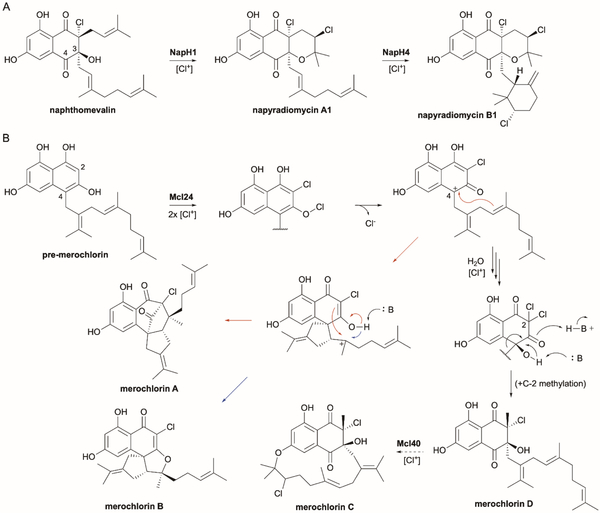
Vanadium haloperoxidases in napyradiomycin and merochlorin biosynthesis. (A) NapH1 and NapH4 are VCPOs that form chloronium ions to initiate terpene cyclization in the biosynthesis of napyradiomycins. (B) In merochlorin biosynthesis, the VCPO Mcl24 forms a hypochlorite intermediate that is transformed into a benzylic cation by loss of Cl. Mcl24 then catalyzes two sequential cyclizations with distinct second steps to yield merochlorins A or B. In basic conditions, Mcl24 catalyzes α-hydroxyketone rearrangement to give merochlorin D, which is further cyclized by the VCPO Mcl40 to afford merochlorin C.
Fig. 10
Fig. 10
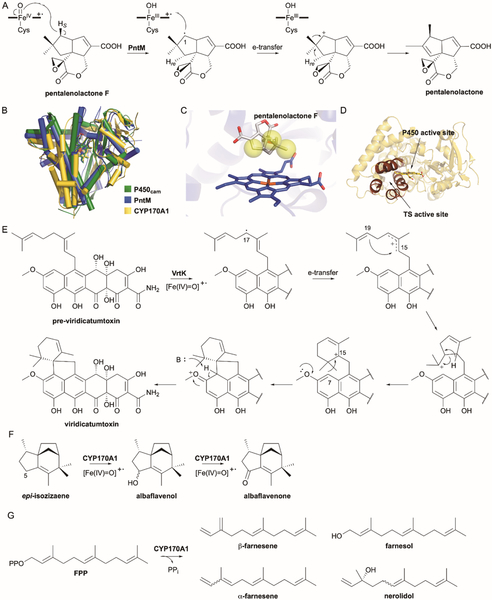
Cytochromes P450 generate carbocations via one-electron transfers or type I ionization. (A) PntM catalyzes a TS-like rearrangement of PNT F to yield PNT by generating a carbocation from a radical via a one-electron transfer. (B) Superposition of the overall structures of P450cam (green; CYP101A1; PDB ID: 2CPP), PntM (blue; PDB ID: 5L1O), and CYP170A1 (yellow; PDB ID: 3EL3). The heme groups are shown as sticks. (C) Local view of the PntM active site. PNT F is shown as gray sticks; yellow spheres depict steric hindrance. (D) Overall structure of CYP170A1 showing the TS active site location in comparison to the P450 active site. The four helices that form the TS active site are colored in brown. (E) A similar one-electron transfer is proposed for the cyclization of pre-viridicatumtoxin by VrtK in viridcatumtoxin biosynthesis. The proposed mechanism includes ring expansion and electrophilic substitution after initial cyclization. (F) The primary activity of CYP170A1 is C-5 oxidation in albaflavenone biosynthesis. (G) CYP170A1 shows moonlighting activity in a second TS-like active site. Farnesol, nerolidol, and farnesene isomers are generated via a type I TS reaction when CYP170A1 is incubated with FPP.
Fig. 11
Fig. 11
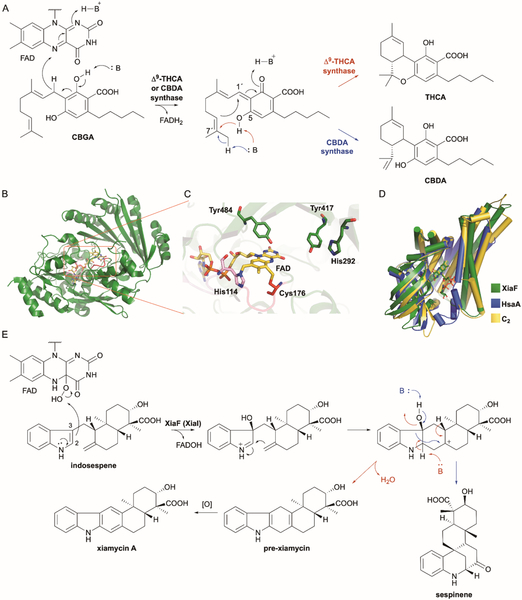
FAD oxidocyclases cyclize terpenoids using two different mechanisms. (A) The cannabinoids Δ9-THCA and CBDA are formed by FAD-dependent oxidative cyclization of CBGA. A hydride from C-1´ of CBGA is ejected onto FAD setting up C-6´–C-1´ cyclization. The isomerization of the C-2´–C-3´ E-alkene in CBGA to a Z-alkene in THCA and CBDA is still mechanistically unknown. (B) Overall structure of Δ9-THCA synthase (PDB ID: 3VTE). Two conserved sequence motifs R/KxxGH and CxxV/L/IG are colored in pink and red, respectively. (C) Local view of the Δ9-THCA synthase active site. FAD, shown as yellow sticks, is covalently bound to His114 and Cys176. Residues Tyr484, Tyr417, and His292 are all implicated in the reaction mechanism. (D) Superposition of the overall structures of XiaF (green; PDB ID: 5MR6), HsaA (blue; PDB ID: 3AFF), and C2 (yellow; PDB ID: 2JBS). FAD in XiaF and FMN in C2 are shown as sticks. (E) In xiamycin A biosynthesis, the FMO XiaF (XiaI) activates molecular oxygen with FAD and cryptically hydroxylates the C-3 of indole, facilitating exo-methylene attack of the resulting iminium cation. Dehydration and deprotonation can either yield pre-xiamycin or sespinene.
Fig. 12
Fig. 12
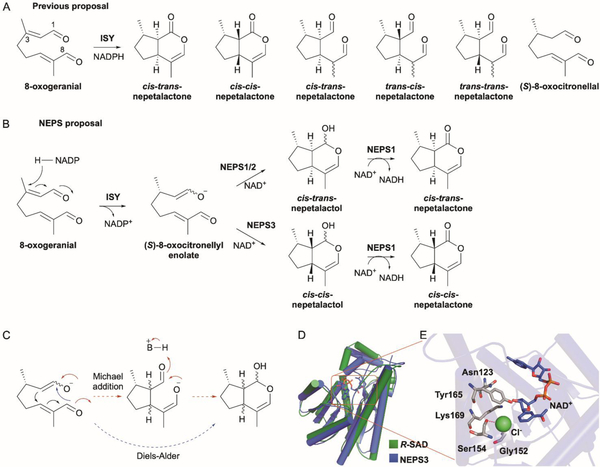
The non-oxidative NAD+-dependent NEPS enzymes catalyze stereoselective cyclization in iridoid biosynthesis. (A) Terpene cyclization in iridoid biosynthesis was previously proposed to be catalyzed by the NADPH-dependent reductase ISY; however, uncontrolled stereo-cyclization suggested otherwise. (B) NEPS1–3 are NAD+-dependent TSs that stereoselectively cyclize the ISY product 8-oxocitronellyl enolate into the nepetalactols. Only NEPS1 retains NAD+-dependent oxidation activity. (C) The proposed mechanism for NEPS cyclization involves either a step-wise or concerted hetero-Diels-Alder reaction. (D) Superposition of the overall structures of NEPS3 (blue; PDB ID: 6F9Q) and R-specific alcohol dehydrogenase (blue; R-SAD; PDB ID: 1NXQ). NAD+ is shown as blue sticks. (E) Local view of the NEPS3 active site. Cl is shown as a limon sphere; interaction between Ser154 and Cl is depicted as a red dash.
Fig. 13
Fig. 13
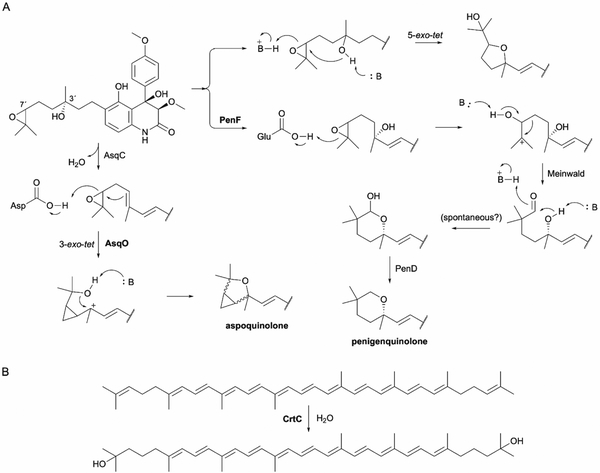
The CrtC-like cyclases use a type II TS-like epoxide protonation to initiate cationic rearrangement and cyclization. (A) Similar to type II TSs, PenF and AsqO protonate the terminal epoxides of prenylated quinolone alkaloids. The resulting cations can either undergo Meinwald rearrangement and cyclization (PenF) or direct 3-exo-tet cyclization to afford a cyclopropylcarbinyl cation that is quenched by an intramolecular hydroxyl (AsqO). A spontaneous or epoxide hydrolase-catalyzed 5-exo-tet cyclization confounded early studies but was suppressed in the presence of PenF or AsqO. (B) CrtC hydratases catalyze the addition of water to alkenes.
Fig. 14
Fig. 14
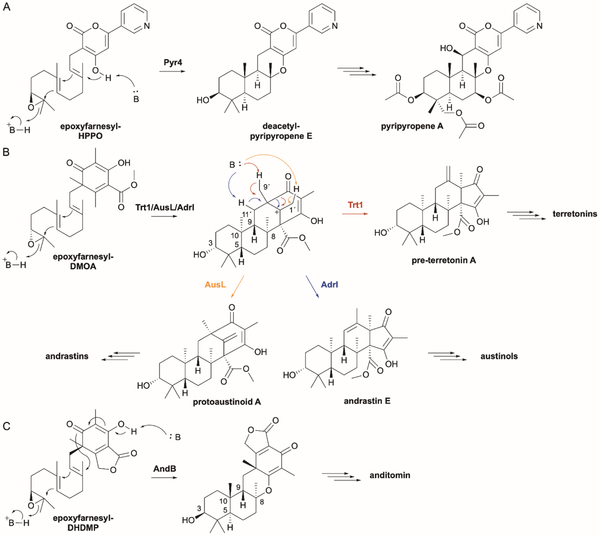
Integral membrane cyclases are membrane-bound type II TSs. (A) Pyr4 performs a type II TS cyclization of epoxyfarnesyl-HPPO in pyripyropene A biosynthesis. (B) Related IMCs Trt1, AusL, and AdrI catalyze similar type II TS cyclization cascades on epoxyfarnesyl-DMOA. Various deprotonations and acyl shifts differentiate the enzymatic products. (C) AndB completes a similar cyclization of epoxyfarnesyl-DHDMP in anditomin biosynthesis.
Fig. 15
Fig. 15
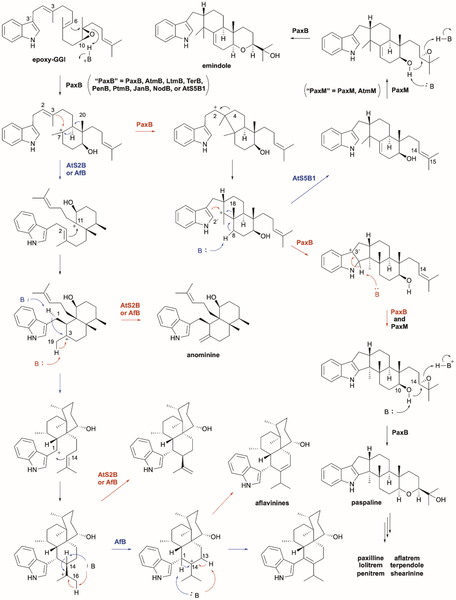
IMC-mediated reaction pathways for fungal indole diterpenoids. The fungal indole diterpenoids including paxilline, aflatrem, emindole, anominine, and the aflavinines all arise from the cyclization of 3´-(epoxygeranylgeranyl)-indole into an initial C-7 carbocation intermediate by IDTCs. A series of cyclizations, ring expansions, 1,2-hydride shifts, 1,2-methyl shifts, and deprotonation reactions bifurcate the enzyme-catalyzed mechanistic pathways and provide intriguing structural diversity.
Fig. 16
Fig. 16
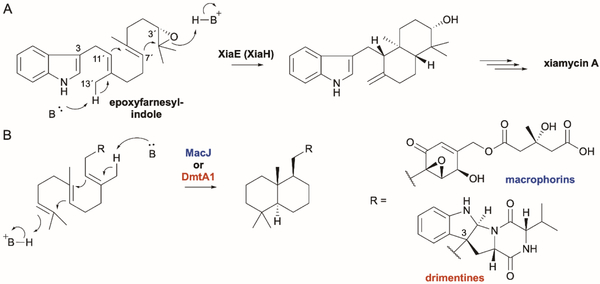
Integral membrane cyclases initiate cyclization via protonation of both epoxides and alkenes. (A) XiaE (XiaH) cyclizes epoxyfarnesyl-indole in xiamycin A biosynthesis. (B) The cyclizations of the bicyclic drimane moieties in macrophorins and drimentines are initiated via protonation of their terminal alkenes by MacJ and DmtA1, respectively.
Fig. 17
Fig. 17
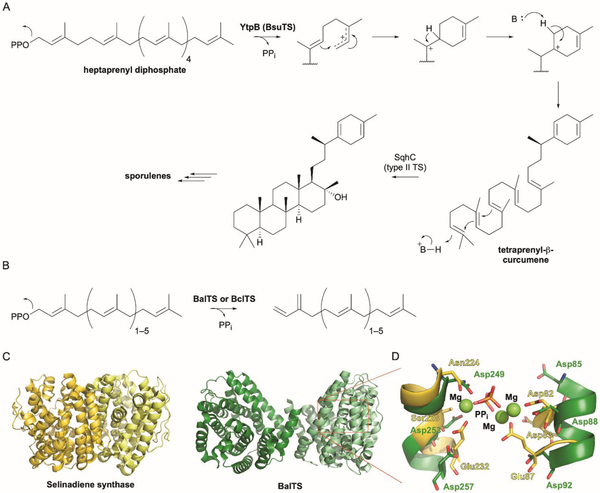
“Large” TSs are a novel family of type I TSs. (A) YtpB (BsuTS) catalyzes the type I cyclization of heptaprenyl diphosphate into tetraprenyl-β-curcumene. A canonical type II TS forms the tetracyclic moiety associated with sporulenes. (B) Related type I TSs accept a variety of prenyl diphosphates but do not catalyze cyclization; only ionization and deprotonation occur. (C) Overall dimeric structures of BalTS (green; PDB ID: 5YO8) and selinadiene synthase (yellow; PDB ID: 4OKM). Deep and light colors represent two subunits. (D) Superposition of the two Asp-rich motifs, shown as sticks, in the active sites of BalTS and selinadiene synthase. PPi and three Mg2+ ions are shown as sticks and limon spheres, respectively.
Fig. 18
Fig. 18
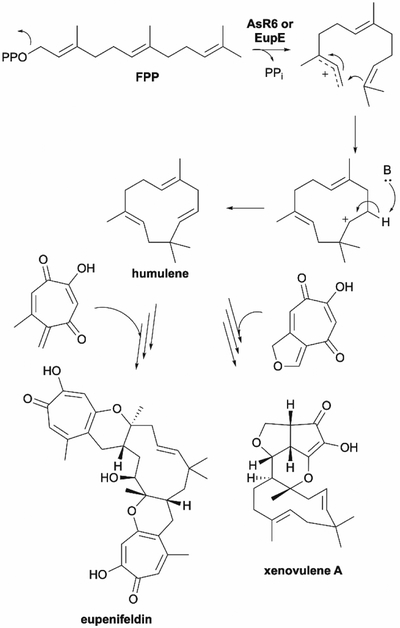
Fungal non-canonical humulene synthases mimic plant humulene synthases. AsR6 and EupE, key enzymes in xenovulene A and eupenifeldin biosynthesis, respectively, were recently identified as novel type I humulene synthases
Fig. 19
Fig. 19
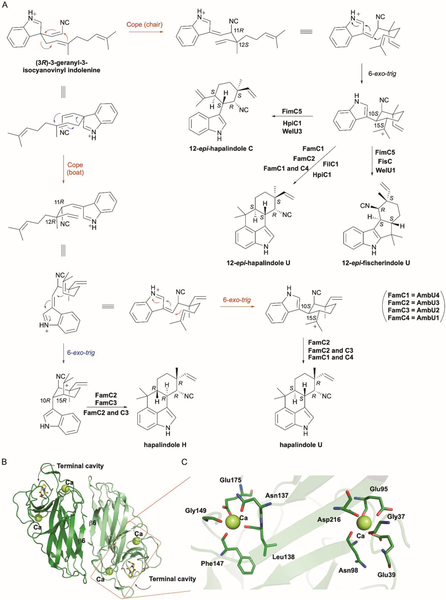
Stig cyclases catalyze Cope rearrangement and terpene cyclization. (A) In the biosynthesis of the cyanobacterial hapalindoles and fischerindoles, an enzymatically catalyzed Cope rearrangement is proposed to initially occur on (3R)-3-geranyl-3-isocyanovinyl indolenine. Subsequent 6-exo-trig cyclization yields a conserved C-15 carbocation that is quenched by electrophilic aromatic substitution or deprotonation by individual or pairs of Ca2+-dependent Stig cyclases. The observed stereocenters of the hapalindoles can be explained by the transition states (chair-like or boat-like) of the Cope rearrangement and 6-exo-trig cyclization. (B) Overall structure of the FamC1 dimer (PDB ID: 5YVK). Deep and light colors represent two subunits. An unexpected ligand, cyclo-l-Arg-d-Pro, found in the terminal cavity, is shown as yellow sticks. (C) Local view of the two Ca2+ binding sites. Ca2+-binding residues and Ca2+ ions are shown as sticks and limon spheres, respectively.

References

    1. Wallach O, Justus Liebigs Ann. Chem, 1893, 277, 154–161.
    1. Ružička L, Experientia, 1953, 9, 357–367. - PubMed
    1. Baunach M, Franke J and Hertweck C, Angew. Chem., Int. Ed, 2015, 54, 2604–2626. - PubMed
    1. Dickschat JS, Angew. Chem., Int. Ed, 2019, 58, 2–15.
    1. Christianson DW, Chem. Rev, 2017, 117, 11570–11648. - PMC - PubMed

Publication types

MeSH terms

LinkOut - more resources