. 2019 Dec;68(12):1971-1978.
doi: 10.1007/s00262-019-02408-7. Epub 2019 Oct 24.

Identification of prognostic genes in the acute myeloid leukemia immune microenvironment based on TCGA data analysis

Affiliations

Identification of prognostic genes in the acute myeloid leukemia immune microenvironment based on TCGA data analysis

Haimeng Yan et al. Cancer Immunol Immunother. 2019 Dec.

Abstract

Acute myeloid leukemia (AML) is a common and lethal hematopoietic malignancy that is highly dependent on the bone marrow (BM) microenvironment. Infiltrating immune and stromal cells are important components of the BM microenvironment and significantly influence the progression of AML. This study aimed to elucidate the value of immune/stromal cell-associated genes for AML prognosis by integrated bioinformatics analysis. We obtained expression profiles from The Cancer Genome Atlas (TCGA) database and used the ESTIMATE algorithm to calculate immune scores and stromal scores; we then identified differentially expressed genes (DEGs) based on these scores. Overall survival analysis was applied to reveal common DEGs of prognostic value. Subsequently, we conducted a functional enrichment analysis, generated a protein-protein interaction (PPI) network and performed an interrelation analysis of immune system processes, showing that these genes are mainly associated with the immune/inflammatory response. Finally, eight genes (CD163, CYP27A1, KCNA5, PPM1J, FOLR1, IL1R2, MYOF, VSIG2) were verified to be significantly associated with AML prognosis in the Gene Expression Omnibus (GEO) database. In summary, we identified key microenvironment-related genes that affect the outcomes of AML patients and might serve as therapeutic targets.

Keywords: AML; Bioinformatics analysis; Immune microenvironment; Overall survival.


Conflict of interest statement

The authors declare that they have no conflict of interest.

Figures
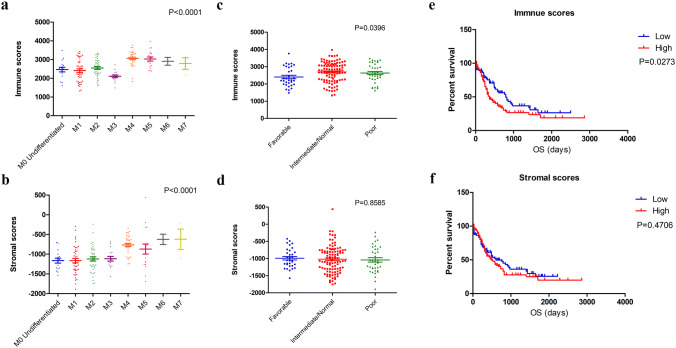
Fig. 1
Fig. 1
Immune conditions are associated with AML clinical features. a, b Distribution of immune scores and stromal scores for AML subtypes. c The significant correlation between immune scores and AML cytogenetic risk (p = 0.0396). d The stromal scores show no significant difference in cytogenetic risk (p = 0.8585). e Kaplan-Meier survival curve reveals that higher immune scores are associated with significantly shorter overall survival (log-rank test, p = 0.0273). f The low stromal score group showed a longer median overall survival than high stromal score group, with no significant difference (log-rank test, p = 0.4706)
Fig. 2
Fig. 2
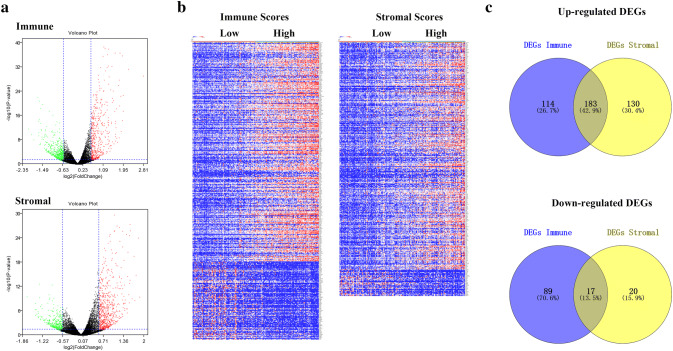
Identification of DEGs based on immune scores and stromal scores. a Volcano plot of DEGs from the low vs. high immune score/stromal score groups. Genes with p < 0.05 are shown in red (fold change > 1.5) and green (fold change < −1.5). Black plots represent the remaining genes (those with no significant difference). b Heatmap of DEGs for the immune and stromal score groups. c Commonly changed DEGs in the stromal and immune score groups (183 up- and 17 downregulated genes)
Fig. 3
Fig. 3
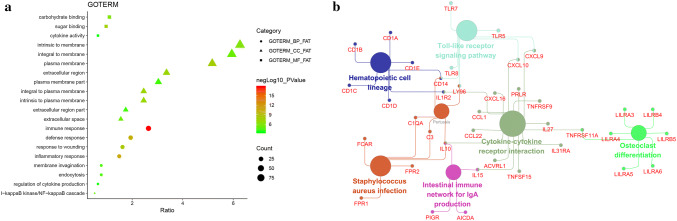
Gene ontology (GO) term enrichment analysis of common DEGs. a The top 30 significantly enriched GO terms, including three subontologies, biological process, molecular function and cellular component, are shown. b Interrelation analysis of KEGG pathways of common DEGs
Fig. 4
Fig. 4
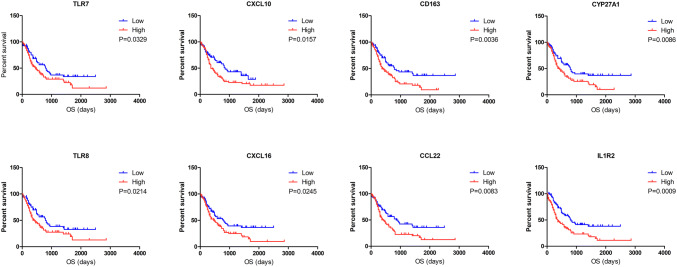
Correlation between expression of individual DEGs and AML overall survival in TCGA. Kaplan-Meier survival curves with the log-rank test were performed for the representative DEGs
Fig. 5
Fig. 5
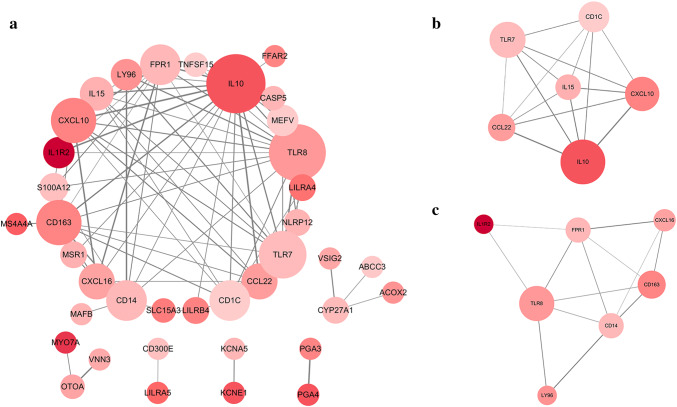
PPI network of DEGs of prognostic value and module identification. a Based on the STRING database and Cytoscape software, a PPI network containing 38 nodes and 85 edges was constructed. The size of the node represents the degree, and the color of the node represents the p value for prognosis. b Two significant modules were identified based on the degree of importance. Module 1 contains 6 nodes and 15 edges. c Module 2 contains 7 nodes and 13 edges
Fig. 6
Fig. 6
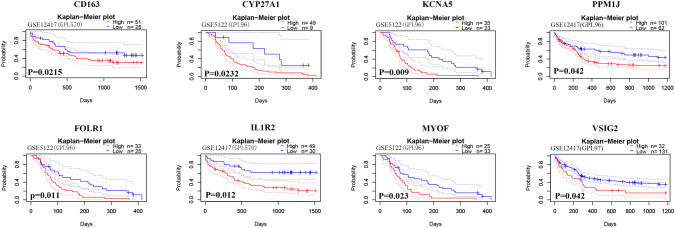
Verification of genes with prognostic value in the GEO database. Kaplan-Meier survival curves with the log-rank test were performed for genes with prognostic value. Genes with statistical significance (p < 0.05) are shown

References

    1. Rowe JM, Tallman MS. How I treat acute myeloid leukemia. Blood. 2010;116:3147–3156. doi: 10.1182/blood-2010-05-260117. - DOI - PubMed
    1. Weinberg OK, Sohani AR. Diagnostic work-up of acute myeloid leukemia. 2017;92:317–321. doi: 10.1002/ajh.24648. - DOI - PubMed
    1. Buckley SA, Kirtane K, Walter RB, Lee SJ, Lyman GH. Patient-reported outcomes in acute myeloid leukemia: Where are we now? Blood Rev. 2018;32:81–87. doi: 10.1016/j.blre.2017.08.010. - DOI - PubMed
    1. Zeng Z, Shi YX, Samudio IJ, Wang RY, Ling X, Frolova O, Levis M, Rubin JB, Negrin RR, Estey EH, Konoplev S, Andreeff M, Konopleva M. Targeting the leukemia microenvironment by CXCR4 inhibition overcomes resistance to kinase inhibitors and chemotherapy in AML. Blood. 2009;113:6215–6224. doi: 10.1182/blood-2008-05-158311. - DOI - PMC - PubMed
    1. Abdul-Aziz AM, Shafat MS, Mehta TK, Di Palma F, Lawes MJ, Rushworth SA, Bowles KM. MIF-induced stromal PKCbeta/IL8 is essential in human acute myeloid leukemia. Can Res. 2017;77:303–311. doi: 10.1158/0008-5472.can-16-1095. - DOI - PubMed

MeSH terms