Progression of glucose intolerance and cardiometabolic risk factors over a decade in Chinese women with polycystic ovary syndrome: A case-control study
- PMID: 31652273
- PMCID: PMC6814217
- DOI: 10.1371/journal.pmed.1002953
Progression of glucose intolerance and cardiometabolic risk factors over a decade in Chinese women with polycystic ovary syndrome: A case-control study
Abstract
Background: Polycystic ovary syndrome (PCOS) is associated with increased metabolic risk, though data on long-term follow-up of cardiometabolic traits are limited. We postulated that Chinese women with PCOS would have higher risk of incident diabetes and cardiometabolic abnormalities than those without PCOS during long-term follow-up.
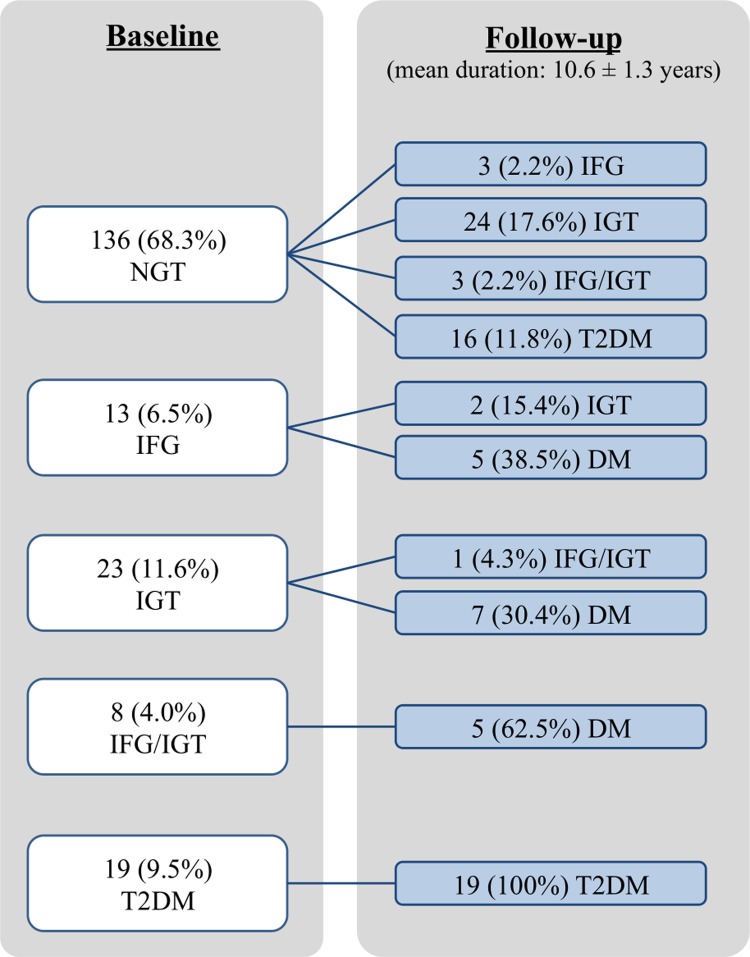
Methods and findings: One hundred ninety-nine Chinese women with PCOS diagnosed by the Rotterdam criteria and with a mean age of 41.2 years (SD = 6.4) completed a follow-up evaluation after an average of 10.6 ± 1.3 years. Two hundred twenty-five women without PCOS (mean age: 54.1 ± 6.7 years) who underwent baseline and follow-up evaluation over the same period were used for comparison. Progression of glycaemic status of women both with and without PCOS was assessed by using 75-g oral glucose tolerance test (OGTT) screening with the adoption of 2009 American Diabetes Association diagnostic criteria. The frequency of impaired glucose regulation, hypertension, and hyperlipidaemia of women with PCOS at follow-up has increased from 31.7% (95% CI 25.2%-38.1%) to 47.2% (95% CI 40.3%-54.2%), 16.1% (95% CI 11.0%-21.2%) to 34.7% (95% CI 28.1%-41.3%), and 52.3% (95% CI 45.3%-59.2%) to 64.3% (95% CI 57.7%-71.0%), respectively. The cumulative incidence of diabetes mellitus (DM) in follow-up women with PCOS is 26.1% (95% CI 20.0%-32.2%), almost double that in the cohort of women without PCOS (p < 0.001). Age-standardised incidence of diabetes among women with PCOS was 22.12 per 1,000 person-years (95% CI 10.86-33.37) compared with the local female population incidence rate of 8.76 per 1,000 person-years (95% CI 8.72-8.80) and 10.09 per 1,000 person-years (95% CI 4.92-15.26, p < 0.001) for women without PCOS in our study. Incidence rate for women with PCOS aged 30-39 years was 20.56 per 1,000 person-years (95% CI 12.57-31.87), which is approximately 10-fold higher than that of the age-matched general female population in Hong Kong (1.88 per 1,000 person-years, [95% CI 1.85-1.92]). The incidence rate of type 2 DM (T2DM) of both normal-weight and overweight women with PCOS was around double that of corresponding control groups (normal weight: 8.96 [95% CI 3.92-17.72] versus 4.86 per 1,000 person-years [95% CI 2.13-9.62], p > 0.05; overweight/obese: 28.64 [95% CI 19.55-40.60] versus 14.1 per 1,000 person-years [95% CI 8.20-22.76], p < 0.05). Logistic regression analysis identified that baseline waist-to-hip ratio (odds ratio [OR] = 1.71 [95% CI 1.08-2.69], p < 0.05) and elevated triglyceride (OR = 6.63 [95% CI 1.23-35.69], p < 0.05) are associated with the progression to T2DM in PCOS. Limitations of this study include moderate sample size with limited number of incident diabetes during follow-up period and potential selection bias.
Conclusions: High risk of diabetes and increased cardiovascular disease risk factors among Chinese women with PCOS are highlighted in this long-term follow-up study. Diabetes onset was, on average, 10 years earlier among women with PCOS than in women without PCOS.
Conflict of interest statement
I have read the journal's policy and the authors of this manuscript have the following competing interests: RCWM acknowledges receiving research support (outside of this work) from AstraZeneca, Bayer, and Pfizer and honoraria or consultancy fees from AstraZeneca and Boehringer Ingelheim, all of which have been donated to the Chinese University of Hong Kong to support diabetes research. CKPL, JCNC and RCWM are co-founders of GemVCare, a diabetes genetic testing laboratory, which was established through support from the Technology Start-up Support Scheme for Universities (TSSSU) from the Hong Kong Government Innovation and Technology Commission (ITC). RCWM is a member of the International Federation of Gynecology and Obstetrics (FIGO) Pregnancy and Non-communicable Diseases Committee and a member of the Executive Board of the Asian Association for the Study of Diabetes (AASD) and Worldwide Diabetes (WWD). RCWM is a member of the editorial board of PLOS Medicine.
Figures
References
Publication types
MeSH terms
Substances
LinkOut - more resources
Full Text Sources
Medical