


GATA1 mutations in red cell disorders
- PMID: 31652397
- PMCID: PMC7323890
- DOI: 10.1002/iub.2177
GATA1 mutations in red cell disorders
Abstract
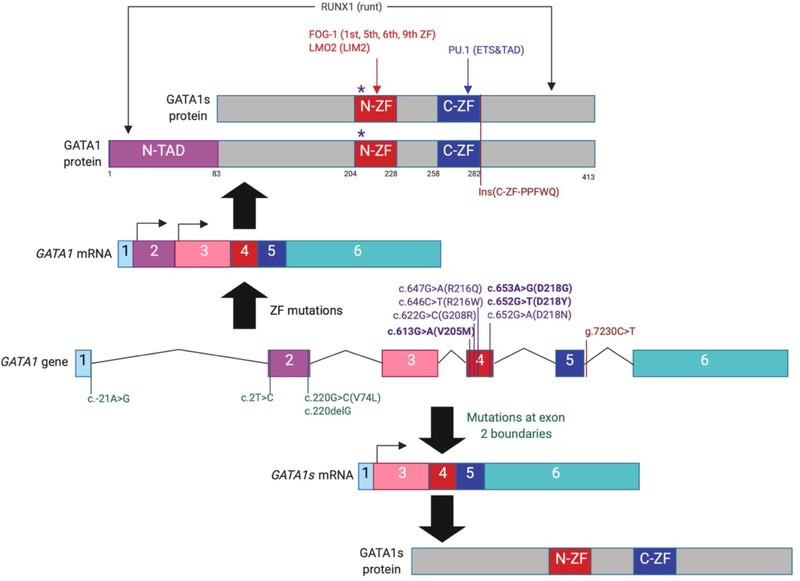
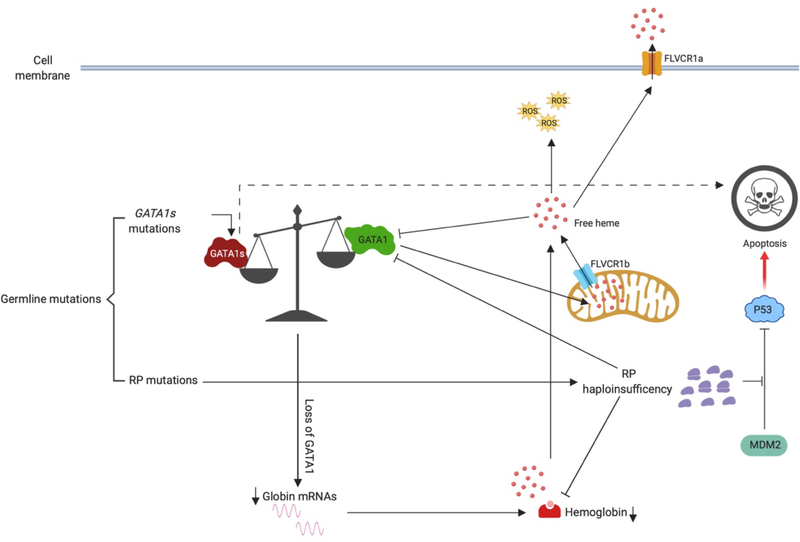
GATA1 is an essential regulator of erythroid cell gene expression and maturation. In its absence, erythroid progenitors are arrested in differentiation and undergo apoptosis. Much has been learned about GATA1 function through animal models, which include genetic knockouts as well as ones with decreased levels of expression. However, even greater insights have come from the finding that a number of rare red cell disorders, including Diamond-Blackfan anemia, are associated with GATA1 mutations. These mutations affect the amino-terminal zinc finger (N-ZF) and the amino-terminus of the protein, and in both cases can alter the DNA-binding activity, which is primarily conferred by the third functional domain, the carboxyl-terminal zinc finger (C-ZF). Here we discuss the role of GATA1 in erythropoiesis with an emphasis on the mutations found in human patients with red cell disorders.
Keywords: GATA1; anemia; erythropoiesis.
© 2019 International Union of Biochemistry and Molecular Biology.
Figures
References
-
- Zon LI, Gurish MF, Stevens RL, et al. GATA-binding transcription factors in mast cells regulate the promoter of the mast cell carboxypeptidase A gene. J Biol Chem. 1991;266(34):22948–22953. - PubMed
-
- Martin DI, Zon LI, Mutter G, Orkin SH. Expression of an erythroid transcription factor in megakaryocytic and mast cell lineages. Nature. 1990;344(6265):444–447. - PubMed
-
- Zon LI, Yamaguchi Y, Yee K, et al. Expression of mRNA for the GATA-binding proteins in human eosinophils and basophils: potential role in gene transcription. Blood. 1993;81(12):3234–3241. - PubMed
-
- Trainor CD, Evans T, Felsenfeld G, Boguski MS. Structure and evolution of a human erythroid transcription factor. Nature. 1990;343(6253):92–96. - PubMed
Publication types
MeSH terms
Substances
Grants and funding
LinkOut - more resources
Full Text Sources
Other Literature Sources
Medical
