


Muscular Atrophy and Sarcopenia in the Elderly: Is There a Role for Creatine Supplementation?
- PMID: 31652853
- PMCID: PMC6921011
- DOI: 10.3390/biom9110642
Muscular Atrophy and Sarcopenia in the Elderly: Is There a Role for Creatine Supplementation?
Abstract
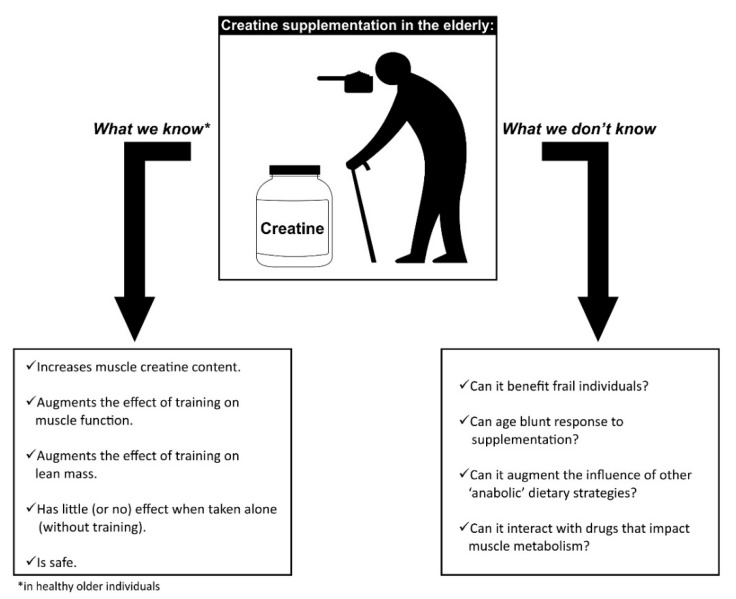
Sarcopenia is characterized by a loss of muscle mass, quality, and function, and negatively impacts health, functionality, and quality of life for numerous populations, particularly older adults. Creatine is an endogenously produced metabolite, which has the theoretical potential to counteract many of the morphological and metabolic parameters underpinning sarcopenia. This can occur through a range of direct and indirect mechanisms, including temporal and spatial functions that accelerate ATP regeneration during times of high energy demand, direct anabolic and anti-catabolic functions, and enhanced muscle regenerating capacity through positively impacting muscle stem cell availability. Studies conducted in older adults show little benefit of creatine supplementation alone on muscle function or mass. In contrast, creatine supplementation as an adjunct to exercise training seems to augment the muscle adaptive response to the training stimulus, potentially through increasing capacity for higher intensity exercise, and/or by enhancing post-exercise recovery and adaptation. As such, creatine may be an effective dietary strategy to combat age-related muscle atrophy and sarcopenia when used to complement the benefits of exercise training.
Keywords: bioenergetics; dietary supplements; ergogenic aids; healthy ageing; metabolism; muscle; older adults; sarcopenia..
Conflict of interest statement
The authors declare no conflict of interest.
Figures
References
-
- Kreider R., Kalman D., Antonio J., Ziegenfuss T., Wildman R., Collins R., Candow D.G., Kleiner S.M., Almada A.L., Lopez H.L. International Society of Sports Nutrition position stand: Safety and efficacy of creatine supplementation in exercise, sport, and medicine. J. Int. Soc. Sports Nutr. 2017;14:18. doi: 10.1186/s12970-017-0173-z. - DOI - PMC - PubMed
-
- Maughan R.J., Burke L.M., Dvorak J., Larson-Meyer D.E., Peeling P., Phillips S.M., Rawson E.S., Walsh N.P., Garthe I., Geyer H., et al. IOC consensus statement: Dietary supplements and the high-performance athlete. Br. J. Sports Med. 2018;52:439–455. doi: 10.1136/bjsports-2018-099027. - DOI - PMC - PubMed
Publication types
MeSH terms
Substances
LinkOut - more resources
Full Text Sources
Medical
Research Materials
