. 2019 Oct 24;9(11):246.
doi: 10.3390/metabo9110246.

Subnormothermic Machine Perfusion of Steatotic Livers Results in Increased Energy Charge at the Cost of Anti-Oxidant Capacity Compared to Normothermic Perfusion

Affiliations

Subnormothermic Machine Perfusion of Steatotic Livers Results in Increased Energy Charge at the Cost of Anti-Oxidant Capacity Compared to Normothermic Perfusion

Negin Karimian et al. Metabolites. .

Abstract

There continues to be significant debate regarding the most effective mode of ex situ machine perfusion of livers for transplantation. Subnormothermic (SNMP) and normothermic machine perfusion (NMP) are two methods with different benefits. We examined the metabolomic profiles of discarded steatotic human livers during three hours of subnormothermic or normothermic machine perfusion. Steatotic livers regenerate higher stores of ATP during SNMP than NMP. However, there is a significant depletion of available glutathione during SNMP, likely due to an inability to overcome the high energy threshold needed to synthesize glutathione. This highlights the increased oxidative stress apparent in steatotic livers. Rescue of discarded steatotic livers with machine perfusion may require the optimization of redox status through repletion or supplementation of reducing agents.

Keywords: anti-oxidant; liver transplantation; machine perfusion; metabolomics; normothermic; steatosis; subnormothermic.


Conflict of interest statement

Uygun is an inventor on pending patents relevant to this study and has a provisional patent application relevant to this study. Uygun has a financial interest in Organ Solutions, a company focused on developing organ preservation technology. Uygun’s interests are managed by the Massachusetts General Hospital and Partners HealthCare in accordance with their conflict of interest policies.

Figures
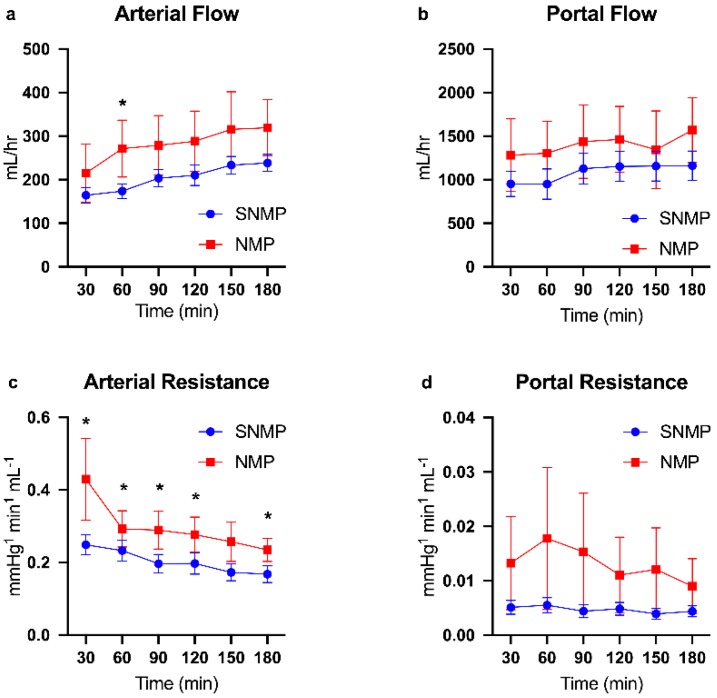
Figure 1
Figure 1
Perfusion parameters during machine perfusion of steatotic livers. Steatotic livers had higher qualitative hepatic artery (a) and portal vein (b) flows during NMP, though this was not statistically significant. Arterial resistance (c) was significantly higher throughout the majority of three hours perfusion during NMP compared to SNMP. Portal vein resistance (d) was also higher during NMP but not statistically significant due to large variance. Random intercept mixed model analysis for longitudinal data was used. Data shown as mean ± SEM, * indicates p < 0.05. NMP, normothermic machine perfusion; SNMP, subnormothermic machine perfusion.
Figure 2
Figure 2
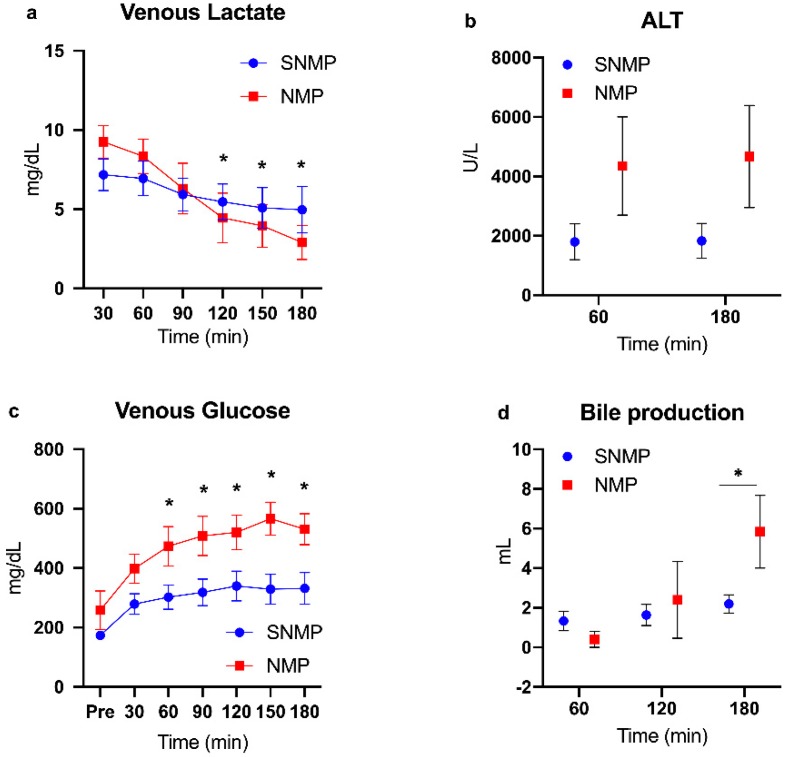
Functional outcome measures during machine perfusion of steatotic livers. NMP of steatotic livers resulted in evidence of higher metabolic activity as expected compared to SNMP. Venous lactate content (a) decreased during three hours of perfusion in both groups but at a fast rate during NMP. ALT (b) is qualitatively higher in steatotic livers during NMP compared to SNMP but did not reach significance. Glucose content in the perfusate (c) was significantly higher during NMP. Steatotic livers produced comparable volumes of bile during the first 2 h of perfusion, but production was significantly higher by the third hour compared to SNMP (d) Data shown as mean ± SEM, * indicates p < 0.05. NMP, normothermic machine perfusion; SNMP, subnormothermic machine perfusion; ALT, alanine aminotransferase.
Figure 3
Figure 3
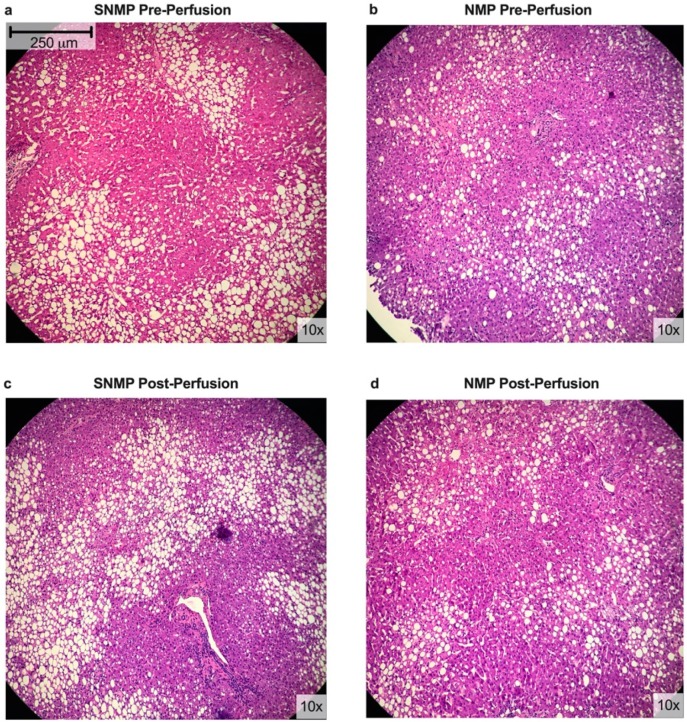
Histologic differences of steatotic livers during NMP and SNMP. Representative H&E-stained liver sections from steatotic livers undergoing NMP and SNMP shown pre-perfusion and post-perfusion. No significant change in macrosteatosis was observed with either perfusion modality. (a) pre-perfusion biopsy of liver in SNMP group, (b) pre-perfusion biopsy of liver in NMP group, (c) biopsy after 3 hours of SNMP, (d) biopsy after 3 hours of NMP.
Figure 4
Figure 4
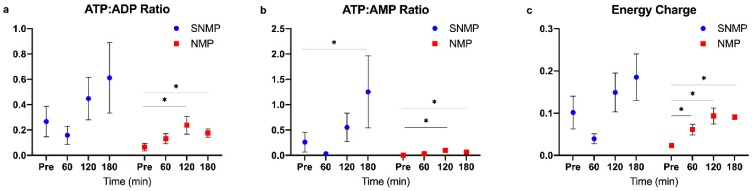
Energy cofactor changes during NMP and SNMP of steatotic livers. (a) ATP:ADP, (b) ATP:AMP, and (c) energy charge ratios at each hour of perfusion. Given the lower metabolic activity at subnormothermic temperatures, steatotic livers are able to regenerate ATP and energy charge to higher levels with oxygenated perfusion compared to NMP. Energy charge was calculated as (ATP + ADP*0.5)/(ATP + ADP + AMP). Within group comparisons at 60, 120, and 180 min are made to a pre-perfusion measurement (time = 0 min). * indicates p < 0.05 for random intercept mixed model comparison of longitudinal data to pre-perfusion levels. Data shown are mean ± SEM. NMP, normothermic machine perfusion; SNMP, subnormothermic machine perfusion.
Figure 5
Figure 5
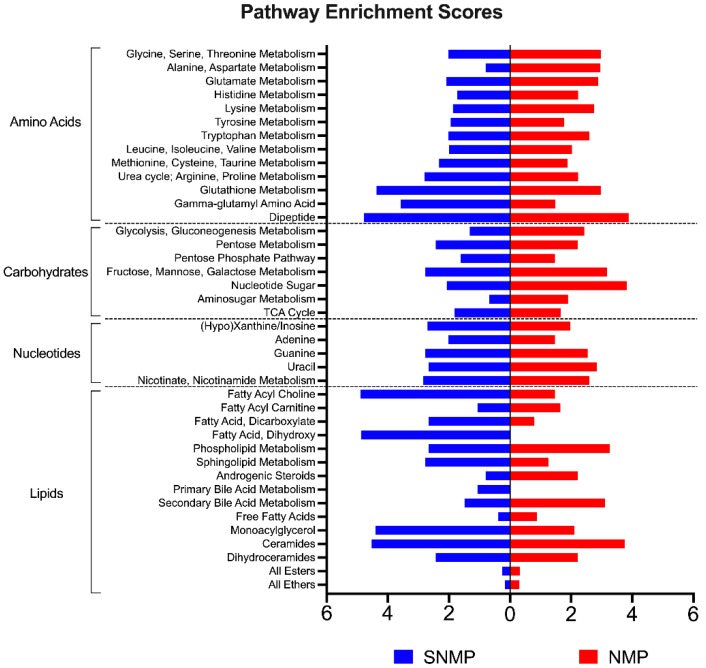
Pathway enrichment analysis for metabolomic profiles of steatotic livers during NMP and SNMP. Pathway enrichment scores of metabolite subgroups at 180 min of perfusion compared to pre-perfusion concentrations between SNMP and NMP groups. NMP, normothermic machine perfusion; SNMP, subnormothermic machine perfusion.
Figure 6
Figure 6
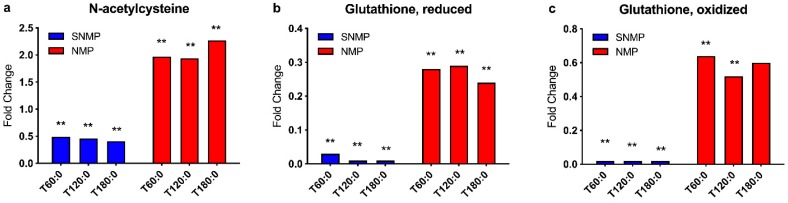
Redox status during NMP and SNMP of steatotic Livers. (a) N-acetylcysteine, (b) reduced glutathione, and (c) oxidized glutathione ratios demonstrate depleted redox capacity within hepatocytes during SNMP compared to NMP. ** indicated p < 0.05. NMP, normothermic machine perfusion; SNMP, subnormothermic machine perfusion; x-axis represents fold change at 60, 120, and 180 min compared to pre-perfusion concentrations.
Figure 7
Figure 7
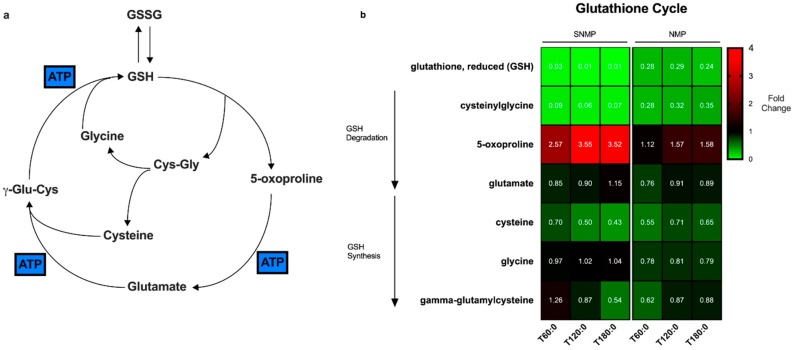
Glutathione degradation varies in steatotic livers during SNMP compared to NMP. (a) The glutathione cycle involves the degradation of glutathione into its base amino acids. Synthesis of glutathione involves three molecules of ATP. (b) Heatmap of the metabolites in the glutathione cycle compared between SNMP and NMP of steatotic livers. There is a significant depletion of the precursor metabolites in the synthesis arm of the cycle during SNMP compared to NMP, as well as a larger accumulation of 5-oxoproline. Reduced glutathione content in hepatocytes is decreased during NMP but depletion is near-total during SNMP. GSH, reduced glutathione; GSSH, oxidized glutathione; Cys-Gly, cysteinylglycine; γ-Glu-Cys, γ-glutamylcysteine; NMP, normothermic machine perfusion; SNMP, subnormothermic machine perfusion; x-axis represents fold change at 60, 120, and 180 min compared to pre-perfusion concentrations.

References

    1. Nasralla D., Coussios C.C., Mergental H., Akhtar M.Z., Butler A.J., Ceresa C.D.L., Chiocchia V., Dutton S.J., Garcia-Valdecasas J.C., Heaton N., et al. A randomized trial of normothermic preservation in liver transplantation. Nature. 2018;557:50–56. doi: 10.1038/s41586-018-0047-9. - DOI - PubMed
    1. Laing R.W., Mergental H., Yap C., Kirkham A., Whilku M., Barton D., Curbishley S., Boteon Y.L., Neil D.A., Hubscher S.G., et al. Viability testing and transplantation of marginal livers (VITTAL) using normothermic machine perfusion: Study protocol for an open-label, non-randomised, prospective, single-arm trial. BMJ Open. 2017;7:e017733. - PMC - PubMed
    1. Matton A.P.M., Burlage L.C., van Rijn R., de Vries Y., Karangwa S.A., Nijsten M.W., Gouw A.S.H., Wiersema-Buist J., Adelmeijer J., Westerkamp A.C., et al. Normothermic machine perfusion of donor livers without the need for human blood products. Liver Transplant. 2018;24:528–538. doi: 10.1002/lt.25005. - DOI - PMC - PubMed
    1. Mergental H., Perera M.T., Laing R.W., Muiesan P., Isaac J.R., Smith A., Stephenson B.T., Cilliers H., Neil D.A., Hubscher S.G., et al. Transplantation of declined liver allografts following normothermic Ex-Situ evaluation. Am. J. Transplant. 2016;16:3235–3245. doi: 10.1111/ajt.13875. - DOI - PubMed
    1. Bruinsma B.G., Sridharan G.V., Weeder P.D., Avruch J.H., Saeidi N., Ozer S., Geerts S., Porte R.J., Heger M., van Gulik T.M., et al. Metabolic profiling during ex vivo machine perfusion of the human liver. Sci. Rep. 2016;6:22415. doi: 10.1038/srep22415. - DOI - PMC - PubMed

LinkOut - more resources