Review
. 2019 Oct 24;20(21):5293.
doi: 10.3390/ijms20215293.

Immunobiology of Atherosclerosis: A Complex Net of Interactions

Affiliations
Review

Immunobiology of Atherosclerosis: A Complex Net of Interactions

Beatriz Herrero-Fernandez et al. Int J Mol Sci. .

Abstract

Cardiovascular disease is the leading cause of mortality worldwide, and atherosclerosis the principal factor underlying cardiovascular events. Atherosclerosis is a chronic inflammatory disease characterized by endothelial dysfunction, intimal lipid deposition, smooth muscle cell proliferation, cell apoptosis and necrosis, and local and systemic inflammation, involving key contributions to from innate and adaptive immunity. The balance between proatherogenic inflammatory and atheroprotective anti-inflammatory responses is modulated by a complex network of interactions among vascular components and immune cells, including monocytes, macrophages, dendritic cells, and T, B, and foam cells; these interactions modulate the further progression and stability of the atherosclerotic lesion. In this review, we take a global perspective on existing knowledge about the pathogenesis of immune responses in the atherosclerotic microenvironment and the interplay between the major innate and adaptive immune factors in atherosclerosis. Studies such as this are the basis for the development of new therapies against atherosclerosis.

Keywords: B-cell; T-cell; atherosclerosis; conventional dendritic cell; foam cell; macrophage; monocyte; monocyte-derived dendritic cell; plasmacytoid dendritic cell; regulatory dendritic cell.


Conflict of interest statement

The authors declare no conflict of interest.

Figures
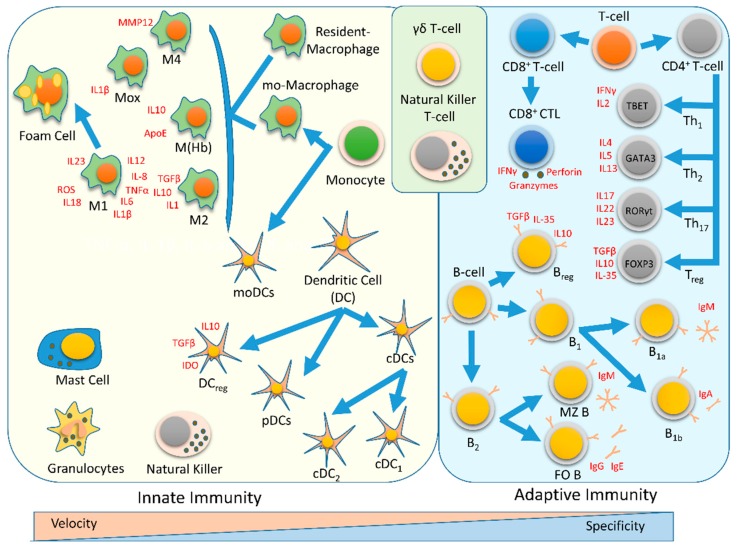
Figure 1
Figure 1
The innate and adaptive immune system in atherosclerosis. The immune system is divided into two main branches: innate and adaptive immunity. Innate immunity is mediated by monocytes, macrophages, dendritic cells, granulocytes, mast cells, and natural killer cells, and is characterized by the capacity of these cells to produce a rapid and nonspecific response as a first line of defense. Innate immune cells mediate host defense responses and inflammation by releasing cytokines and chemokines, activating the complement cascade and phagocytosis, and activating the adaptive immune response via antigen presentation. The adaptive immune response occurs later and depends on the presentation of antigens by antigen presenting cells (APCs) and the cytokine milieu generated by the innate response. The adaptive response is specific and relies on CD4+ and CD8+ T cell activation and antibody production by B cells. Natural killer T (NKT) cells and γδ T cells are cytotoxic T lymphocytes at the interface between innate and adaptive immunity. Abundant evidence points to a role of innate and adaptive immunity in the onset and progression of atherosclerosis. Several immune cell types play a proatherogenic role, including Th1 cells, M1 macrophages, and some B cells. In contrast, Tregs, Bregs, and DCregs have atheroprotective effects. DC, dendritic cell; moDC, monocyte-derived DC; mo-Macrophage, monocyte-derived macrophage; pDC, plasmacytoid DC; cDC, conventional DC; FO B, follicular B cell; MZ B, marginal zone B cell; Breg regulatory B cell; Treg, regulatory T cell.
Figure 2
Figure 2
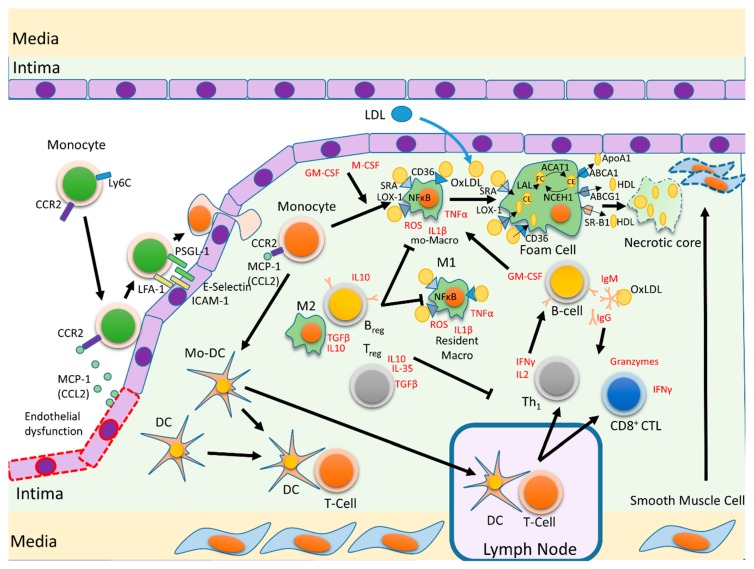
Pathogenesis of atherosclerosis. Atherosclerosis is a chronic inflammatory disease characterized by endothelial dysfunction and accumulation of low-density lipoproteins (LDLs), immune cells, and necrotic debris in the subendothelial space. Endothelial activation triggers the expression of leukocyte adhesion molecules, such as E and P-selectins, the glycoproteins ICAM-1 and VCAM-1, and the chemokine MCP-1, which signals via CCR2 to stimulate migration and infiltration of inflammatory monocytes. LDL deposition promotes the release of M-CSF and GM-CSF, which facilitates the maturation of infiltrating monocytes into macrophages or dendritic cells. LDLs give rise to modified-LDLs (especially oxLDL) that are recognized by macrophage scavenger receptors, such as CD36, LOX-1, and SR-A. These scavenger receptors activate NFκB signaling in macrophages, enhancing the release of proinflammatory cytokines, such as IL1β and TNFα, and leading to the generation of foam cells. Foam cells uptake ox-LDL, and LAL converts cholesterol esters (CE) into free cholesterol (FC) and free fatty acids. FC can be converted into CE by ACAT1 and ACAT2. NCEH1 transforms CE into FC. FC can be transported outside the foam cell by ABCA1, ABCG1, and SR-B1. APCs, such as DCs, process intraplaque oxLDLs and stimulate the adaptive immune response by presenting oxLDL-derived antigens in atheromatous plaques and in secondary lymphoid organs. M1 macrophages, Th1 cells, and some B cell subtypes promote atherosclerosis by the production of proinflammatory cytokines and chemokines, among other mechanisms. In contrast, Bregs, Tregs, M2 macrophages, and tolerogenic DCs suppress inflammation, reducing plaque size and stabilizing atheosclerotic lesions through several mechanisms. Plaque development is also promoted by the differentiation of smooth muscle cells to a proliferating phenotype.

References

    1. Shimada K. Immune System and Atherosclerotic Disease: Heterogeneity of Leukocyte Subsets Participating in the Pathogenesis of Atherosclerosis. Circ. J. 2009;73:994–1001. doi: 10.1253/circj.CJ-09-0277. - DOI - PubMed
    1. Hansson G.K., Hermansson A. The Immune System in Atherosclerosis. Nat. Immunol. 2011;12:204–212. doi: 10.1038/ni.2001. - DOI - PubMed
    1. Ammirati E., Moroni F., Magnoni M., Camici P.G. The Role of T and B Cells in Human Atherosclerosis and Atherothrombosis. Clin. Exp. Immunol. 2015;179:173–187. doi: 10.1111/cei.12477. - DOI - PMC - PubMed
    1. Smith J.D., Trogan E., Ginsberg M., Grigaux C., Tian J., Miyata M. Decreased Atherosclerosis in Mice Deficient in Both Macrophage Colony-Stimulating Factor (op) and Apolipoprotein E. Proc. Natl. Acad. Sci. USA. 1995;92:8264–8268. doi: 10.1073/pnas.92.18.8264. - DOI - PMC - PubMed
    1. Song L., Leung C., Schindler C. Lymphocytes are Important in Early Atherosclerosis. J. Clin. Investig. 2001;108:251–259. doi: 10.1172/JCI200111380. - DOI - PMC - PubMed