. 2019 Dec 16;377(2160):20190275.
doi: 10.1098/rsta.2019.0275. Epub 2019 Oct 28.

Synchronization transitions caused by time-varying coupling functions

Affiliations

Synchronization transitions caused by time-varying coupling functions

Zeray Hagos et al. Philos Trans A Math Phys Eng Sci. .

Abstract

Interacting dynamical systems are widespread in nature. The influence that one such system exerts on another is described by a coupling function; and the coupling functions extracted from the time-series of interacting dynamical systems are often found to be time-varying. Although much effort has been devoted to the analysis of coupling functions, the influence of time-variability on the associated dynamics remains largely unexplored. Motivated especially by coupling functions in biology, including the cardiorespiratory and neural delta-alpha coupling functions, this paper offers a contribution to the understanding of effects due to time-varying interactions. Through both numerics and mathematically rigorous theoretical consideration, we show that for time-variable coupling functions with time-independent net coupling strength, transitions into and out of phase- synchronization can occur, even though the frozen coupling functions determine phase-synchronization solely by virtue of their net coupling strength. Thus the information about interactions provided by the shape of coupling functions plays a greater role in determining behaviour when these coupling functions are time-variable. This article is part of the theme issue 'Coupling functions: dynamical interaction mechanisms in the physical, biological and social sciences'.

Keywords: coupled oscillators; coupling functions; dynamical systems; interactions.


Conflict of interest statement

The authors declare that they have no competing interests.

Figures
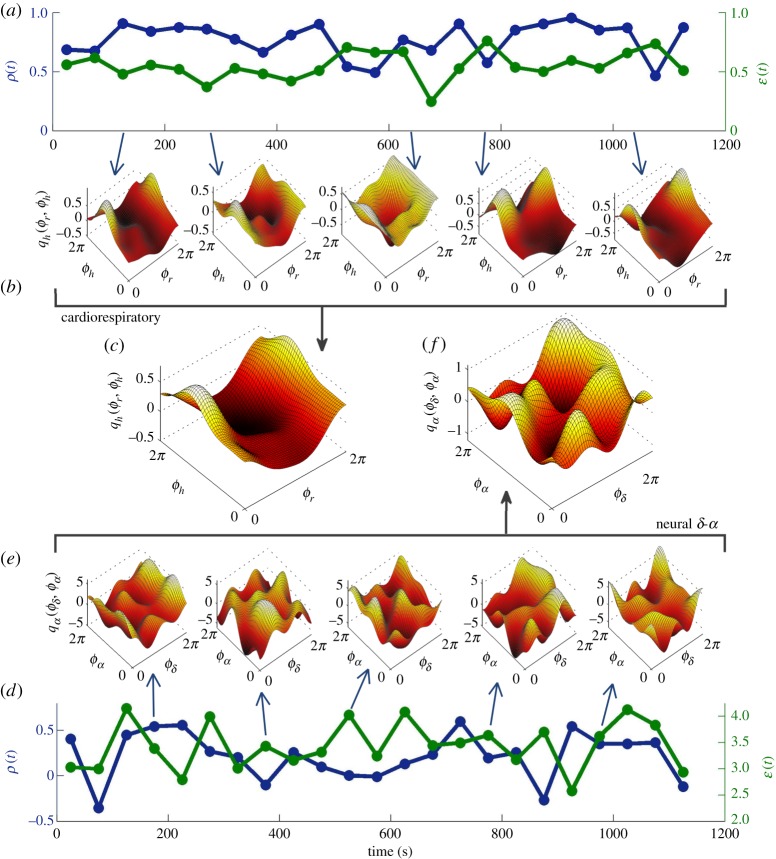
Figure 1.
Figure 1.
Time-variability of cardiorespiratory and delta-alpha neural interactions. Here, panels (ac) show results of phase coupling from respiration to cardiac oscillations, while panels (df ) show results of phase coupling from delta brainwaves to alpha brainwaves. Panel (a) plots the time-variability of the similarity of form of coupling functions ρ(t) (blue line, left ordinate) and the net coupling strength ε(t) (green line, right ordinate) for the cardiorespiratory interactions. The similarity index ρ(t) is calculated with respect to the time-averaged coupling function. The five plots in (b) show the changes in the cardiorespiratory coupling function at different times; the time of each is indicated by a small arrow from the time axis in (a). For comparison, Panel (c) presents the time-averaged cardiorespiratory coupling function. Panels (df ) follow the same logic of presentation, but for delta-alpha neural coupling functions.
Figure 2.
Figure 2.
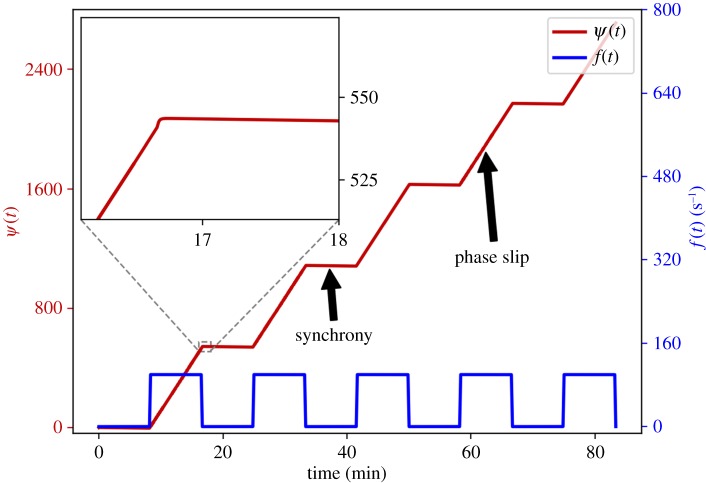
Synchronization transitions in the model equation (5.1), due to a time-varying coupling function qt in equation (4.1). Specifically, c1(t)=2αcos(f(t)t) and c2(t)=2αsin(f(t)t) as in equation (5.3), where f(t) is the periodic function defined in equation (5.4). In red is shown the phase difference ψ(t) = ϕ1(t) − ϕ2(t) as governed by equation (5.2), and in blue is shown f(t). The parameters ε and k were set to ε = 0.01 rad s−1, k = 100 rad s−1, and the net coupling strength was set to α=1.55/2s1. The inset shows the transition to synchronization. The dynamics of the phase difference is shown to alternate between synchrony states and phase slips (indicated by bold arrows in the plot of ψ(t)), due to the time-variability of the coupling function qt in equation (4.1) via the parameters c1(t) and c2(t) while the net coupling strength remains constant.
Figure 3.
Figure 3.
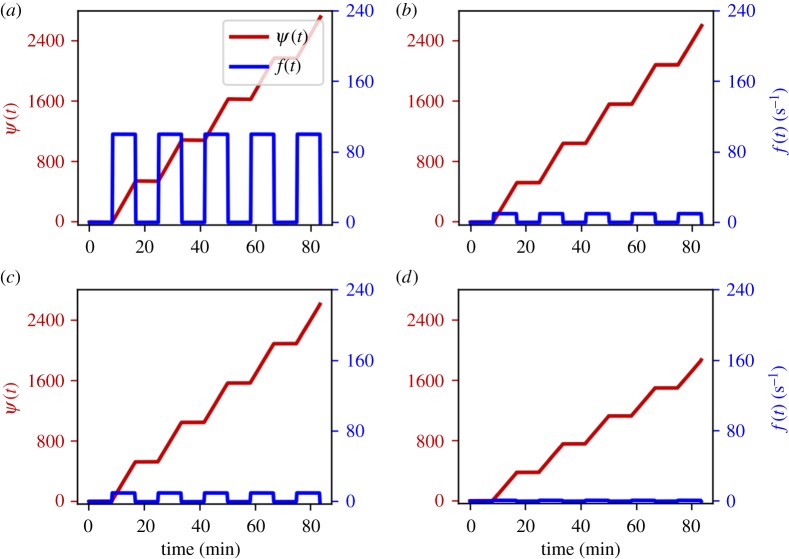
Synchronization transitions due to a time-varying coupling function, like in figure 2, with different values of the parameters ε and k for the function f(t) in equation (5.4). In all four plots, in red is shown the phase difference ψ(t), and in blue is shown f(t). The parameters ε and k were set to (a) ε = 0.01, k = 100, (b) ε = 0.001, k = 10, (c) ε = 0.0001, k = 10 and (d) ε = 0, k = 1 (all in rad s−1). In all four plots, the net coupling strength was set to α=1.176/2s1. The plots of the phase difference reveal synchronous and asynchronous states due to the time-variability of the coupling function while the net coupling strength remains constant.

References

    1. Zhang G, Ma J, Alsaedi A, Ahmad B, Alzahrani F. 2018. Dynamical behavior and application in Josephson junction coupled by memristor. Appl. Math. Comput. 321, 290–299. (10.1016/j.amc.2017.10.054) - DOI
    1. Wiesenfeld K, Colet P, Strogatz SH. 1996. Synchronization transitions in a disordered Josephson series array. Phys. Rev. Lett. 76, 404–407. (10.1103/PhysRevLett.76.404) - DOI - PubMed
    1. Cessac B. 2010. A view of neural networks as dynamical systems. Intern. J. Bifurc. Chaos 20, 1585–1629. (10.1142/S0218127410026721) - DOI
    1. Ma J, Mi L, Zhou P, Xu Y, Hayat T. 2017. Phase synchronization between two neurons induced by coupling of electromagnetic field. Appl. Math. Comput. 307, 321–328. (10.1016/j.amc.2017.03.002) - DOI
    1. Sun XJ, Perc M, Kurths J. 2017. Effect of partial time delays on phase synchronization in Watts-Strogatz small-world neuronal networks. Chaos 27, 053113 (10.1063/1.4983838) - DOI - PubMed