


Treatment as Prevention: Concepts and Challenges for Reducing HIV Incidence
- PMID: 31658196
- PMCID: PMC6820703
- DOI: 10.1097/QAI.0000000000002168
Treatment as Prevention: Concepts and Challenges for Reducing HIV Incidence
Abstract
Background: Four of the largest HIV prevention trials have been conducted in sub-Saharan Africa, enrolling hundreds of thousands of participants in catchment areas of millions of people. The trials have focused on community-level interventions to increase diagnosis and initiation of antiretroviral therapy (ART) to improve health and reduce HIV transmission. Universal test-and-treat strategies are deployed to achieve viral suppression thereby reducing risk to uninfected persons, known as treatment as prevention (TasP).
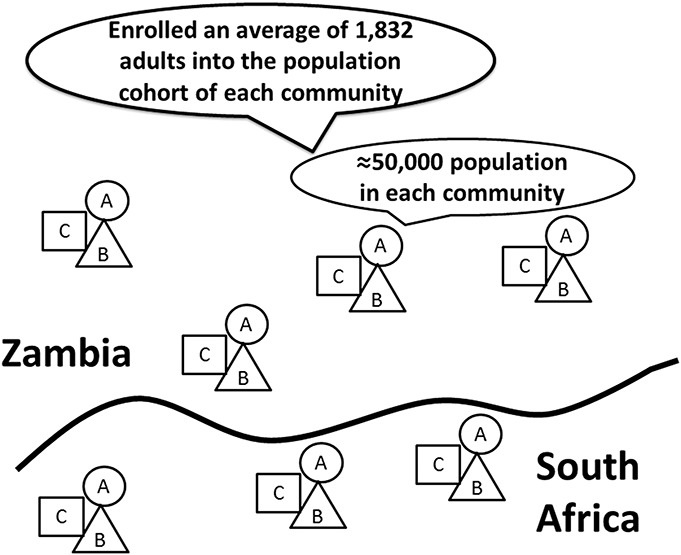
Purpose: We review the work that found HIV plasma load to correlate with transmission risk, demonstrated that ART could reduce genital tract viral expression, and showed early treatment to be beneficial for persons living with HIV, and that HIV-uninfected sexual partners were protected from infection. We review the seemingly inconsistent findings of the major TasP trials: the TasP [National Agency for AIDS Research (ANRS) 12249] study in South Africa, the SEARCH trial in Kenya and Uganda, the Botswana Combination Prevention Project Ya Tsie study, and the HIV Prevention Trials Network 071 (PopART) trial in Zambia and South Africa.
Findings: All the trials reinforce the critical need to identify approaches to optimize programs and incentivize uptake and engagement in HIV testing and ART-based care in ways that consistently reduce HIV transmission. That other chronic conditions can be screened for and treated in the same infrastructures suggests added value of HIV investments.
Conclusions: Implementation challenges are a principal frontier in the global struggle to reduce HIV transmission and mortality using TasP, complementing efforts to find a cure for HIV and an effective, deployable vaccine.
Conflict of interest statement
The authors have no conflicts of interest to disclose.
Figures
References
-
- Granich R, Williams B, Montaner J, et al. 90-90-90 and ending AIDS: necessary and feasible. Lancet. 2017;390:341–343. - PubMed
-
- Dieffenbach CW, Fauci AS. Universal voluntary testing and treatment for prevention of HIV transmission. JAMA. 2009;301:2380–2382. - PubMed
-
- Granich RM, Gilks CF, Dye C, et al. Universal voluntary HIV testing with immediate antiretroviral therapy as a strategy for elimination of HIV transmission: a mathematical model. Lancet. 2009;373:48–57. - PubMed
-
- Quinn TC, Wawer MJ, Sewankambo N, et al. Viral load and heterosexual transmission of human immunodeficiency virus type 1. Rakai Project Study Group. N Engl J Med. 2000;342:921–929. - PubMed
Publication types
MeSH terms
Substances
Grants and funding
- U01 AI068619/AI/NIAID NIH HHS/United States
- U01 AI096299/AI/NIAID NIH HHS/United States
- R13 HD074468/HD/NICHD NIH HHS/United States
- P30 MH062294/MH/NIMH NIH HHS/United States
- UL1 TR001863/TR/NCATS NIH HHS/United States
- P30 MH043520/MH/NIMH NIH HHS/United States
- P30 AI045008/AI/NIAID NIH HHS/United States
- K12 HS023000/HS/AHRQ HHS/United States
- UM1 AI068619/AI/NIAID NIH HHS/United States
- P30 AI124414/AI/NIAID NIH HHS/United States
- P30 MH097488/MH/NIMH NIH HHS/United States
- R01 AI112339/AI/NIAID NIH HHS/United States
LinkOut - more resources
Full Text Sources
Medical
Miscellaneous
