Review
. 2019 Oct 10;20(20):5020.
doi: 10.3390/ijms20205020.

Caenorhabditis Elegans and Probiotics Interactions from a Prolongevity Perspective

Affiliations
Review

Caenorhabditis Elegans and Probiotics Interactions from a Prolongevity Perspective

Marianna Roselli et al. Int J Mol Sci. .

Abstract

Probiotics exert beneficial effects on host health through different mechanisms of action, such as production of antimicrobial substances, competition with pathogens, enhancement of host mucosal barrier integrity and immunomodulation. In the context of ageing, which is characterized by several physiological alterations leading to a low grade inflammatory status called inflammageing, evidences suggest a potential prolongevity role of probiotics. Unraveling the mechanisms underlying anti-ageing effects requires the use of simple model systems. To this respect, the nematode Caenorhabditis elegans represents a suitable model organism for the study of both host-microbe interactions and for ageing studies, because of conserved signaling pathways and host defense mechanisms involved in the regulation of its lifespan. Therefore, this review analyses the impact of probiotics on C. elegans age-related parameters, with particular emphasis on oxidative stress, immunity, inflammation and protection from pathogen infections. The picture emerging from our analysis highlights that several probiotic strains are able to exert anti-ageing effects in nematodes by acting on common molecular pathways, such as insulin/insulin-like growth factor-1 (IIS) and p38 mitogen-activated protein kinase (p38 MAPK). In this perspective, C. elegans appears to be advantageous for shedding light on key mechanisms involved in host prolongevity in response to probiotics supplementation.

Keywords: ageing; immunosenescence; lifespan; nematode; oxidative stress; pathogen protection; probiotic bacteria.


Conflict of interest statement

The authors declare no conflicts of interest.

Figures
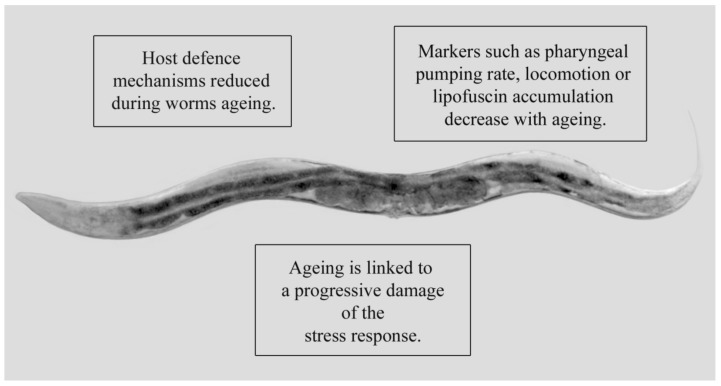
Figure 1
Figure 1
Micrograph representing the model organism Caenorhabditis elegans (the head is on the left; the tail is on the right). The principal biomarkers and physiological traits associated with ageing are described in the squares. Magnification: 5×.
Figure 2
Figure 2
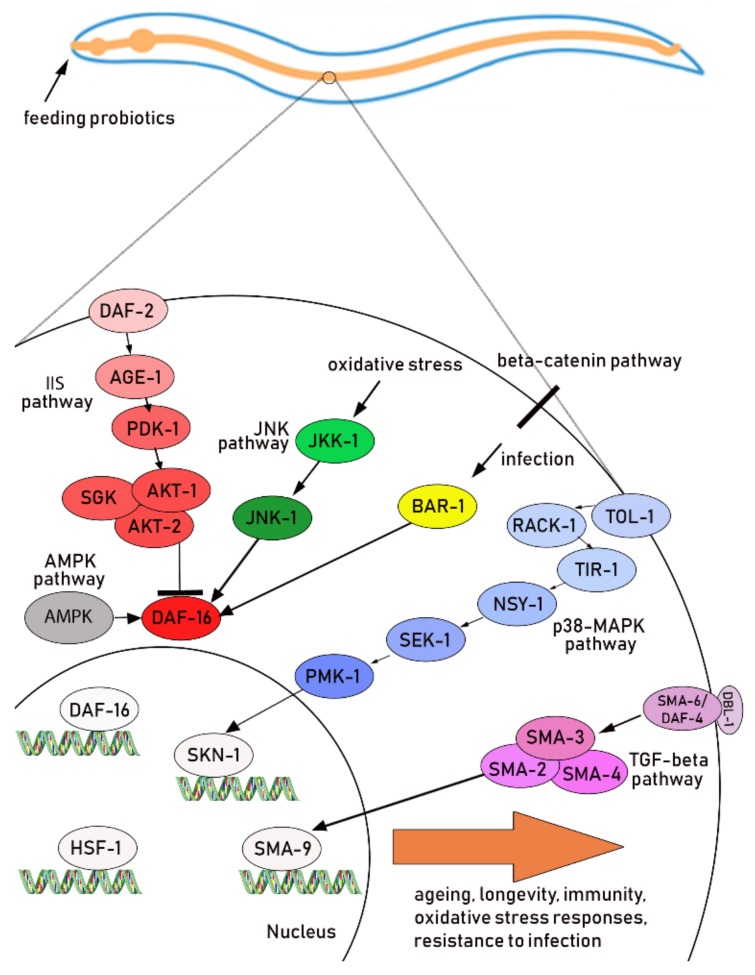
Schematic representation of the most common signaling pathways influenced by probiotic strains employed in C. elegans studies. Each pathway is represented by a distinct color gradient. The list of single bacterial strains influencing the different pathways is reported in Table 1. Abbreviations used: AMPK: 5′ AMP-activated protein kinase; AKT-1/2: serine/threonine protein kinase orthologs; BAR-1: beta-catenin/armadillo Related-1; DAF: dauer formation; DBL-1: DPP/BMP-Like-1; HSF-1: heat-shock transcription factor-1; IIS: insulin/insulin-like growth factor-1; JKK-1: c-Jun N-terminal kinase kinase; JNK-1: c-Jun N-terminal kinase; MAPK: mitogen-activated protein kinase; NSY-1: neuronal symmetry-1; PDK-1: phosphoinositide-dependent kinase 1; PMK-1: p38 mitogen-activated protein kinase-1 ortholog; RACK-1: receptor activated protein C kinase; SEK-1: SAPK/ERK kinase-1; SGK-1: serine/threonine protein kinase ortholog; SKN-1: skinhead family member-1; SMA: small; TIR-1: toll interleukin-1 receptor-1.

References

    1. Brenner S. The genetics of Caenorhabditis elegans. Genetics. 1974;77:71–94. - PMC - PubMed
    1. Kenyon C. A conserved regulatory system for aging. Cell. 2001;105:165–168. doi: 10.1016/S0092-8674(01)00306-3. - DOI - PubMed
    1. O’Kane C.J. Modelling human diseases in Drosophila and Caenorhabditis. Semin. Cell Dev. Biol. 2003;14:3–10. doi: 10.1016/S1084-9521(02)00162-3. - DOI - PubMed
    1. Fontana L., Partridge L., Longo V.D. Extending healthy life span—From yeast to humans. Science. 2010;328:321–326. doi: 10.1126/science.1172539. - DOI - PMC - PubMed
    1. Murphy C.T., McCarroll S.A., Bargmann C.I., Fraser A., Kamath R.S., Ahringer J., Li H., Kenyon C. Genes that act downstream of DAF-16 to influence the lifespan of Caenorhabditis elegans. Nature. 2003;424:277–283. doi: 10.1038/nature01789. - DOI - PubMed

Substances

LinkOut - more resources