. 2019 Sep 9;7(10):3349-3360.
doi: 10.1002/fsn3.1204. eCollection 2019 Oct.

Aluminum contamination of food during culinary preparation: Case study with aluminum foil and consumers' preferences

Affiliations

Aluminum contamination of food during culinary preparation: Case study with aluminum foil and consumers' preferences

Dani Dordevic et al. Food Sci Nutr. .

Abstract

The aim of the work was to estimate the degree of aluminum leakage from aluminum foil during baking process of selected food/meals. The experiment included 11 different types of food (Atlantic salmon Salmo salar, mackerel Scomber scombrus, duck breasts, cheese Hermelín, tomato, paprika, Carlsbad dumplings, pork roast, pork neck, chicken breasts, and chicken thighs) baked both marinated and not marinated. The aluminum content was measured by AAS and ICP/MS methods. The highest aluminum increase was observed in the samples of marinated Salmo salar (41.86 ± 0.56 mg/kg), Scomber scombrus (49.34 ± 0.44 mg/kg), and duck breast (117.26 ± 1.37 g/kg). The research was also supported by the survey that consisted of 784 respondents with different sociodemographic characteristics. The study clearly showed the occurrence of aluminum contamination of food when it is prepared by baking in aluminum foil. It cannot be concluded that aluminum leakage will occur with each type of food. The aluminum contents found among investigated samples are not alarming, though the increase was measured up to 40 times. On the other hand, revealed aluminum contents can represent a risk for younger/smaller children and for individuals with diagnosed certain ailments.

Keywords: aluminum foil; baking; consumers’ preferences; leakage; marinating.


Conflict of interest statement

The authors declare no conflict of interest or relationship, financial or otherwise.

Figures
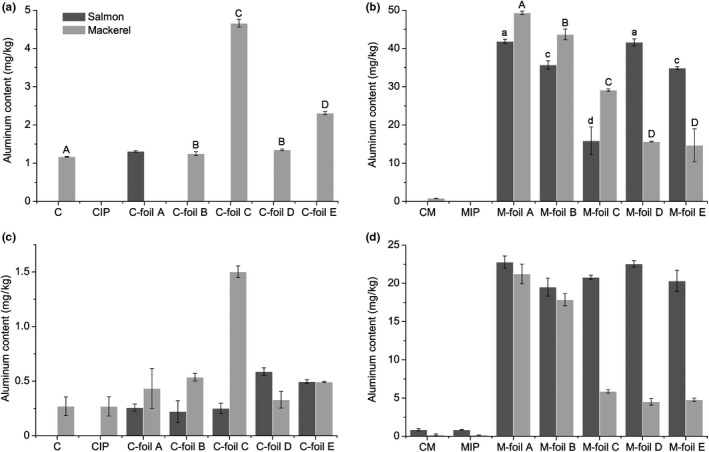
Figure 1
Figure 1
Aluminum content in baked salmon and mackerel fish (marinated and not marinated) determined by ICP‐MS and AAS. *A: aluminum content in the samples of salmon and mackerel not marinated (measured by ICP/MS), B: aluminum content in the samples of salmon and mackerel marinated (measured by ICP/MS), C: aluminum content in the samples of salmon and mackerel not marinated (measured by AAS), D: aluminum content in the samples of salmon and mackerel marinated (measured by AAS), **C: control; CIP: control packed in inert packaging; C‐foil A, C‐foil B, C‐foil C, C‐foil D, C‐foil E: samples packed in different foils CM: control marinade; MIP: samples in marinade packed in inert packaging; M‐foil A, M‐foil B, M‐foil C, M‐foil D, M‐foil E: samples in marinade packed in different foils, ***Different lowercase letters (a, b, c, d) indicate significant statistical (p < .05) difference between salmon samples. Different uppercase letters (A, B, C, D) indicate significant statistical (p < .05) difference between salmon samples
Figure 2
Figure 2
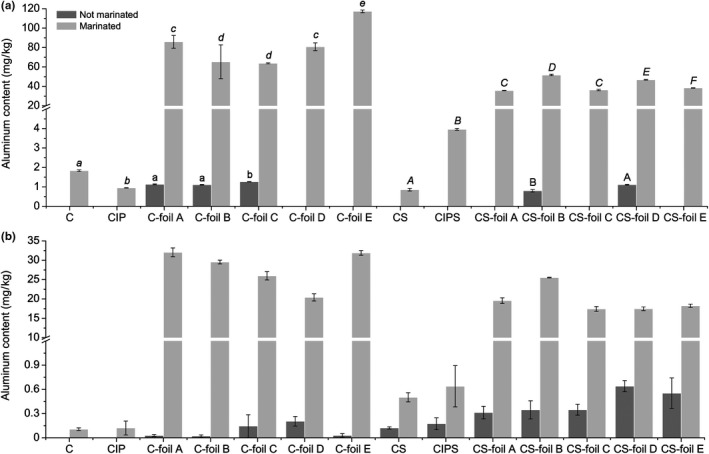
Aluminum content in baked duck breast samples (with skin and without skin) (ICP‐MS and AAS). **C: control; CIP: control packed in inert packaging; C‐foil A, C‐foil B, C‐foil C, C‐foil D, C‐foil E: samples packed in different foils CM: control marinade; MIP: samples in marinade packed in inert packaging; M‐foil A, M‐foil B, M‐foil C, M‐foil D, M‐foil E: samples in marinade packed in different foils. *A: aluminum content in the samples of duck breast without and with skin (measured by ICP‐MS). B: aluminum content in the samples of duck breast without and with skin (measured by AAS). *C: control without skin; CIP: control packed in inert packaging without skin; C‐foil A, C‐foil B, C‐foil C, C‐foil D, C‐foil E: samples packed in different foils without skin; CS: control marinade with skin; CIPS: samples in marinade packed in inert packaging with skin; CS‐foil A, CS‐foil B, CS‐foil C, CS‐foil D, CS‐foil E: samples in marinade packed in different foils with skin. ***Different lowercase letters (a, b, c) indicate significant statistical (p < .05) difference between duck breast samples without skin. Different uppercase letters (A, B, C) indicate significant statistical (p < .05) difference between duck breast samples with skin
Figure 3
Figure 3
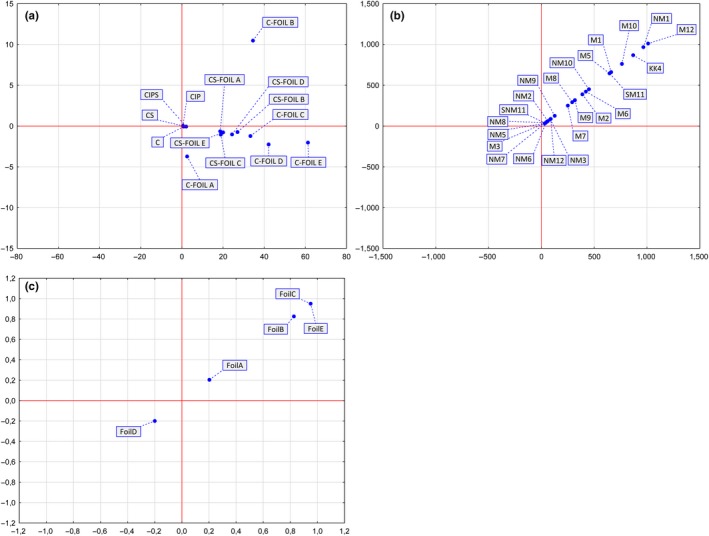
Principal component analysis of aluminum content in investigated samples and the profile of used aluminum foils. A*C: control without skin; CIP: control packed in inert packaging without skin; C‐foil A, C‐foil B, C‐foil C, C‐foil D, C‐foil E: samples packed in different foils without skin; CS: control marinade with skin; CIPS: samples in marinade packed in inert packaging with skin; CS‐foil A, CS‐foil B, CS‐foil C, CS‐foil D, CS‐foil E: samples in marinade packed in different foils with skin. B*NM1: hermelin not marinated, NM2: tomato not marinated, NM3: paprika not marinated, NM5: pork roast not marinated, NM6: pork neck not marinated, NM7: chicken breasts not marinated, NM8: chicken legs not marinated, NM9: salmon not marinated, NM10: mackerel not marinated, NM12: duck breasts without skin not marinated. M1: hermelin marinated, M2: tomato marinated, M3: paprika marinated, M6: pork neck marinated, M7: chicken breasts marinated, M8: chicken legs marinated, M9: salmon marinated, M10: mackerel marinated, M12: duck breasts without skin marinated. KK4: karlovarsky knedlik, SNM11: duck breasts with skin not marinated, SM11: duck breasts with skin marinated
Figure 4
Figure 4
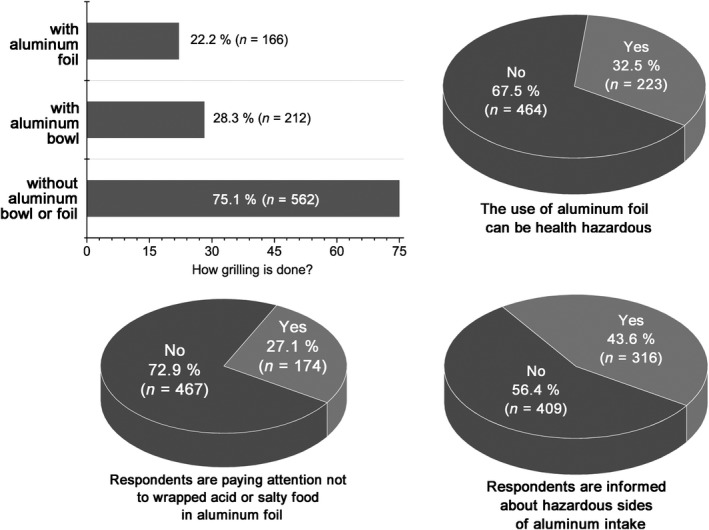
Respondents’ preferences concerning the use of aluminum foil

References

    1. Al Juhaiman, L. A. (2010). Estimating Aluminum leaching from Aluminum cook wares in different meat extracts and milk. Journal of Saudi Chemical Society, 14, 131–137. 10.1016/j.jscs.2009.12.020 - DOI
    1. Al Juhaiman, L. A. , Al‐Shihry, R. A. , & Al‐Hazimi, H. M. (2014). Effect of cardamom extract on leaching of aluminum cookware. International Journal of Electrochemical Science, 9, 1055–1070.
    1. Al Zubaidy, E. A. H. , Mohammad, F. S. , & Bassioni, G. (2011). Effects of pH, salinity and temperature on aluminum cookware leaching during food preparation. International Journal of Electrochemical Science, 6, 6424–6441.
    1. Bassioni, G. , Mohammed, F. S. , Al Zubaidy, E. , & Kobrsi, I. (2012). Risk assessment of using aluminum foil in food preparation. International Journal of Electrochemical Science, 7, 4498–4509.
    1. Becaria, A. , Campbell, A. , & Bondy, S. C. (2002). Aluminium is a toxicant. Toxicology and Industrial Health, 18, 309–320. - PubMed

LinkOut - more resources