


Effectiveness of influenza vaccine against influenza A in Europe in seasons of different A(H1N1)pdm09 and the same A(H3N2) vaccine components (2016-17 and 2017-18)
- PMID: 31660536
- PMCID: PMC6807025
- DOI: 10.1016/j.jvacx.2019.100042
Effectiveness of influenza vaccine against influenza A in Europe in seasons of different A(H1N1)pdm09 and the same A(H3N2) vaccine components (2016-17 and 2017-18)
Abstract
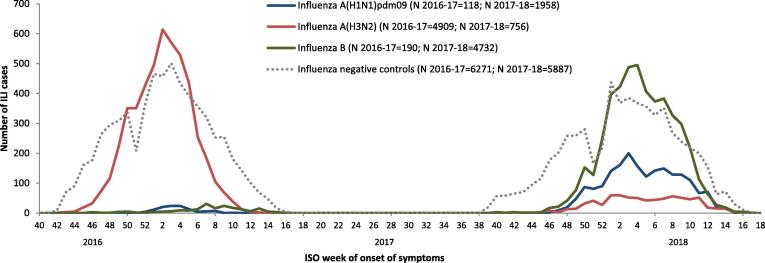
Introduction: Influenza A(H3N2) viruses predominated in Europe in 2016-17. In 2017-18 A(H3N2) and A(H1N1)pdm09 viruses co-circulated. The A(H3N2) vaccine component was the same in both seasons; while the A(H1N1)pdm09 component changed in 2017-18. In both seasons, vaccine seed A(H3N2) viruses developed adaptations/alterations during propagation in eggs, impacting antigenicity.
Methods: We used the test-negative design in a multicentre primary care case-control study in 12 European countries to measure 2016-17 and 2017-18 influenza vaccine effectiveness (VE) against laboratory-confirmed influenza A(H1N1)pdm09 and A(H3N2) overall and by age group.
Results: During the 2017-18 season, the overall VE against influenza A(H1N1)pdm09 was 59% (95% CI: 47-69). Among those aged 0-14, 15-64 and ≥65 years, VE against A(H1N1)pdm09 was 64% (95% CI: 37-79), 50% (95% CI: 28-66) and 66% (95% CI: 42-80), respectively. Overall VE against influenza A(H3N2) was 28% (95% CI: 17-38) in 2016-17 and 13% (95% CI: -15 to 34) in 2017-18. Among 0-14-year-olds VE against A(H3N2) was 28% (95%CI: -10 to 53) and 29% (95% CI: -87 to 73), among 15-64-year-olds 34% (95% CI: 18-46) and 33% (95% CI: -3 to 56) and among those aged ≥65 years 15% (95% CI: -10 to 34) and -9% (95% CI: -74 to 32) in 2016-17 and 2017-18, respectively.
Conclusions: Our study suggests the new A(H1N1)pdm09 vaccine component conferred good protection against circulating strains, while VE against A(H3N2) was <35% in 2016-17 and 2017-18. The egg propagation derived antigenic mismatch of the vaccine seed virus with circulating strains may have contributed to this low effectiveness. A(H3N2) seed viruses for vaccines in subsequent seasons may be subject to the same adaptations; in years with lower than expected VE, recommendations of preventive measures other than vaccination should be given in a timely manner.
Keywords: Case-control study; Europe; Influenza; Influenza vaccine; Multicentre study; Vaccine effectiveness.
© 2019 The Authors.
Conflict of interest statement
The authors declare that they have no known competing financial interests or personal relationships that could have appeared to influence the work reported in this paper.
Figures
References
-
- ECDC, ‘Influenza virus characterisation - Summary Europe, June 2016’, Jul. 2016.
-
- C. Adlhoch, R. Snacken, A. Melidou, S. Ionescu, P. Penttinen, and The European Influenza Surveillance Network, ‘Dominant influenza A(H3N2) and B/Yamagata virus circulation in EU/EEA, 2016/17 and 2017/18 seasons, respectively’, Euro Surveill. Bull. Eur. Sur Mal. Transm. Eur. Commun. Dis. Bull., vol. 23, no. 13, 2018. - PMC - PubMed
-
- EuroMOMO, ‘European monitoring of excess mortality for public health action - EuroMOMO’. [Online]. Available: [Accessed: 14-Aug-2018]. http://www.euromomo.eu/index.html.
-
- Valenciano M., Ciancio B., I-MOVE study team I-MOVE: a European network to measure the effectiveness of influenza vaccines. Euro Surveill. Bull. Eur. Sur Mal. Transm. Eur. Commun. Dis. Bull. 2012;17(39) Sep. - PubMed
LinkOut - more resources
Full Text Sources
