


An integrated health delivery platform, targeting soil-transmitted helminths (STH) and canine mediated human rabies, results in cost savings and increased breadth of treatment for STH in remote communities in Tanzania
- PMID: 31660915
- PMCID: PMC6819457
- DOI: 10.1186/s12889-019-7737-6
An integrated health delivery platform, targeting soil-transmitted helminths (STH) and canine mediated human rabies, results in cost savings and increased breadth of treatment for STH in remote communities in Tanzania
Abstract
Background: Achieving the Sustainable Development Goal of a 90% reduction in neglected tropical diseases (NTDs) by 2030 requires innovative control strategies. This proof-of-concept study examined the effectiveness of integrating control programs for two NTDs: mass drug administration (MDA) for soil-transmitted helminths in humans and mass dog rabies vaccination (MDRV).
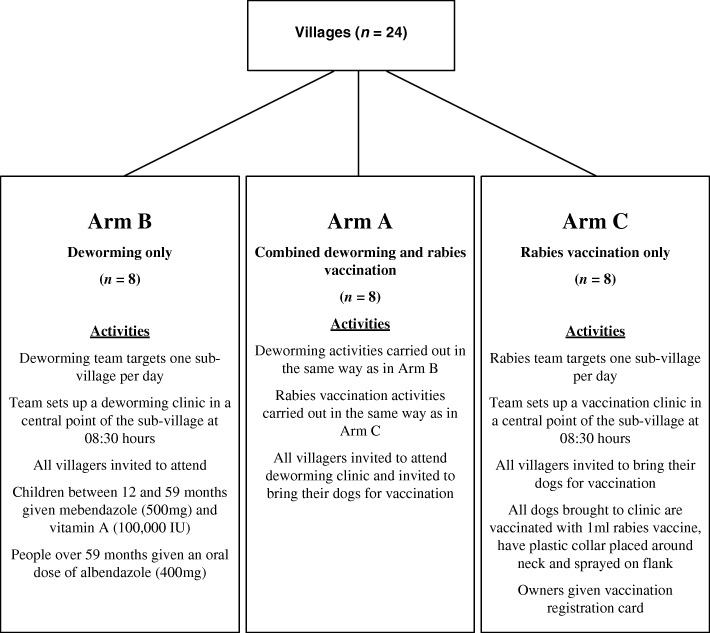
Methods: The study was carried out in 24 Tanzanian villages. The primary goal was to demonstrate the feasibility of integrating community-wide MDA for STH and MDRV for rabies. The objectives were to investigate the popularity, participation and cost and time savings of integrated delivery, and to investigate the reach of the MDA with respect to primary school-aged children and other community members. To implement, we randomly allocated villages for delivery of MDA and MDRV (Arm A), MDA only (Arm B) or MDRV only (Arm C).
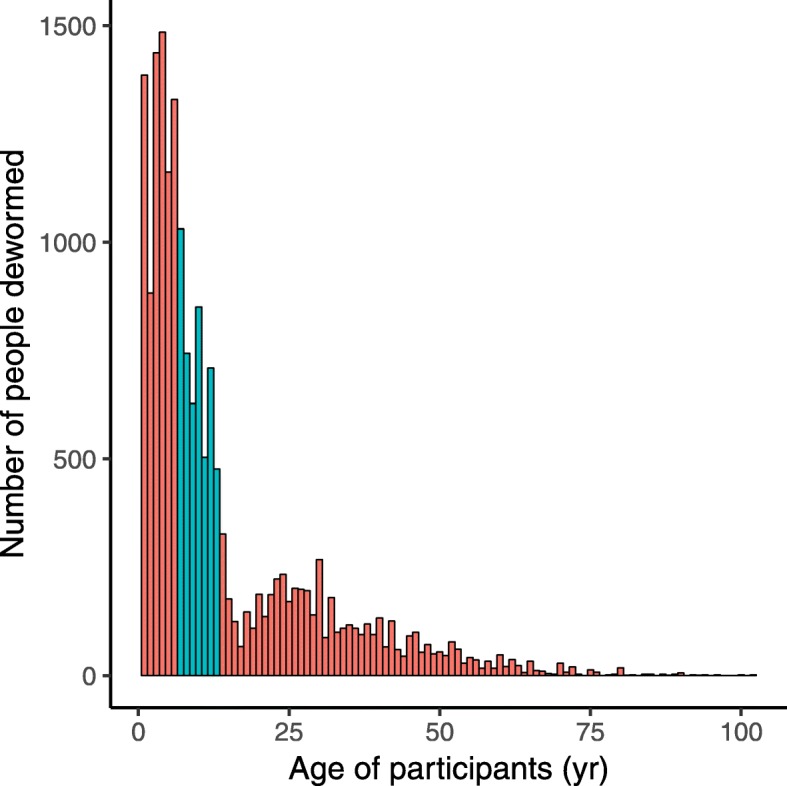
Results: Community support for the integrated delivery was strong (e.g. 85% of focus group discussions concluded that it would result in people getting "two for one" health treatments). A high proportion of households participated in the integrated Arm A events (81.7% MDA, 80.4% MDRV), and these proportions were similar to those in Arms B and C. These findings suggest that coverage might not be reduced when interventions are integrated. Moreover, in addition to time savings, integrated delivery resulted in a 33% lower cost per deworming dose and a 16% lower cost per rabies vaccination. The median percentage of enrolled primary school children treated by this study was 76%. However, because 37% of the primary school aged children that received deworming treatment were not enrolled in school, we hypothesize that the employed strategy could reach more school-aged children than would be reached through a solely school-based delivery strategy.
Conclusions: Integrated delivery platforms for health interventions can be feasible, popular, cost and time saving. The insights gained could be applicable in areas of sub-Saharan Africa that are remote or underserved by health services. These results indicate the utility of integrated One Health delivery platforms and suggest an important role in the global campaign to reduce the burden of NTDs, especially in hard-to-reach communities.
Trial registration: clinicaltrials.gov NCT03667079 , retrospectively registered 11th September 2018.
Keywords: Integrated mass drug delivery; Neglected tropical disease; One health; Rabies; Soil transmitted helminths; Tanzania.
Conflict of interest statement
The authors declare that they have no competing interests.
Figures
References
-
- The Economist. Winning the endgame: a global attack on long-neglected tropical diseases is succeeding. Econ 2017.
-
- World Health Organisation. Fourth WHO report on neglected tropical diseases: Integrating neglected tropical diseases into global health and development. Geneva: 2017.
Publication types
MeSH terms
Substances
Associated data
Grants and funding
LinkOut - more resources
Full Text Sources
Medical
