


Recent advances in nanotheranostics for triple negative breast cancer treatment
- PMID: 31661003
- PMCID: PMC6819447
- DOI: 10.1186/s13046-019-1443-1
Recent advances in nanotheranostics for triple negative breast cancer treatment
Abstract
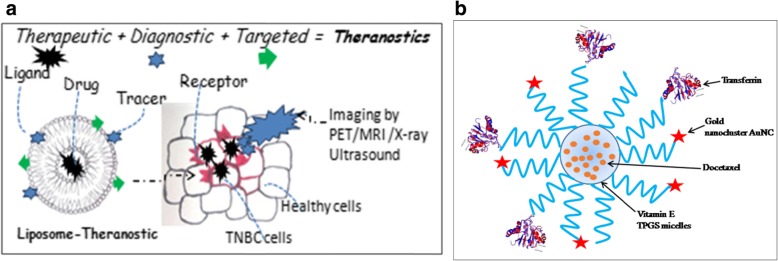
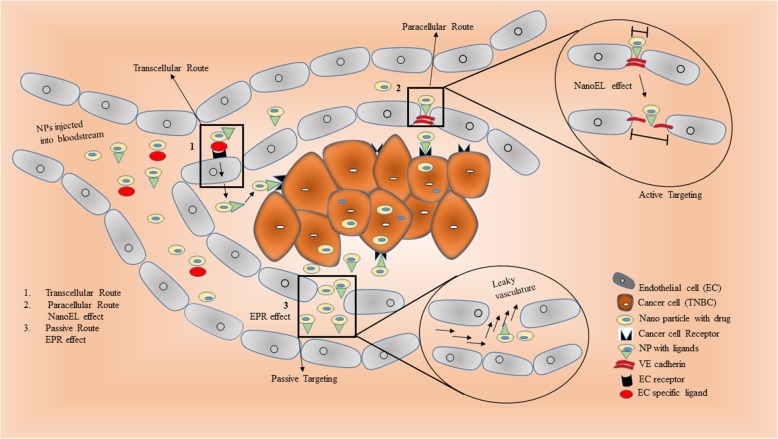
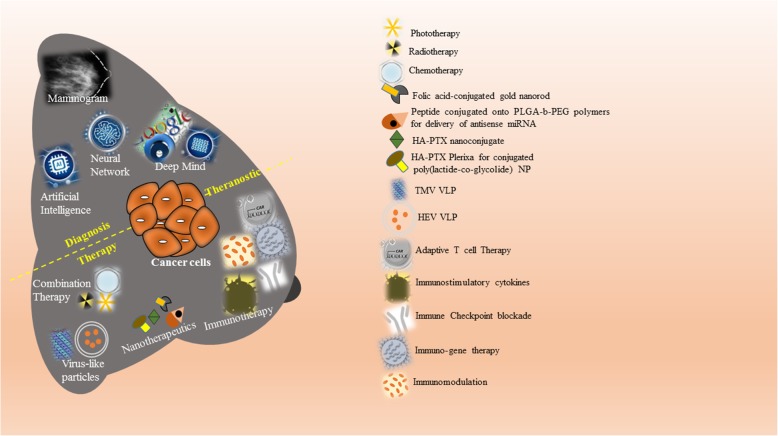
Triple-negative breast cancer (TNBC) is the most complex and aggressive type of breast cancer encountered world widely in women. Absence of hormonal receptors on breast cancer cells necessitates the chemotherapy as the only treatment regime. High propensity to metastasize and relapse in addition to poor prognosis and survival motivated the oncologist, nano-medical scientist to develop novel and efficient nanotherapies to solve such a big TNBC challenge. Recently, the focus for enhanced availability, targeted cellular uptake with minimal toxicity is achieved by nano-carriers. These smart nano-carriers carrying all the necessary arsenals (drugs, tracking probe, and ligand) designed in such a way that specifically targets the TNBC cells at site. Articulating the targeted delivery system with multifunctional molecules for high specificity, tracking, diagnosis, and treatment emerged as theranostic approach. In this review, in addition to classical treatment modalities, recent advances in nanotheranostics for early and effective diagnostic and treatment is discussed. This review highlighted the recently FDA approved immunotherapy and all the ongoing clinical trials for TNBC, in addition to nanoparticle assisted immunotherapy. Futuristic but realistic advancements in artificial intelligence (AI) and machine learning not only improve early diagnosis but also assist clinicians for their workup in TNBC. The novel concept of Nanoparticles induced endothelial leakiness (NanoEL) as a way of tumor invasion is also discussed in addition to classical EPR effect. This review intends to provide basic insight and understanding of the novel nano-therapeutic modalities in TNBC diagnosis and treatment and to sensitize the readers for continue designing the novel nanomedicine. This is the first time that designing nanoparticles with stoichiometric definable number of antibodies per nanoparticle now represents the next level of precision by design in nanomedicine.
Keywords: Breast Cancer; Immunotherapy; NanoEL; Nanomedicine; Nanotechnology; Theranostics.
Conflict of interest statement
The authors declare that they have no competing interests
Figures
References
-
- EER Preliminary Cancer Incidence Rate Estimates for 2017, and diagnosis years 2000 to 2017, SEER 18, National Cancer Institute. Bethesda, MD, https://seer.cancer.gov/statistics/preliminary-estimates/, based on the February 2019 SEER data submission and the November 2018 SEER data submission. Posted to the SEER web site, September 2019.
-
- Bonsang-Kitzis H, Sadacca B, Hamy-Petit AS, Moarii M, Pinheiro A, Laurent C, et al. Biological network-driven gene selection identifies a stromal immune module as a key determinant of triple-negative breast carcinoma prognosis. Oncoimmunology. 2016;5(1):e1061176. doi: 10.1080/2162402X.2015.1061176. - DOI - PMC - PubMed
Publication types
MeSH terms
Grants and funding
LinkOut - more resources
Full Text Sources
Other Literature Sources
