Review
. 2020 Jan;113(1):4-21.
doi: 10.1111/mmi.14409. Epub 2019 Nov 24.

New insights into the mycobacterial PE and PPE proteins provide a framework for future research

Affiliations
Review

New insights into the mycobacterial PE and PPE proteins provide a framework for future research

Louis S Ates. Mol Microbiol. 2020 Jan.

Abstract

The PE and PPE proteins of Mycobacterium tuberculosis have been studied with great interest since their discovery. Named after the conserved proline (P) and glutamic acid (E) residues in their N-terminal domains, these proteins are postulated to perform wide-ranging roles in virulence and immune modulation. However, technical challenges in studying these proteins and their encoding genes have hampered the elucidation of molecular mechanisms and leave many open questions regarding the biological functions mediated by these proteins. Here, I review the shared and unique characteristics of PE and PPE proteins from a molecular perspective linking this information to their functions in mycobacterial virulence. I discuss how the different subgroups (PE_PGRS, PPE-PPW, PPE-SVP and PPE-MPTR) are defined and why this classification of paramount importance to understand the PE and PPE proteins as individuals and or groups. The goal of this MicroReview is to summarize and structure the existing information on this gene family into a simplified framework of thinking about PE and PPE proteins and genes. Thereby, I hope to provide helpful starting points in studying these genes and proteins for researchers with different backgrounds. This has particular implications for the design and monitoring of novel vaccine candidates and in understanding the evolution of the M. tuberculosis complex.


Conflict of interest statement

The author declares no financial conflict of interest.

Figures
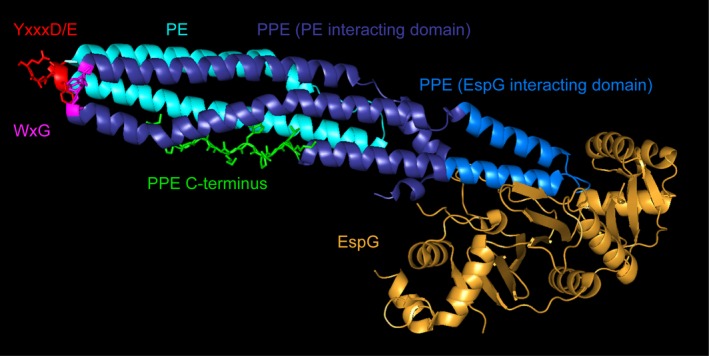
Figure 1
Figure 1
Structure of the EspG5‐PPE41‐PE25 complex (4KXR). The EspG chaperone (Gold) binds to the EspG‐binding domain of the PPE protein (Light blue), thereby conferring TypeVII secretion system specificity (Daleke et al., 2012b; Korotkova et al., 2014; Phan et al., 2017). The rest of the PPE‐protein interacts with its PE partner (Teal) via hydrophobic interactions. The conserved WxG residues of the PPE (Pink) and YxxxD/E of the PE (Red) are closely associated and may form a composite TypeVII secretion signal. The C‐terminus of the PPE (Green) extends toward the C‐terminus of the PE (Red), suggesting that PE/PPE protein pairs with C‐terminal extensions may have further PE/PPE interactions between those specific domains.
Figure 2
Figure 2
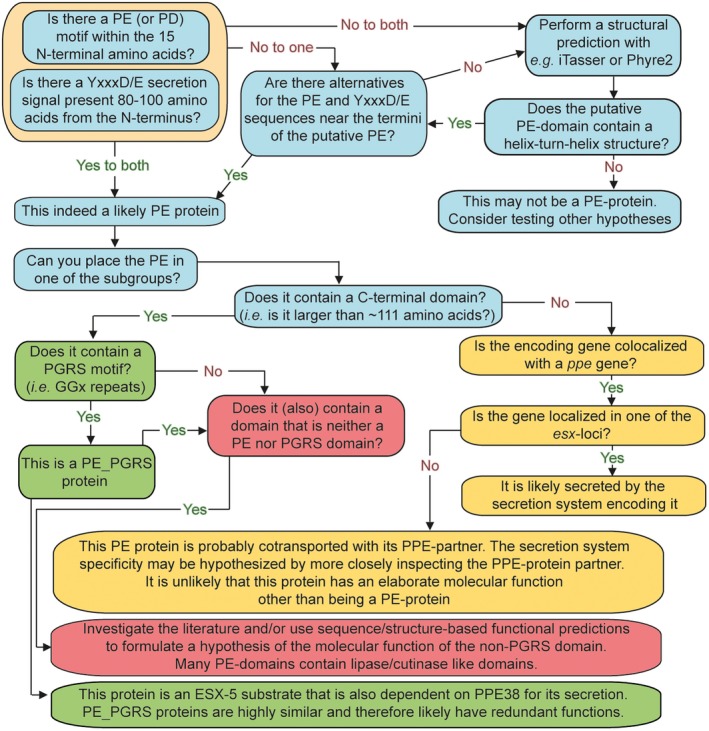
A proposed flow chart to aid researchers to identify and classify PE‐proteins and to formulate testable hypotheses. When interested in a PE gene or protein, a first step can be to verify that it is indeed a functional PE protein, by investigating presence of the defining characteristics (Start at the left top of the flow chart). A following step is to classify the PE‐protein based on its C‐terminal domains (or lack thereof) and genomic localization.
Figure 3
Figure 3
A proposed flow chart to aid researchers to identify and classify PPE proteins in order to formulate testable hypotheses. When interested in a PPE gene or protein, a first step can be to verify it is indeed a functional PPE protein, by investigating presence of the defining characteristics (Start at the left top of the flow chart). A following step is to classify the PPE‐protein as a PPE‐PPW (Green), PPE‐SVP (Red), PPE‐MPTR (Yellow), or other (blue), based on its C‐terminal domains (or lack thereof).
Figure 4
Figure 4
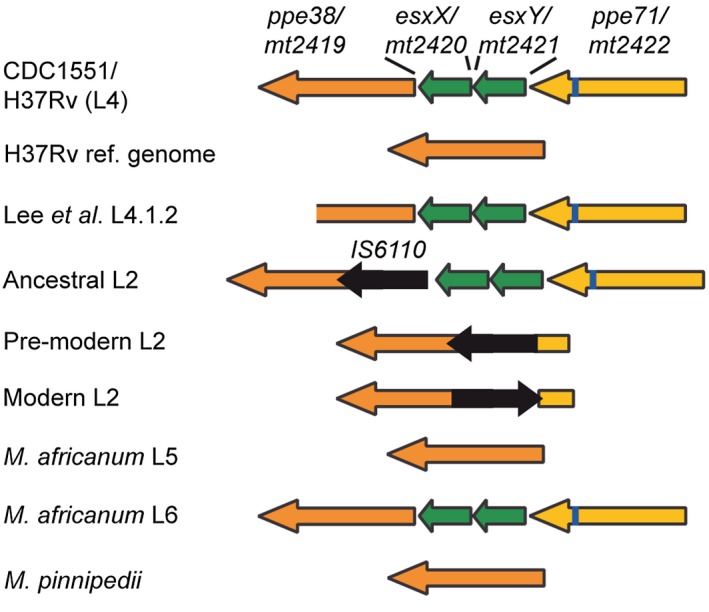
A selection of existing configurations of the ppe38‐71 locus. Gene numbers correspond to the M. tuberculosis CDC1551 reference genome. ppe38 (orange) and ppe71 (yellow) are genetically identical except for a 21bp deletion (blue) in ppe71. The two esx‐genes (green) have been named esxX and esxY based on standardized nomenclature (Bitter et al., 2009; Ates et al., 2018b). The most common configuration of the locus is depicted at the top (McEvoy et al., 2009a). The H37Rv reference genome (second line) is misannotated as having only one copy of ppe38, but multiple H37Rv strains were shown to possess the CDC1551‐like locus (Box 1; McEvoy et al., 2009a; Ates et al., 2018b). However, the configuration of a single copy of either ppe38, or ppe71, does occur due to recombination in diverse clinical isolates and is referred to as RvD7 (McEvoy et al., 2009a). An RD5‐like deletion that truncates ppe38, but keeps ppe71 intact, was found in certain L4 isolates. This polymorphism did not negatively affect PPE38‐dependent secretion (Lee et al., 2015; Ates et al., 2018c). Similarly, in an ancestral L2‐isolate (SAWC_2088) an IS6110 (black) insertion truncation ppe38 does not negatively affect PPE‐38‐dependent secretion. Subsequent recombination that occurred at the branching point of the modern L2‐lineages, have also truncated ppe71 and deleted esxXY, resulting in a loss of PPE38‐dependent secretion (McEvoy et al., 2009a; Ates et al., 2018b). It should be emphasized that many more configurations of the ppe38‐71 locus, including different RD5‐like deletions have been more thoroughly described in McEvoy et al., 2009b (McEvoy et al., 2009a).
Figure 5
Figure 5
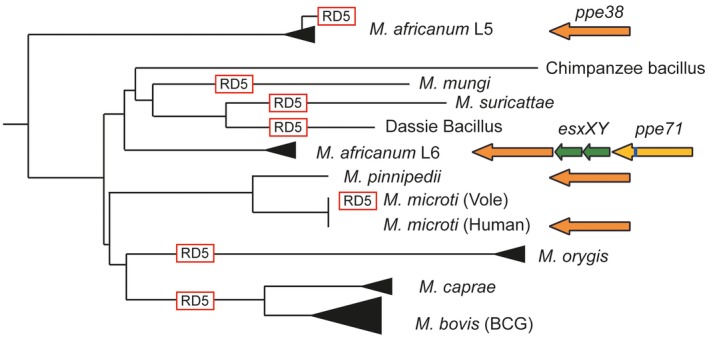
RD5 and ppe38 polymorphisms in M. africanum and the animal‐adapted species of the M. tuberculosis complex. The phylogeny is adapted from Brites et al. with permission of the author (Brites et al., 2018). Independent RD5 deletions, with unique remaining flanking sequences, are depicted in the phylogenetic tree. The organization of the ppe38 locus in M. africanum L5, L6 and M. microti and M. pinnipedii is indicated with arrows, similar as in Fig. 4. Only one out of 18 M. africanum L5 isolates was found to have an RD5‐like deletion (Ates et al., 2018a). In a study by Brodin et al. three M. microti isolates from humans had an intact RD5‐locus, while four strains isolated from voles had RD5‐deletions (Brodin et al., 2002).

References

    1. Abdallah, A.M. , Verboom, T. , Hannes, F. , Safi, M. , Strong, M. , Eisenberg, D. , et al (2006) A specific secretion system mediates PPE41 transport in pathogenic mycobacteria. Molecular Microbiology, 62, 667–679. - PubMed
    1. Abdallah, A.M. , Gey van Pittius, N.C. , Champion, P.A.D. , Cox, J. , Luirink, J. , Vandenbroucke‐Grauls, C.M.J.E. , et al (2007) Type VII secretion – mycobacteria show the way. Nature Reviews Microbiology, 5, 883–891. - PubMed
    1. Abdallah, A.M. , Verboom, T. , Weerdenburg, E.M. , Gey van Pittius, N.C. , Mahasha, P.W. , Jiménez, C. , et al (2009) PPE and PE_PGRS proteins of Mycobacterium marinum are transported via the type VII secretion system ESX‐5. Molecular Microbiology, 73, 329–340. - PubMed
    1. Adindla, S. and Guruprasad, L. (2003) Sequence analysis corresponding to the PPE and PE proteins in Mycobacterium tuberculosis and other genomes. Journal of Biosciences, 28, 169–179. - PubMed
    1. Aguilar, D. , Hanekom, M. , Mata, D. , Gey van Pittius, N.C. , van Helden, P.D. , Warren, R.M. , et al (2010) Mycobacterium tuberculosis strains with the Beijing genotype demonstrate variability in virulence associated with transmission. Tuberculosis (Edinb), 90, 319–325. - PubMed

Publication types

MeSH terms