


Healthcare needs and programmatic gaps in transition from pediatric to adult care of vertically transmitted HIV infected adolescents in India
- PMID: 31661535
- PMCID: PMC6818794
- DOI: 10.1371/journal.pone.0224490
Healthcare needs and programmatic gaps in transition from pediatric to adult care of vertically transmitted HIV infected adolescents in India
Abstract
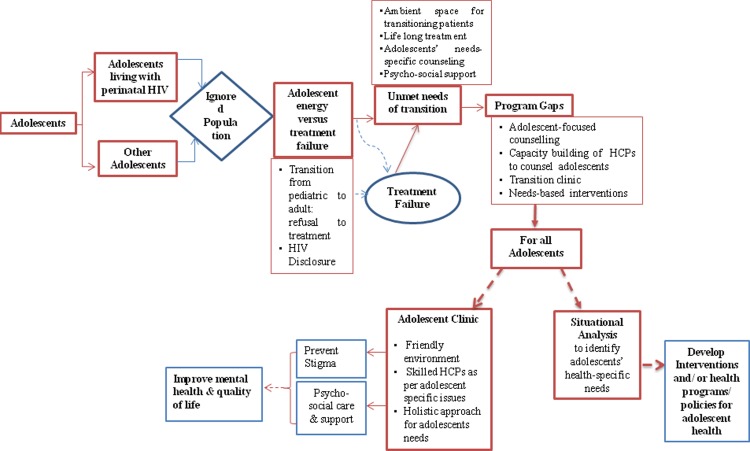
Treatment transition for 'adolescents living with perinatally acquired HIV' (ALPH) from paediatric to adult care is not addressed adequately. This study explores the ALPH's health care needs and programmatic gaps in health systems for the care of ALPH in India. Forty-nine in-depth interviews were conducted with purposively selected primary and key stakeholders in India. Thematic analysis utilizing grounded theory was performed in QSR NUD*IST 6. Stakeholders explicitly recognized adolescent HIV to be a critical public health issue which requires a separate mandate in India. It was found that none of the health policies in India focus on adolescent age group; ALPH is therefore even more neglected population. No/partial HIV disclosure to ALPH is the first crisis for retention in care continuum and adherence to the treatment becomes sub-optimal. Unmet needs of transitioning from paediatric to adult care in existing settings was the major gap. Age-specific counselling guidelines and counselling skills among HCPs were found lacking where tailored counseling and capacity building of HCPs was an expectation. Need of holistic approach for adolescents led to consensus on establishing 'adolescent transition clinic' with a strict 'no' for 'standalone Adolescent HIV' clinics. School setting having peer-based counselling provision was recommended. Age disaggregated health data is required to inform the policymakers about adolescents' specific needs for developing interventions. Situational analysis to identify and shape health priorities of adolescents is recommended.
Conflict of interest statement
The authors have declared that no competing interests exist.
Figures
References
-
- WHO. More than 1.2 million adolescents die every year, nearly all preventable. News Release. 2017 [cited 6 Nov 2017]. Available: http://www.who.int/mediacentre/news/releases/2017/yearly-adolescent-deat...
-
- UNICEF. Turning the tide against AIDS will require more concentrated focus on adolescents and young people. In: UNICEF DATA; [Internet]. 2017. [cited 6 Nov 2017]. Available: //data.unicef.org/topic/adolescents/hivaids-2/
-
- NACO. National AIDS Control Organization (NACO). ANNUAL REPORT 2016–17. Chapter 24. 2017 [cited 29 May 2018]. Available: http://naco.gov.in/sites/default/files/NACO%20ANNUAL%20REPORT%202016-17.pdf
-
- Okonofua F. African Journal of Reproductive Health: Vol.18, No.3 Special Edition. Universal-Publishers; 2014.
Publication types
MeSH terms
LinkOut - more resources
Full Text Sources
Medical
Miscellaneous
