


Ultra-processed foods and excessive free sugar intake in the UK: a nationally representative cross-sectional study
- PMID: 31662351
- PMCID: PMC6830631
- DOI: 10.1136/bmjopen-2018-027546
Ultra-processed foods and excessive free sugar intake in the UK: a nationally representative cross-sectional study
Abstract
Objectives: To describe dietary sources of free sugars in different age groups of the UK population considering food groups classified according to the NOVA system and to estimate the proportion of excessive free sugars that could potentially be avoided by reducing consumption of their main sources.
Design and setting: Cross-sectional data from the UK National Diet and Nutrition Survey (2008-2014) were analysed. Food items collected using a 4-day food diary were classified according to the NOVA system.
Participants: 9364 individuals aged 1.5 years and above.
Main outcome measures: Average dietary content of free sugars and proportion of individuals consuming more than 10% of total energy from free sugars.
Data analysis: Poisson regression was used to estimate the associations between each of the NOVA food group and intake of free sugars. We estimated the per cent reduction in prevalence of excessive free sugar intake from eliminating ultra-processed foods and table sugar. Analyses were stratified by age group and adjusted for age, sex, ethnicity, survey year, region and equivalised household income (sterling pounds).
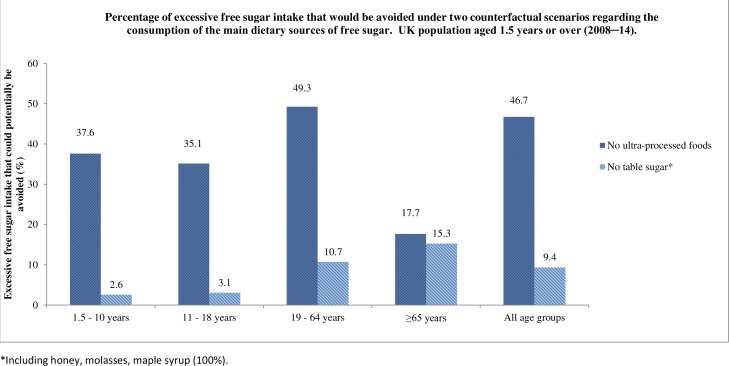
Results: Ultra-processed foods account for 56.8% of total energy intake and 64.7% of total free sugars in the UK diet. Free sugars represent 12.4% of total energy intake, and 61.3% of the sample exceeded the recommended limit of 10% energy from free sugars. This percentage was higher among children (74.9%) and adolescents (82.9%). Prevalence of excessive free sugar intake increased linearly across quintiles of ultra-processed food consumption for all age groups, except among the elderly. Eliminating ultra-processed foods could potentially reduce the prevalence of excessive free sugar intake by 47%.
Conclusion: Our findings suggest that actions to reduce the ultra-processed food consumption generally rich in free sugars could lead to substantial public health benefits.
Keywords: United Kingdom; food processing; free sugar; ultra-processed.
© Author(s) (or their employer(s)) 2019. Re-use permitted under CC BY-NC. No commercial re-use. See rights and permissions. Published by BMJ.
Conflict of interest statement
Competing interests: None declared.
Figures
References
-
- Scientific Advisory Committee on Nutrition SACN’s sugars and health recommendations: why 5%. London, UK: Scientific Advisory Committee on Nutrition, Department of Health, 2015.
-
- Scientific Advisory Committee on Nutrition Carbohydrates and health report. London, UK: Scientific Advisory Committee on Nutrition, Department of Health, 2015.
-
- World Health Organization Sugars intake for adults and children. Geneva, Switzerland: World Health Organization, 2015.
Publication types
MeSH terms
Substances
Grants and funding
LinkOut - more resources
Full Text Sources
