


The use of information and communication technologies to promote healthy lifestyle behaviour: a systematic scoping review
- PMID: 31662364
- PMCID: PMC6830587
- DOI: 10.1136/bmjopen-2019-029872
The use of information and communication technologies to promote healthy lifestyle behaviour: a systematic scoping review
Abstract
Introduction: Health-promoting lifestyle behaviours are part of the activities of daily living that influence individual happiness, values and well-being. They play a crucial role in prevention and control of non-communicable diseases (NCDs) among all age groups. Current statistics on mortality, disability and morbidity associated with NCDs are alarming globally. The use of information and communication technology (ICT) for a health-promoting lifestyle behaviour programme enhances health behaviours that are important in the prevention and control of both communicable and non-communicable diseases. Our study aimed to map evidence on the use of ICT in comprehensive health-promoting lifestyle behaviour among healthy adults.
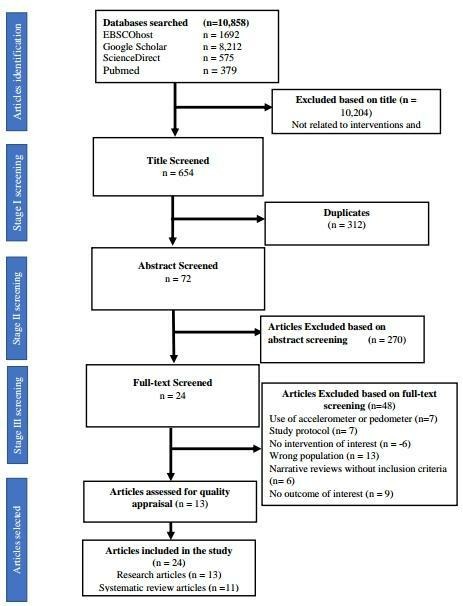
Methods: Eleven electronic databases were searched for the study. We included studies published in English between January 2007 and December 2018 reporting on healthy adults, ICT and any subscales of the health-promoting lifestyle profile (HPLP). Studies focusing on diseases or disease management and studies that combine monitoring tools in the form of hardware (accelerometer or pedometer) with ICT or computer games were excluded. Data were summarised numerically and thematically.
Results: All the studies reviewed were conducted in developed countries. Most of the studies reported on physical activity, and findings of one study covered all the subscales of HPLP. The use of ICT for health-promoting lifestyle behaviours was reported to be effective in ensuring health behaviours that can improve physical and mental health.
Conclusion: Our findings showed that there is a dearth of knowledge on comprehensive health-promoting lifestyle behaviour that can be beneficial for the control and prevention of NCDs. There is a need to carry out primary studies on the use of ICT and comprehensive health-promoting lifestyle, especially among adults in low-income and middle-income countries where there are alarming statistics for mortality and disability associated with NCDs.
Prospero registration number: CRD42016042568.
Keywords: health responsibility; health-promoting lifestyle behaviour; healthy adults; information and communication technology; interpersonal relationship; nutrition; physical activity; self-actualisation; stress management; systematic scoping review.
© Author(s) (or their employer(s)) 2019. Re-use permitted under CC BY-NC. No commercial re-use. See rights and permissions. Published by BMJ.
Conflict of interest statement
Competing interests: None declared.
Figures
References
-
- WHO Noncommunicable diseases, 2017. Available: http://www.who.int/mediacentre/factsheets/fs355/en/ [Accessed 27/05/2017].
-
- Murray CJ, Lopez AD, World Health Organization . The global burden of disease: a comprehensive assessment of mortality and disability from diseases, injuries, and risk factors in 1990 and projected to 2020. Summary 1996.
-
- Mokdad A. Global non-communicable disease prevention: building on success by addressing an emerging health need in developing countries. Journal of Health Specialties 2016;4 10.4103/1658-600X.179820 - DOI
Publication types
MeSH terms
LinkOut - more resources
Full Text Sources
Medical
