Mindfulness-Oriented Recovery Enhancement remediates hedonic dysregulation in opioid users: Neural and affective evidence of target engagement
- PMID: 31663023
- PMCID: PMC6795512
- DOI: 10.1126/sciadv.aax1569
Mindfulness-Oriented Recovery Enhancement remediates hedonic dysregulation in opioid users: Neural and affective evidence of target engagement
Abstract
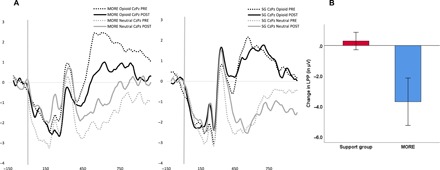
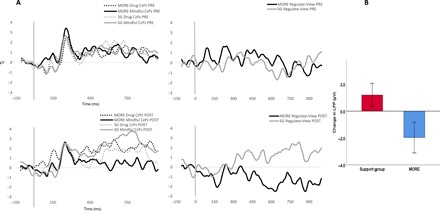
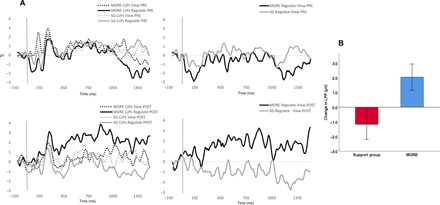
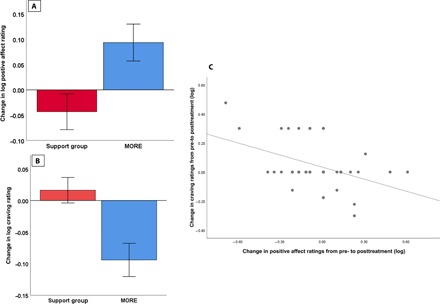
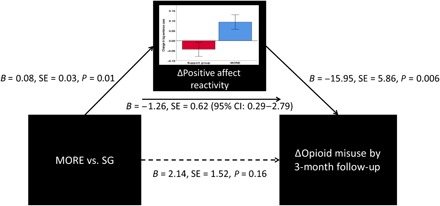
Addiction neuroscience models posit that recurrent drug use increases reactivity to drug-related cues and blunts responsiveness to natural rewards, propelling a cycle of hedonic dysregulation that drives addictive behavior. Here, we assessed whether a cognitive intervention for addiction, Mindfulness-Oriented Recovery Enhancement (MORE), could restructure reward responsiveness from valuation of drug-related reward back to valuation of natural reward. Before and after 8 weeks of MORE or a support group control, prescription opioid users (N = 135) viewed opioid and natural reward cues while an electroencephalogram biomarker of target engagement was assessed. MORE was associated with decreased opioid cue-reactivity and enhanced capacity to regulate responses to opioid and natural reward cues. Increased positive affective responses to natural reward cues were associated with decreased craving and mediated MORE's therapeutic effects on opioid misuse. This series of randomized experiments provide the first neurophysiological evidence that an integrative behavioral treatment can remediate hedonic dysregulation among chronic opioid users.
Copyright © 2019 The Authors, some rights reserved; exclusive licensee American Association for the Advancement of Science. No claim to original U.S. Government Works. Distributed under a Creative Commons Attribution NonCommercial License 4.0 (CC BY-NC).
Figures
References
-
- Han B., Compton W. M., Blanco C., Crane E., Lee J., Jones C. M., Prescription opioid use, misuse, and use disorders in U.S. adults: 2015 National Survey on Drug Use and Health. Ann. Intern. Med. 167, 293–301 (2017). - PubMed
-
- Elman I., Borsook D., Common brain mechanisms of chronic pain and addiction. Neuron 89, 11–36 (2016). - PubMed
-
- Koob G. F., Le Moal M., Drug addiction, dysregulation of reward, and allostasis. Neuropsychopharmacology 24, 97–129 (2001). - PubMed
Publication types
MeSH terms
Substances
Grants and funding
LinkOut - more resources
Full Text Sources
Other Literature Sources
Medical