Proposed objective scoring algorithm for assessment and intervention recovery following surgery for lumbar spinal stenosis based on relevant gait metrics from wearable devices: the Gait Posture index (GPi)
- PMID: 31663040
- PMCID: PMC6787370
- DOI: 10.21037/jss.2019.09.06
Proposed objective scoring algorithm for assessment and intervention recovery following surgery for lumbar spinal stenosis based on relevant gait metrics from wearable devices: the Gait Posture index (GPi)
Abstract
Background: Lumbar spinal stenosis (LSS) results in significant pain and disability. As spine healthcare providers, monitoring patient's outcomes is of the highest importance, and guides everything we do. However, a large amount of our data has been based solely on subjective, single time-point outcome tools limited by their subjective nature.
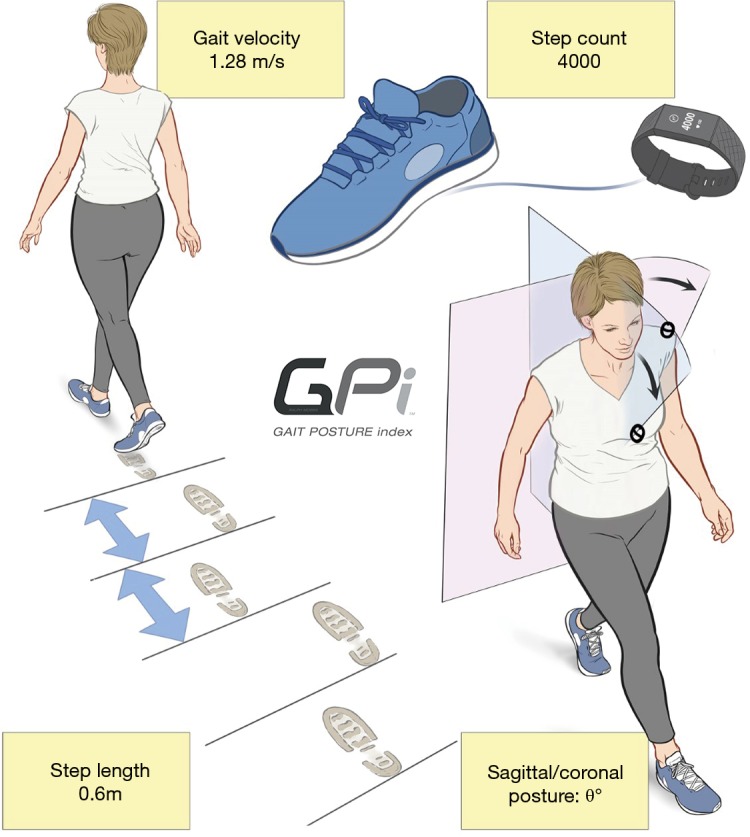
Methods: We herein propose a novel, simple objective scoring system, the Gait Posture index (GPi). Four key objective health metrics, which can be measured using wearable devices have been identified to correlate with health status: (I) step count; (II) gait velocity; (III) step length; (IV) posture. An algorithm combining the above metrics was established to 'score' patient's ambulation from 0 (bed bound)-100 (excellent mobility and gait function). Thirteen surgical patients were assigned to the GPi scoring algorithm and compared with traditional subjective scoring systems Oswestry Disability Index (ODI) and Patient Satisfaction Index (PSI) as a proof of concept and confirmation of validity.
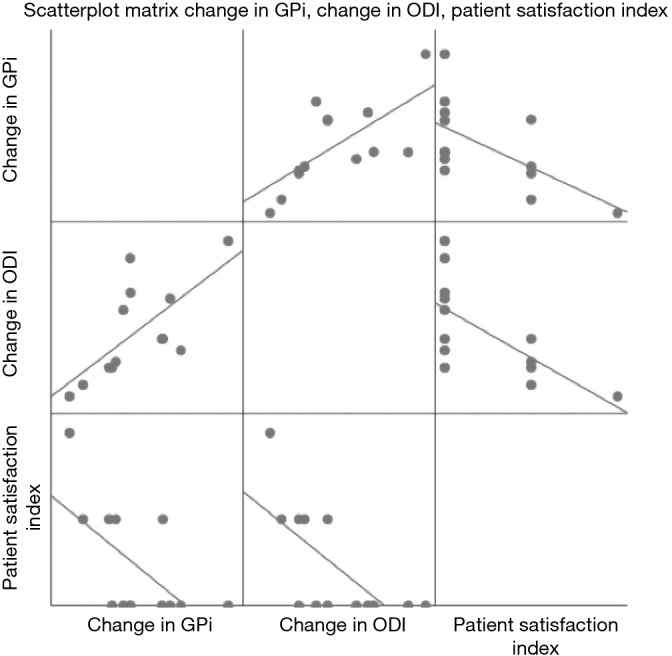
Results: At 3 months, 11 out of 13 patients following decompression for LSS had an improvement with their GPi 20.79±17.44, P=0.001. In addition, Pearson correlation revealed positive correlation between change in GPi with change in ODI (r=0.682, n=13, P=0.01) and negative correlation between change in GPi with PSI (r=-0.618, n=13, P=0.024).
Conclusions: The GPi algorithm correlates accurately with preoperative and post-operative mobility which are comparable to traditional subjective scoring systems. GPi affords the health care provider with a relevant measure of patient outcome, and real-time recovery dynamics following decompression for LSS.
Keywords: Gait Posture index (GPi); Lumbar spinal stenosis (LSS); gait velocity; posture; spine; step count; step length.
2019 Journal of Spine Surgery. All rights reserved.
Conflict of interest statement
Conflicts of Interest: The authors have no conflicts of interest to declare.
Figures
References
-
- Weinstein JN, Lurie JD, Tosteson TD, et al. Surgical compared with nonoperative treatment for lumbar degenerative spondylolisthesis. four-year results in the Spine Patient Outcomes Research Trial (SPORT) randomized and observational cohorts. J Bone Joint Surg Am 2009;91:1295-304. 10.2106/JBJS.H.00913 - DOI - PMC - PubMed
LinkOut - more resources
Full Text Sources
Other Literature Sources
Research Materials