


doi: 10.1080/21541264.2019.1684137.
Epub 2019 Oct 30.
Exploiting phage strategies to modulate bacterial transcription
Affiliations
- PMID: 31663818
- PMCID: PMC6948966
- DOI: 10.1080/21541264.2019.1684137
Item in Clipboard
Exploiting phage strategies to modulate bacterial transcription
Transcription.
2019 Aug-Oct.
Abstract
Bacteriophages employ small proteins to usurp host molecular machinery, thereby interfering with central metabolic processes in infected bacteria. Generally, phages inhibit or redirect host transcription to favor transcription of their own genomes. Mechanistic and structural studies of phage-modulated host transcription may provide inspirations for the development of novel antibacterial substances.
Keywords: Antimicrobial peptides; bacteriophage antibacterial proteins; structural biology; transcription regulation in bacteria.
Figures
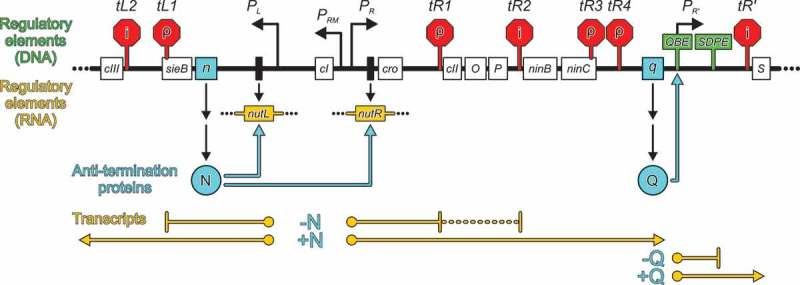
Biological activities of lambdoid phage N and Q proteins. Scheme of part of the phage λ genome (thick black line) containing early and late control regions. The sizes of regions and elements, and their positions, are not drawn to scale. Open boxes with names – protein-coding regions; narrow black boxes, nut site DNA; black-angled arrows, promoters; red stop signs, intrinsic (“i”) and ρ-dependent (“ρ”) terminators; green signs, regulatory regions active as DNA (QBE and SDPE); dark yellow boxes, nut regulatory regions active as RNA; cyan spheres, anti-termination proteins; cyan angled arrows, sites of recruitment of anti-termination proteins to ECs; dark yellow lines, transcripts. Scheme adapted from [43] with changes.
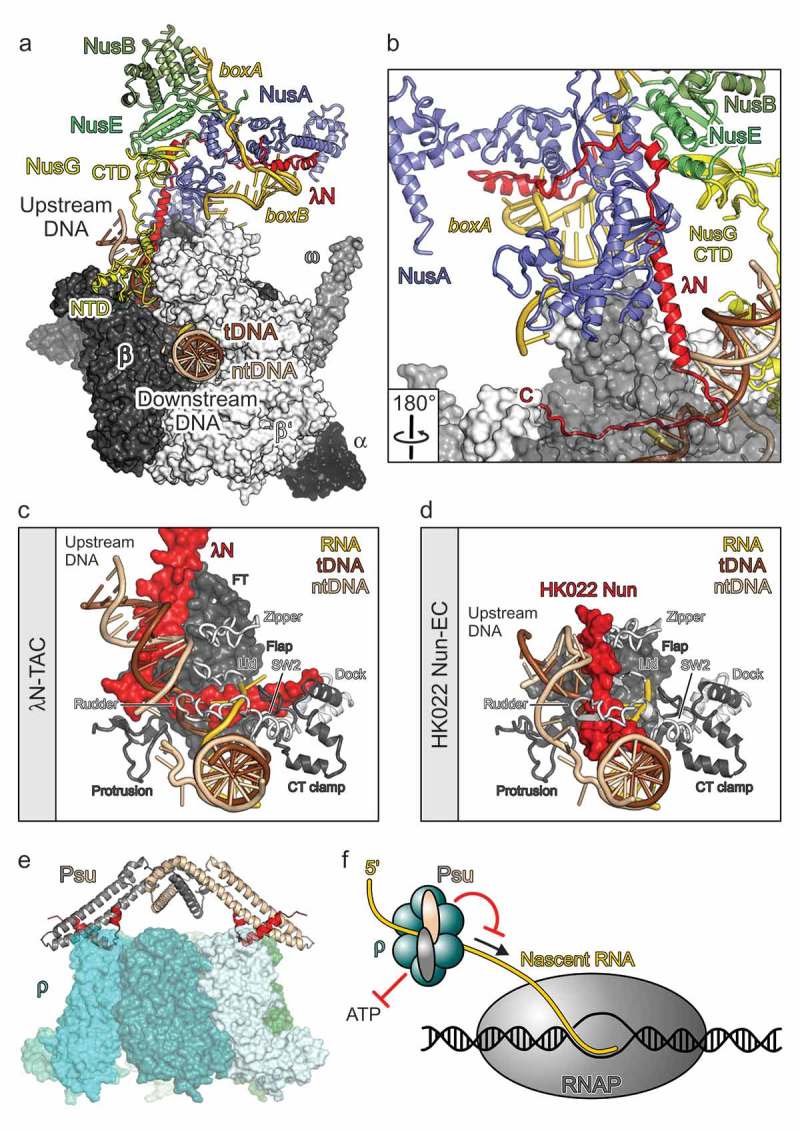
Molecular models of phage factors modulating host transcription elongation and termination. (a) A Single-particle cryoEM structure of an λN-TAC [17]. RNAP subunits in surface representation. Nucleic acids, Nus factors, and λN in cartoon representation. (b) λN remains highly extended in the λN-TAC, allowing short peptides along its sequence to interact with spatially widely distributed regions on nascent RNA, Nus factors and RNAP. RNAP subunit β as semi-transparent surface. Rotation symbol – view relative to (a). (c) Interaction of the C-terminal region of λN with nucleic acids and various elements of RNAP in and around the active site cleft (β elements: flap, FT – flap tip, protrusion, CT clamp – C-terminal clamp; β’ elements: zipper, lid, rudder, SW2 – switch 2, dock). View as in (a). (d) HK022 Nun interacting with nucleic acids and RNAP elements [60]. Same orientation of RNAP as in (d). (e) presumed mode of action of Psu [16]. By inhibiting ρ’s ATPase, Psu will hinder the translocation of ρ along the nascent RNA toward RNAP (arrow). Red symbols – inhibition. (f) Docking model of the phage P4 Psu protein interacting with E. coli transcription termination factor ρ [62]. (c) and (d) adapted from [17].
References
Publication types
MeSH terms
Substances
LinkOut - more resources
Full Text Sources
