


Influence of Gastric Emptying and Gut Transit Testing on Clinical Management Decisions in Suspected Gastroparesis
- PMID: 31663906
- PMCID: PMC6919448
- DOI: 10.14309/ctg.0000000000000084
Influence of Gastric Emptying and Gut Transit Testing on Clinical Management Decisions in Suspected Gastroparesis
Abstract
Introduction: Gastric emptying scintigraphy (GES) or wireless motility capsules (WMCs) can evaluate upper gastrointestinal symptoms in suspected gastroparesis; WMC tests can also investigate lower gut symptoms. We aimed to determine whether these tests impact treatment plans and needs for additional diagnostic evaluation.
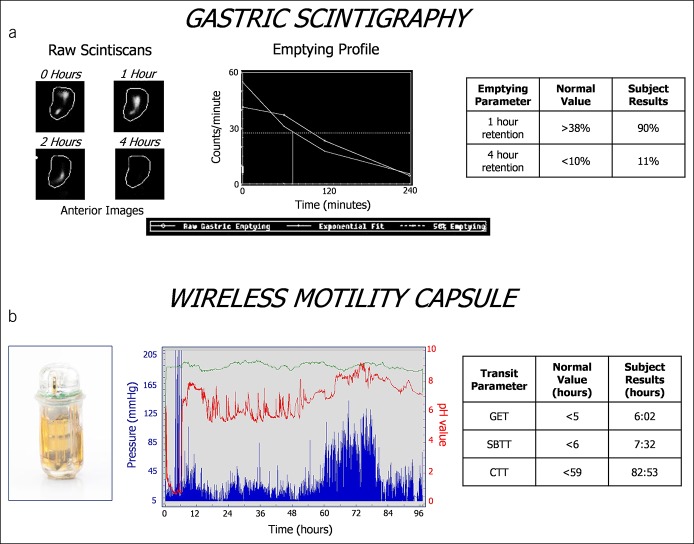
Methods: In a prospective, multicenter study, 150 patients with gastroparesis symptoms simultaneously underwent GES and WMC testing. Based on these results, investigators devised management plans to recommend changes in medications, diet, and surgical therapies and order additional diagnostic tests.
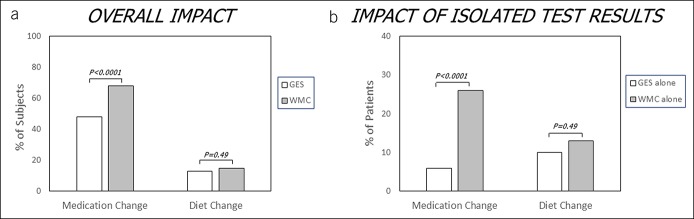
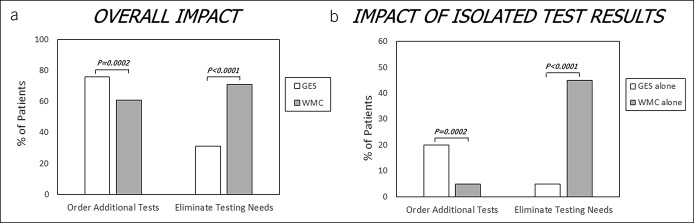
Results: Treatment changes were recommended more often based on the WMC vs GES results (68% vs 48%) (P < 0.0001). Ordering of additional test(s) was eliminated more often with WMC vs GES (71% vs 31%) (P < 0.0001). Prokinetics (P = 0.0007) and laxatives (P < 0.0001) were recommended more often based on the WMC vs GES results. Recommendations for prokinetics and gastroparesis diets were higher and neuromodulators lower in subjects with delayed emptying on both tests (all P ≤ 0.0006). Laxatives and additional motility tests were ordered more frequently for delayed compared with normal WMC colonic transit (P ≤ 0.02). Multiple motility tests were ordered more often on the basis of GES vs WMC findings (P ≤ 0.004). Antidumping diets and transit slowing medications were more commonly recommended for rapid WMC gastric emptying (P ≤ 0.03).
Discussion: WMC transit results promote medication changes and eliminate additional diagnostic testing more often than GES because of greater detection of delayed gastric emptying and profiling the entire gastrointestinal tract in patients with gastroparesis symptoms.
Translational impact: Gastric scintigraphy and WMCs have differential impact on management decisions in suspected gastroparesis.
Trial registration: ClinicalTrials.gov NCT02022826.
Figures
References
-
- Hasler WL. Gastroparesis: Pathogenesis, diagnosis and management. Nat Rev Gastroenterol Hepatol 2011;8:438–53. - PubMed
-
- Abell TL, Camilleri M, Donohoe K, et al. Consensus recommendations for gastric emptying scintigraphy: A joint report of the American Neurogastroenterology and Motility Society and the Society of Nuclear Medicine. Am J Gastroenterol 2008;103:753–63. - PubMed
-
- Tougas G, Eaker EY, Abell TL, et al. Assessment of gastric emptying using a low fat meal: Establishment of international control values. Am J Gastroenterol 2000;95:1456–62. - PubMed
-
- Kuo B, McCallum RW, Koch KL, et al. Comparison of gastric emptying of a nondigestible capsule to a radiolabelled meal in healthy and gastroparetic subjects. Aliment Pharmacol Ther 2008;27:186–96. - PubMed
-
- Hasler WL. The use of SmartPill for gastric monitoring. Expert Rev Gastroenterol Hepatol 2014;8:587–600. - PubMed
Publication types
MeSH terms
Associated data
LinkOut - more resources
Full Text Sources
Medical
