


The Impact of Complications and Pain on Patient Satisfaction
- PMID: 31663968
- PMCID: PMC7303925
- DOI: 10.1097/SLA.0000000000003621
The Impact of Complications and Pain on Patient Satisfaction
Abstract
Objective: To measure the association between patient-reported satisfaction and regret and clinical outcomes.
Summary of background data: Patient-reported outcomes are becoming an increasingly important marker of the quality of patient care. It is unclear however, how well patient-reported outcomes adequately reflect care quality and clinical outcomes in surgical patients.
Methods: Retrospective, population-based analysis of adults ages 18 and older undergoing surgery across 38 hospitals in Michigan between January 1, 2017 and May 31, 2018.
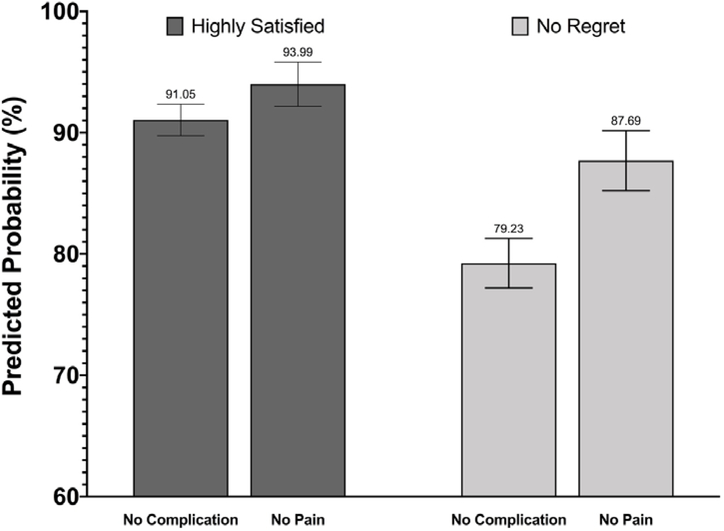
Results: In this study, 9953 patients (mean age 56 years; 5634 women (57%)) underwent 1 of 16 procedures. 9550 (96%) patients experienced no complication, whereas 240 (2%) and 163 (2%) patients experienced Grade 1 and Grade 2-3 complications, respectively. Postoperative pain scores were: none (908 (9%) patients), mild (3863 (40%) patients), moderate (3893 (40%) patients), and severe (1075 (11%) patients). Overall, 7881 (79%) patients were highly satisfied and 8911 (91%) had absolutely no regret after surgery. Patients were less likely to be highly satisfied if they experienced a Grade 1 complication [odds ratio (OR) 0.50, 95% confidence interval (CI) 0.37-0.66], Grade 2-3 complication (OR 0.44, 95% CI 0.31-0.62), minimal pain (OR 0.80, 95% CI 0.64-0.99, moderate pain (OR 0.39, 95% CI 0.32-0.49), or severe pain (OR 0.23, 95% CI 0.18-0.29). Patients were less likely to have no regret if they experienced a Grade 1 complication (OR 0.48, 95% CI 0.33-0.70), Grade 2-3 complication (OR 0.39, 95% CI 0.25-0.60), moderate pain (OR 0.55, 95% CI 0.40-0.76), or severe pain (OR 0.22, 95% CI 0.16-0.31). The predicted probability of being highly satisfied was 79% for patients who had no complications and 88% for patients who had no pain.
Conclusions: Patients who experienced postoperative complications and pain were less likely to be highly satisfied or have no regret. Notably, postoperative pain had a more significant effect on satisfaction and regret after surgery, suggesting focused postsurgical pain management is an opportunity to substantially improve patient experiences. More research and patient education are needed for managing expectations of postoperative pain, and use of adjuncts and regional anesthesia.
Copyright © 2019 Wolters Kluwer Health, Inc. All rights reserved.
Conflict of interest statement
The authors report no conflicts of interest.
Figures
References
-
- Services CfMM. HCAHPS Fact Sheet (CAHPS® Hospital Survey). [PDF]. 2017; https://www.hcahpsonline.org/globalassets/hcahps/facts/hcahps_fact_sheet.... Accessed June 4, 2019.
-
- Donabedian A The Quality of Care: How Can It Be Assessed? JAMA. 1988;260(12):1743–1748. - PubMed
-
- Gurland BH, Merlino J, Sobol T, et al. Surgical complications impact patient perception of hospital care. Journal of the American College of Surgeons. 2013;217(5):843–849. - PubMed
Publication types
MeSH terms
Grants and funding
LinkOut - more resources
Full Text Sources
Medical
Research Materials
