Review
. 2020 Feb;69(2):237-244.
doi: 10.1007/s00262-019-02421-w. Epub 2019 Oct 29.

TAM-ing T cells in the tumor microenvironment: implications for TAM receptor targeting

Affiliations
Review

TAM-ing T cells in the tumor microenvironment: implications for TAM receptor targeting

Marlies J W Peeters et al. Cancer Immunol Immunother. 2020 Feb.

Abstract

The TAM receptors-TYRO3, AXL, MERTK-are pleiotropically expressed receptors in both healthy and diseased tissue. A complex of the ligands Protein S (PROS1) or Growth Arrest-Specific 6 (GAS6) with apoptotic phosphatidylserine activates the TAM receptors. Hence, this receptor family is essential for the efferocytosis of apoptotic material by antigen-presenting cells. In addition, TAM receptors are expressed by virtually all cells of the tumor microenvironment. They are also potent oncogenes, frequently overexpressed in cancer and involved in survival and therapy resistance. Due to their pro-oncogenic and immune-inhibitory traits, TAM receptors have emerged as promising targets for cancer therapy. Recently, TAM receptors have been described to function as costimulatory molecules on human T cells. TAM receptors' ambivalent functions on many different cell types therefore make therapeutic targeting not straight-forward. In this review we summarize our current knowledge of the function of TAM receptors in the tumor microenvironment. We place particular focus on TAM receptors and the recently unraveled role of MERTK in activated T cells and potential consequences for anti-tumor immunity.

Keywords: CITIM 2019; Costimulation; MERTK; PROS1; T lymphocytes; TAM receptors.


Conflict of interest statement

Per thor Straten and Marlies J.W. Peeters are authors on a pending European patent 18168195.8 pertaining the use of MERTK in adoptive T cell therapy. Anne Rahbech declares no competing interests.

Figures
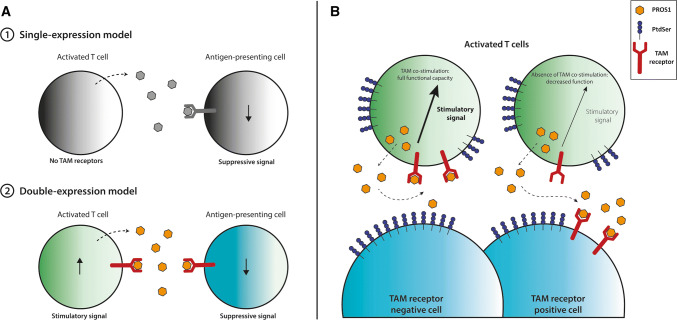
Fig. 1
Fig. 1
Consequences of TAM receptor signaling on T cells and competing cells. a Previously, T cells were thought to express PROS1, but not TAM receptors. PROS1 secretion by T cells subsequently resulted in a negative feedback loop to the APC. In the double-expression model, T-cell secreted PROS1 serves as an auto-stimulatory signal for the T cell and an inhibitory signal for the APC. b Activated T cells express PROS1, TAM receptors, and PtdSer. When the T cell encounters a TAM receptor negative cell, PROS1 will activate MERTK on the T cell. When the T cell encounters another TAM receptor positive cell, PROS1 will be competed for, as APCs and cancer cells express high amounts of TAM receptors. T cell-produced PROS1 will subsequently activate the other TAM receptor-positive cell (APC, cancer cell) and T cells will lose the PROS1-MERTK costimulatory signal. PROS1 Protein S, PtdSer phosphatidylserine, TAM receptor TYRO3, AXL, MERTK receptor family

References

    1. Lai C, Lemke G. An extended family of protein-tyrosine kinase genes differentially expressed in the vertebrate nervous system. Neuron. 1991;6(5):691–704. doi: 10.1016/0896-6273(91)90167-X. - DOI - PubMed
    1. Gould WR, Baxi SM, Schroeder R, Peng YW, Leadley RJ, Peterson JT, Perrin LA. Gas6 receptors Axl, Sky and Mer enhance platelet activation and regulate thrombotic responses. J Thromb Haemost. 2005;3(4):733–741. doi: 10.1111/j.1538-7836.2005.01186.x. - DOI - PubMed
    1. Ji R, Meng L, Jiang X, Cvm NK, Ding J, Li Q, Lu Q. TAM receptors support neural stem cell survival, proliferation and neuronal differentiation. PLoS One. 2014;9(12):e115140. doi: 10.1371/journal.pone.0115140. - DOI - PMC - PubMed
    1. Lu Q, Gore M, Zhang Q, Camenisch T, Boast S, Casagranda F, Lai C, Skinner MK, Klein R, Matsushima GK, Earp HS, Goff SP, Lemke G. Tyro-3 family receptors are essential regulators of mammalian spermatogenesis. Nature. 1999;398(6729):723–728. doi: 10.1038/19554. - DOI - PubMed
    1. Prasad D, Rothlin CV, Burrola P, Burstyn-Cohen T, Lu Q, Garcia de Frutos P, Lemke G. TAM receptor function in the retinal pigment epithelium. Mol Cell Neurosci. 2006;33(1):96–108. doi: 10.1016/j.mcn.2006.06.011. - DOI - PubMed

MeSH terms
