


Neuropsychological management of multiple sclerosis: evaluation of a supervised and customized cognitive rehabilitation program for self-used at home (SEPIA): protocol for a randomized controlled trial
- PMID: 31665039
- PMCID: PMC6819362
- DOI: 10.1186/s13063-019-3715-7
Neuropsychological management of multiple sclerosis: evaluation of a supervised and customized cognitive rehabilitation program for self-used at home (SEPIA): protocol for a randomized controlled trial
Abstract
Background: Cognitive and mood disorders negatively impact daily life in patients with multiple sclerosis (MS). Pharmacological treatments did not demonstrate any effect on cognition compared with cognitive rehabilitation (CR). However, if CR programs offer promising results on cognition, they are less consistent concerning mood and quality of life (QoL). In this context, we designed a randomized controlled trial to evaluate the efficacy of an innovative computerized CR program, conducted at home, on QoL. Secondary objectives will estimate the improvement, or the stabilization over time, of patients' cognitive performances and their emotional affects.
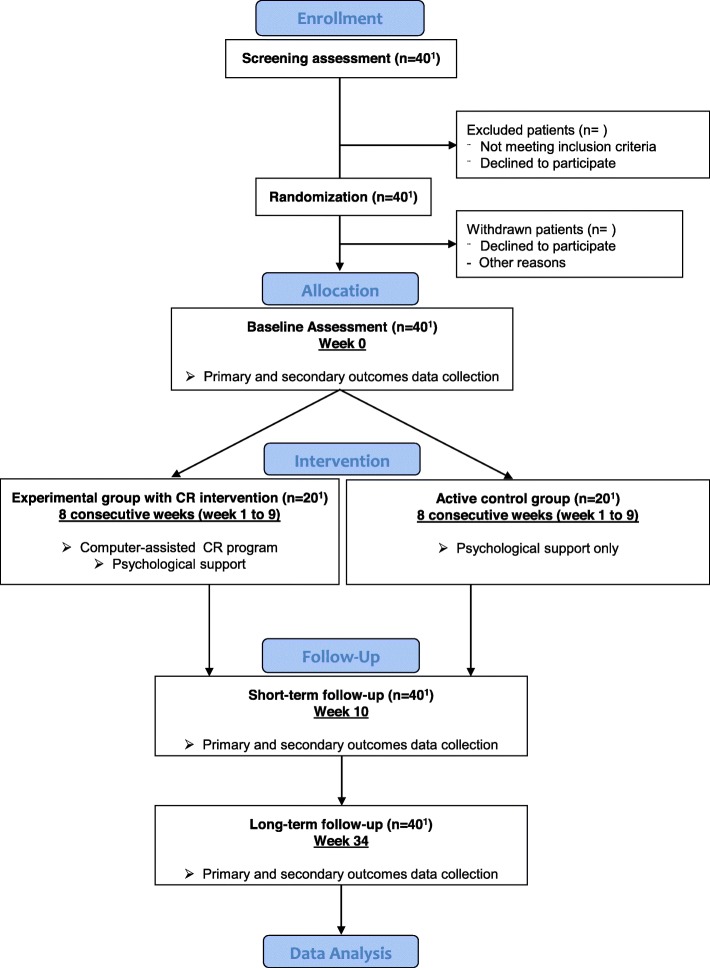
Methods: Forty MS patients (relapsing-remitting or secondary progressive forms) who have cognitive impairment will be recruited for the trial (called SEPIA-NCT03471338) and randomly assigned to either the experimental group or the control group. Patients randomly assigned in the experimental group will perform a home-based CR program with psychological support during eight consecutive weeks. CR will be based on computerized cognitive exercises from the PRESCO® software developed by HAPPYneuron©. Training sessions (three sessions of 45 min per week) will consist of short exercises evaluating a broad range of cognitive domains and will be personalized for each patient (tracking tool and supervised guidance). The control group, designed to control for non-specific elements of the intervention, will receive only psychological support consisting of various issues related to MS, such as everyday cognitive-related difficulties or management of emotions. QoL, assessed by the MUSIQOL (Multiple Sclerosis International Quality Of Life) questionnaire, will be evaluated three times (at baseline and after 1 week and 25 weeks after home-based intervention) as well as secondary outcomes measuring self-esteem, cognition, depression, anxiety, metacognition, fatigue, and sleep quality. Given the expected MUSIQOL variation, the inclusion of 20 patients per group (alpha risk 5% and power 80%) will be required.
Discussion: Evidence suggests that computerized programs may be a practice option for CR for people with MS, but there is a paucity of studies evaluating QoL. We hope that this innovative program will highlight such benefits over time in patients' daily life. In the future, such programs will allow a wider range of available therapeutic options for MS patients with cognitive impairment and for practitioners in charge of their care.
Trial registration: ClinicalTrials.gov identifier: NCT03471338. Retrospectively registered on 25 April 2018. https://clinicaltrials.gov/ct2/show/NCT03471338?term=NCT03471338&cond=Multiple+Sclerosis&draw=2&rank=1 .
Keywords: Cognitive rehabilitation; Multiple sclerosis; Quality of life; Randomized controlled trial; Self-esteem.
Conflict of interest statement
The funders had no involvement in the collection, management, analysis, or interpretation of data. GD received personal compensation for serving on scientific advisory boards of Biogen Idec, Novartis, Genzyme, Merck Serono, and Teva and received funding for travel and/or speaker honoraria from Merck Serono, Biogen Idec, Sanofi-Genzyme, Novartis, and Teva. The other authors declare that they have no competing interests.
Figures
References
-
- Chiaravalloti ND, DeLuca J. Cognitive impairment in multiple sclerosis. Lancet Neurol. 2008;7(12):1139–51. 10.1016/S1474-4422(08)70259-X. - PubMed
-
- Harand C, Defer G. Prise en charge des troubles cognitifs. In: La Sclérose En Plaques - Clinique et Thérapeutique. Elsevier Masson SAS, 65 rue Camille Desmoulins, 92442 Issy-les-Moulineaux, France; 2017. p. 197–204.
Publication types
MeSH terms
LinkOut - more resources
Full Text Sources
Medical
Miscellaneous
