


The food environment in Latin America: a systematic review with a focus on environments relevant to obesity and related chronic diseases
- PMID: 31666140
- PMCID: PMC10260576
- DOI: 10.1017/S1368980019002891
The food environment in Latin America: a systematic review with a focus on environments relevant to obesity and related chronic diseases
Abstract
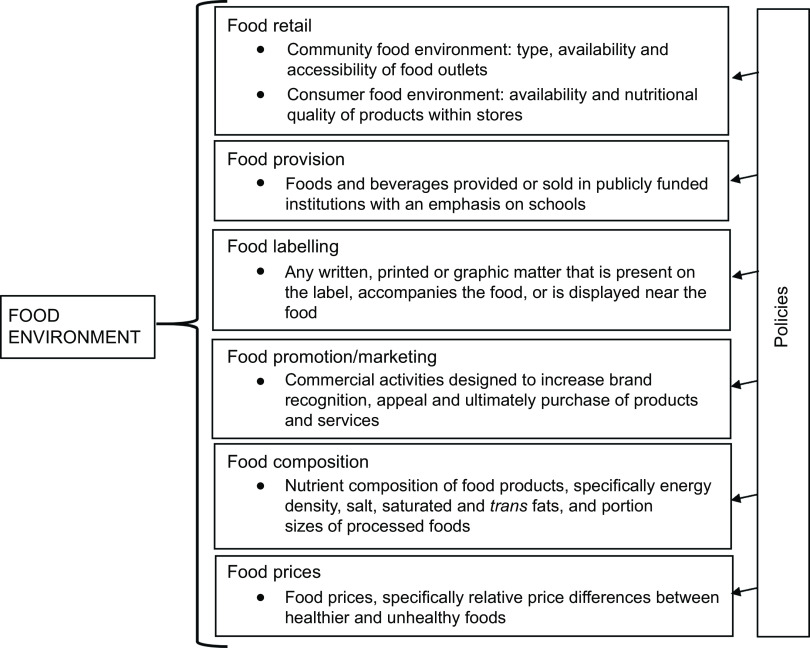
Objective: Food environments may be contributing to the rapid increase in obesity occurring in most Latin American (LA) countries. The present study reviews literature from LA that (i) describes the food environment and policies targeting the food environment (FEP); and (ii) analytic studies that investigate associations between the FEP and dietary behaviours, overweight/obesity and obesity related chronic diseases. We focus on six dimensions of the FEP: food retail, provision, labelling, marketing, price and composition.
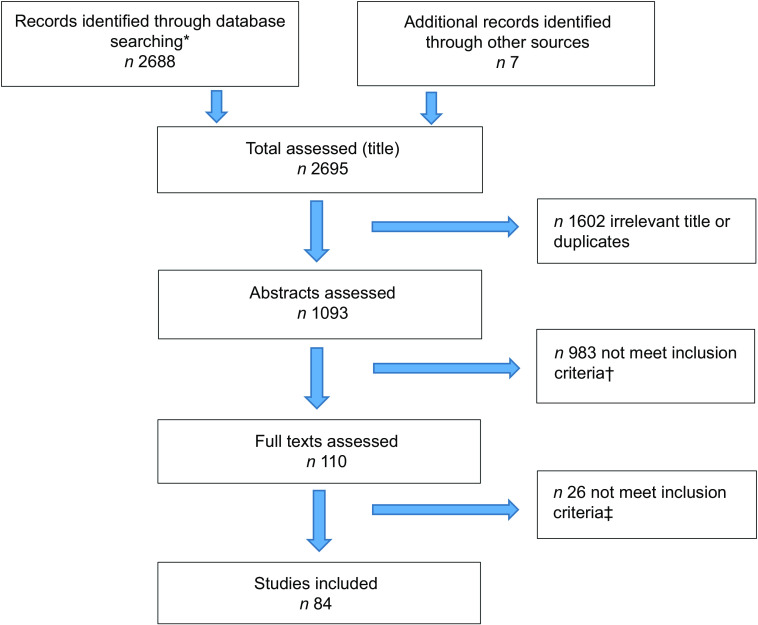
Design: Systematic literature review. Three databases (Web of Science, SciELO, LILACS) were searched, from 1 January 1999 up to July 2017. Two authors independently selected the studies. A narrative synthesis was used to summarize, integrate and interpret findings.
Setting: Studies conducted in LA countries.
Participants: The search yielded 2695 articles of which eighty-four met inclusion criteria.
Results: Most studies were descriptive and came from Brazil (61 %), followed by Mexico (18 %) and Guatemala (6 %). Studies were focused primarily on retail/provision (n 27), marketing (n 16) and labelling (n 15). Consistent associations between availability of fruit and vegetable markets and higher consumption of fruits and vegetables were found in cross-sectional studies. Health claims in food packaging were prevalent and mostly misleading. There was widespread use of marketing strategies for unhealthy foods aimed at children. Food prices were lower for processed relative to fresh foods. Some studies documented high sodium in industrially processed foods.
Conclusions: Gaps in knowledge remain regarding policy evaluations, longitudinal food retail studies, impacts of food price on diet and effects of digital marketing on diet/health.
Keywords: Food environment; Food labelling; Food price; Food promotion; Food retail; Latin America; Systematic literature review.
Figures
References
-
- Swinburn B, Sacks G, Vandevijvere S et al.. (2013) INFORMAS (International Network for Food and Obesity/non-communicable Diseases Research, Monitoring and Action Support): overview and key principles. Obes Rev 14, Suppl. 1, 1–12. - PubMed
Publication types
MeSH terms
Grants and funding
LinkOut - more resources
Full Text Sources
Miscellaneous
