Review
. 2019 Oct 30;83(4):e00012-19.
doi: 10.1128/MMBR.00012-19. Print 2019 Nov 20.

Pharmacologically Aware Phage Therapy: Pharmacodynamic and Pharmacokinetic Obstacles to Phage Antibacterial Action in Animal and Human Bodies

Affiliations
Review

Pharmacologically Aware Phage Therapy: Pharmacodynamic and Pharmacokinetic Obstacles to Phage Antibacterial Action in Animal and Human Bodies

Krystyna Dąbrowska et al. Microbiol Mol Biol Rev. .

Abstract

The use of viruses infecting bacteria (bacteriophages or phages) to treat bacterial infections has been ongoing clinically for approximately 100 years. Despite that long history, the growing international crisis of resistance to standard antibiotics, abundant anecdotal evidence of efficacy, and one successful modern clinical trial of efficacy, this phage therapy is not yet a mainstream approach in medicine. One explanation for why phage therapy has not been subject to more widespread implementation is that phage therapy research, both preclinical and clinical, can be insufficiently pharmacologically aware. Consequently, here we consider the pharmacological obstacles to phage therapy effectiveness, with phages in phage therapy explicitly being considered to serve as drug equivalents. The study of pharmacology has traditionally been differentiated into pharmacokinetic and pharmacodynamic aspects. We therefore separately consider the difficulties that phages as virions can have in traveling through body compartments toward reaching their target bacteria (pharmacokinetics) and the difficulties that phages can have in exerting antibacterial activity once they have reached those bacteria (pharmacodynamics). The latter difficulties, at least in part, are functions of phage host range and bacterial resistance to phages. Given the apparently low toxicity of phages and the minimal side effects of phage therapy as practiced, phage therapy should be successful so long as phages can reach the targeted bacteria in sufficiently high numbers, adsorb, and then kill those bacteria. Greater awareness of what obstacles to this success generally or specifically can exist, as documented in this review, should aid in the further development of phage therapy toward wider use.

Keywords: bacteriophage therapy; phage circulation; phage clearance; phage movement; phage resistance; spectrum of activity.


Figures

FIG 1
FIG 1
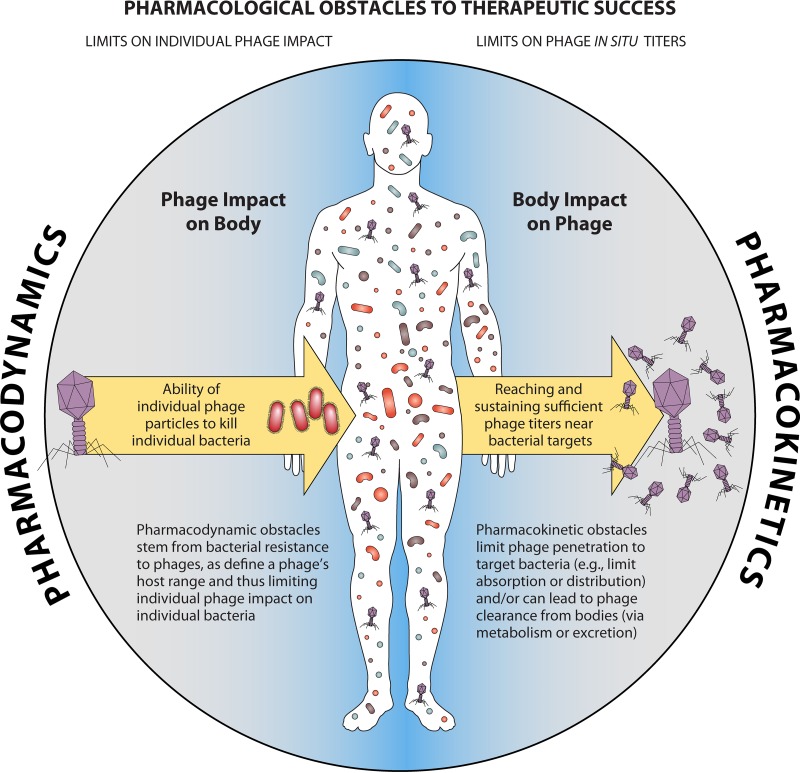
General principles of obstacles to phage therapy success. Pharmacokinetics refers to the impact of the body on drugs, while pharmacodynamics is described as the impact of the drug on bodies, with body in both cases including both body tissues and the associated microbiome. Pharmacokinetic obstacles are obstacles to drug movement, i.e., drug movement to the site of drug action, as well as problems with drug persistence within the body. Pharmacodynamic obstacles consist of bacterial mechanisms of resistance to phages, which can range from absolute (the infecting phage is inactivated, while the infected bacterium survives) to partial (neither the phage nor the bacterium survives) and which can consist of more subtle impacts of phage functionality (the bacterium does not survive but the phage infection vigor is compromised but not fully compromised, e.g., phage burst sizes are smaller or phages do not even adsorb to the phage-resistant bacterium). Not indicated in the figure are secondary pharmacodynamic issues, particularly, toxicities and side effects, which were not an emphasis of this review.
FIG 2
FIG 2
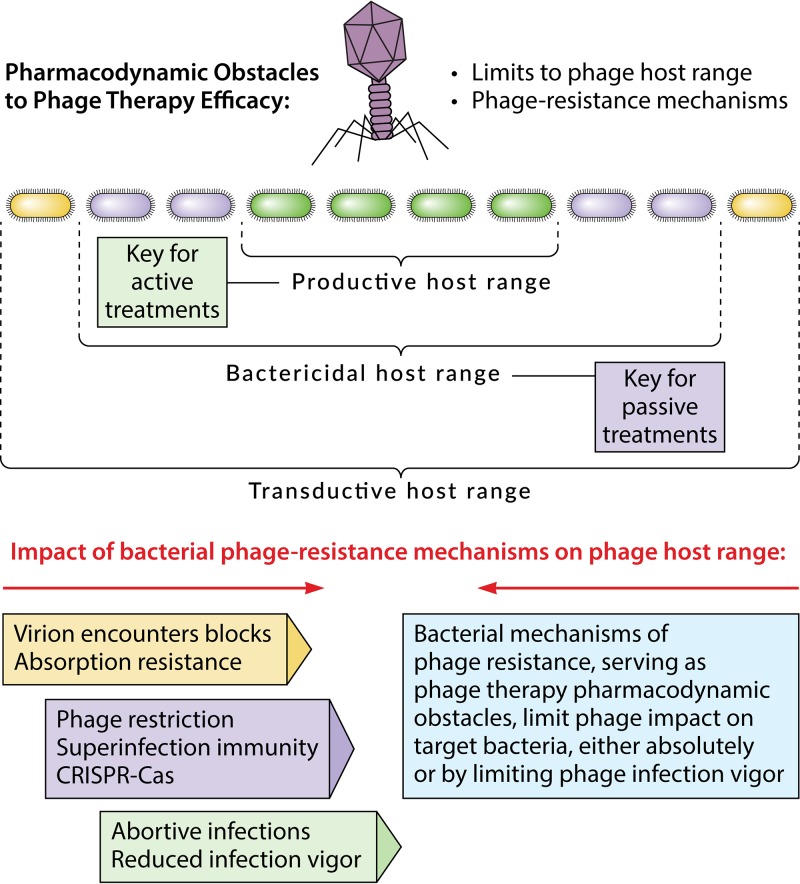
Obstacles to phage action, given a phage-bacterium encounter. These pharmacodynamic obstacles collectively consist of bacterial mechanisms of resistance to phages. These in turn serve to define a given phage’s host range and, thereby, spectrum of activity. Three concepts of host range are presented, where phages can adsorb onto but may or may not kill or successfully infect the bacteria (but which may thereby still result in phage transduction of genetic material), where phages can kill bacteria but may or may not otherwise successfully infect the bacteria (referred to as a bactericidal host range; i.e., the phages do not necessarily produce new phage virions, but this bactericidal activity is still key for successful passive phage therapy), and where phages can kill the bacteria and, in the process, produce new virions (which is referred to as a productive host range and which is key for active phage therapy). Note that even if phages are allowed to produce virions, phage productivity while infecting a given bacterium, such as in terms of the phage burst size, may still be reduced to levels lower than expected or desired due to bacterial properties, i.e., productivity lower than may be desirable for phage therapy purposes. Shown to the lower left are various general mechanisms of bacterial resistance to phages, which are color coded to indicate what aspect of the host range they affect.
FIG 3
FIG 3
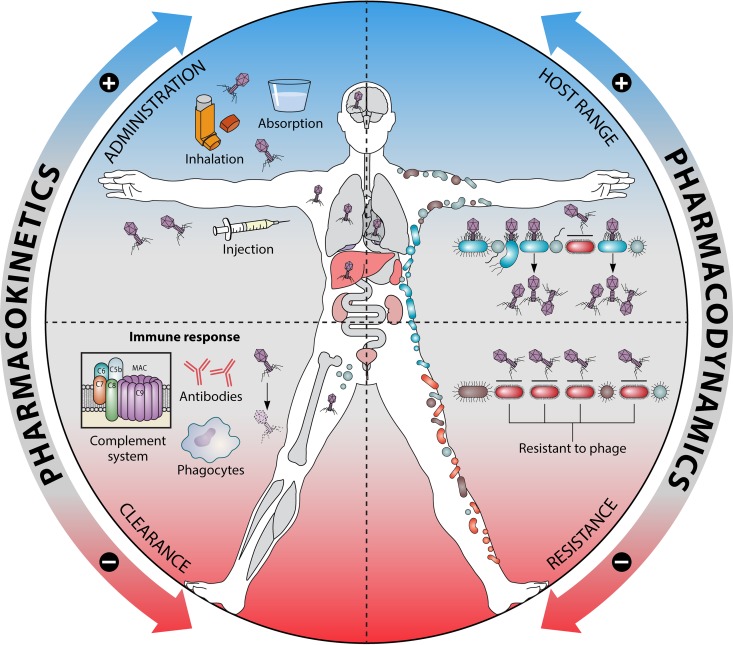
Effects of pharmacokinetics and pharmacodynamics on bacteriophages in bodies. The ability of phages to penetrate into a bacterium-containing living system and to reach specific sites of bacterial infection is crucial for achieving an effective therapeutic concentration by the phage. The phage concentration decreases due to body responses, mainly due to the pressure of the immune system, with a prominent contribution of nonspecific mechanisms of inactivation. Phage host range defines the applicability of phage therapy at the practical level of the available phage strains. Bacterial resistance mechanisms limit a phage’s host range and related spectrum of activity as an antibacterial drug. MAC, membrane attack complex.

References

    1. Karam G, Chastre J, Wilcox MH, Vincent JL. 2016. Antibiotic strategies in the era of multidrug resistance. Crit Care 20:136. doi:10.1186/s13054-016-1320-7. - DOI - PMC - PubMed
    1. Furfaro LL, Payne MS, Chang BJ. 2018. Bacteriophage therapy: clinical trials and regulatory hurdles. Front Cell Infect Microbiol 8:376. doi:10.3389/fcimb.2018.00376. - DOI - PMC - PubMed
    1. Neu HC. 1992. The crisis in antibiotic resistance. Science 257:1064–1073. doi:10.1126/science.257.5073.1064. - DOI - PubMed
    1. Martens E, Demain AL. 2017. The antibiotic resistance crisis, with a focus on the United States. J Antibiot (Tokyo) 70:520–526. doi:10.1038/ja.2017.30. - DOI - PubMed
    1. Czaplewski L, Bax R, Clokie M, Dawson M, Fairhead H, Fischetti VA, Foster S, Gilmore BF, Hancock RE, Harper D, Henderson IR, Hilpert K, Jones BV, Kadioglu A, Knowles D, Olafsdottir S, Payne D, Projan S, Shaunak S, Silverman J, Thomas CM, Trust TJ, Warn P, Rex JH. 2016. Alternatives to antibiotics—a pipeline portfolio review. Lancet Infect Dis 16:239–251. doi:10.1016/S1473-3099(15)00466-1. - DOI - PubMed

Publication types